
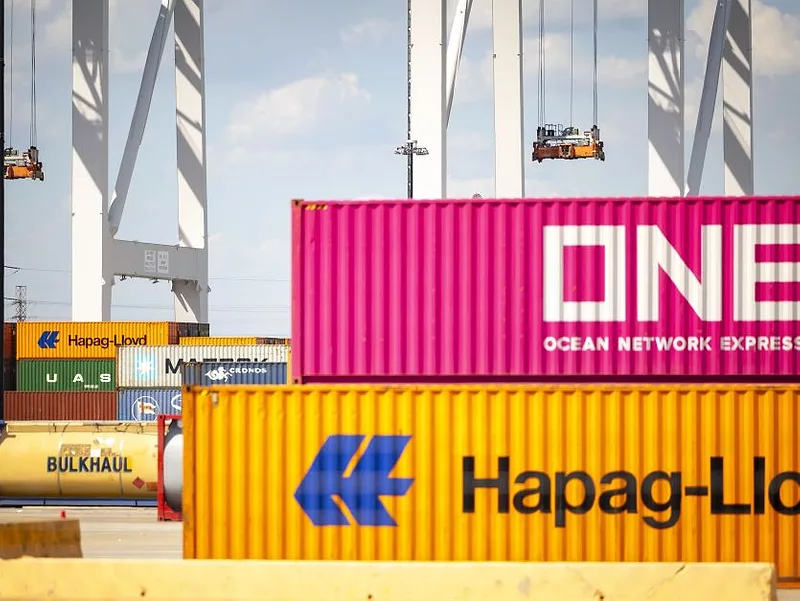
The White House said Wednesday it is temporarily suspending a requirement that goods moved between U.S. ports have to be transported on U.S. vessels, as part of an effort to ease high oil and fertilizer prices.
The Merchant Marine Act, better known as the Jones Act, is a century-old law that requires goods shipped between U.S. ports to move on U.S.-built, flagged, owned and staffed vessels.
White House Press Secretary Karoline Leavitt on Wednesday said the administration is waiving the requirement for 60 days in an attempt to lower oil and fertilizer prices caused by trade disruptions from the Iran war.
“President Trump’s decision to issue a 60-day Jones Act waiver is just another step to mitigate the short-term disruptions to the oil market as the U.S. military continues meeting the objectives of Operation Epic Fury,” she said in a post to social media.
“This action will allow vital resources like oil, natural gas, fertilizer, and coal to flow freely to U.S. ports for 60 days, and the administration remains committed to continuing to strengthen our critical supply chains,” she added.
The action comes on the heels of measures from the Treasury Department to ease restrictions on purchases and investment in Venezuela’s fertilizer industry.
But analysts and industry representatives are skeptical that both short-term measures can provide meaningful price relief for farmers facing significantly higher fertilizer costs.
“Venezuela is a fairly minor supplier to the U.S. market,” Nancy Martinez, director of public policy for trade and biotechnology at the National Corn Growers Association, told reporters Wednesday. We “don't know that that will be that big of a help.”
Similarly, she said it's not clear what the impacts of the Jones Act waiver will be.
The U.S. produces the bulk of its nitrogen fertilizer production domestically, with imports accounting for between 5% and 20% of annual supply. The Agriculture Department notes that domestically produced fertilizer moves by rail, barge, truck or pipeline, not by dry bulk vessels moving between ports.
Imported fertilizer often reaches the most productive corn-growing regions through the port of New Orleans, where it is transferred to barges.
Neither of these operations would be affected by the Jones Act waiver.
“We'll kind of have to wait and see the true effects,” Martinez said. “We do appreciate some creative ideas.”
In a social media post Wednesday, Agriculture Secretary Brooke Rollins suggested that the administration may have more up its sleeve.
"We’re working hard on other solutions and all options are on the table — stay tuned," she said. She also called the Jones Act waiver a " timely move to support America’s farmers during planting season."
Urea prices have climbed more than 30% in recent weeks, as major exporters in the Middle East have seen their production taken offline amid sharply reduced vessel traffic in the Strait of Hormuz. The price surge has landed amid falling returns for corn and soybeans and as farmers prepare for planting, prompting fears of reduced yields.
“Some [growers] in our area were already cutting fertilizer rates last year because of high prices,” Matt Frostic, a Michigan-based grower and NCGA’s vice president, told reporters on Wedneday.
“Nitrogen is like that energy drink to the plant. If you cut one unit of nitrogen out of that crop, you will see a one-unit loss in production.”
The impacts of a 60-day Jones Act waiver on fertilizer prices may be unclear, but some U.S. commodities could stand to benefit from the looser shipping requirements.
In the Puerto Rican rice market, for example, U.S.-grown product competes with imports from China. The USA Rice Federation on Wednesday argued in a statement that the Jones Act was contributing to an environment where Chinese rice exporters enjoy more affordable freight rates than exporters based in the U.S.
"We are very excited to see this temporary waiver from the White House on Jones Act requirements,” said Arkansas rice miller and USA Rice Chair Keith Glover in a statement Wednesday. “While we know this is intended to help reduce costs associated with agriculture and manufacturing inputs, oil movement, etc., it will have a positive effect on our rice shipments from the West Coast and the Gulf to our domestic customers."
For more news, go to Agri-Pulse.com
This article has been corrected to reflect that the announcement was made Wednesday, March 18.

