
|
Chinese authorities are rejecting more food and agricultural imports at the border, particularly from countries with intensifying trade frictions, as Beijing adds a new trade tool to its arsenal.
Every country rejects certain agricultural products that lack necessary documentation and fail to meet domestic sanitary and phytosanitary requirements. But Chinese rejections have jumped in recent years, particularly for U.S. meat exports, suggesting border enforcement is now being wielded to advance political interests and motives extend beyond animal and plant health.
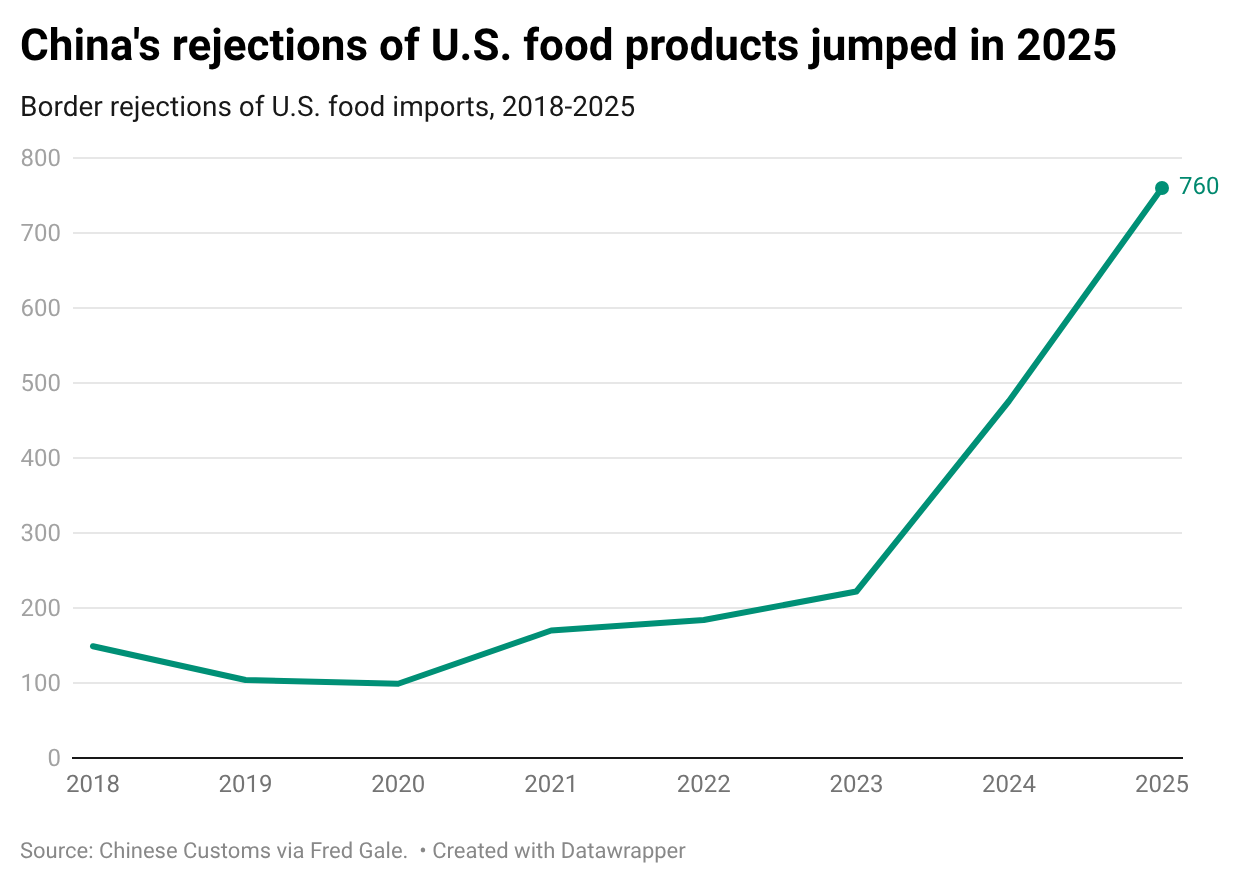
Overall, China’s rejections of imported food increased 55% in 2025 from 2024, according to former USDA economist Fred Gale. Gale has been translating and crunching monthly numbers from Chinese Customs and notes that 2025 rejection volumes are the highest since the customs administration took over the task in 2018.
For U.S. food products, rejections started rising sharply in 2024, jumping from 222 in 2023, to 476 in 2024 and 760 in 2025.
The reasons for food product rejections at the Chinese border are varied, including detections of hormone residue, banned feed additives like Ractopamine, sensory inspection issues, gaps in documentation, exporter registration and labeling issues.
“A lot of these rejections probably are legitimate,” Gale told Agri-Pulse in an interview. But Gale also pointed out that Beijing could also be using sanitary and phytosanitary inspections to “mask” retaliatory actions.
Rejections of European pork exports, for example, surged in summer of 2024, when the EU launched investigations into Chinese subsidies and dumping practices, according to Matthew Nicol, an agriculture and trade policy analyst at the European Union-China Legal Economic Reform Agenda (EU-CLERA).
“It would be a bit naive to not see the retaliatory nature of some of this,” Nicol noted.
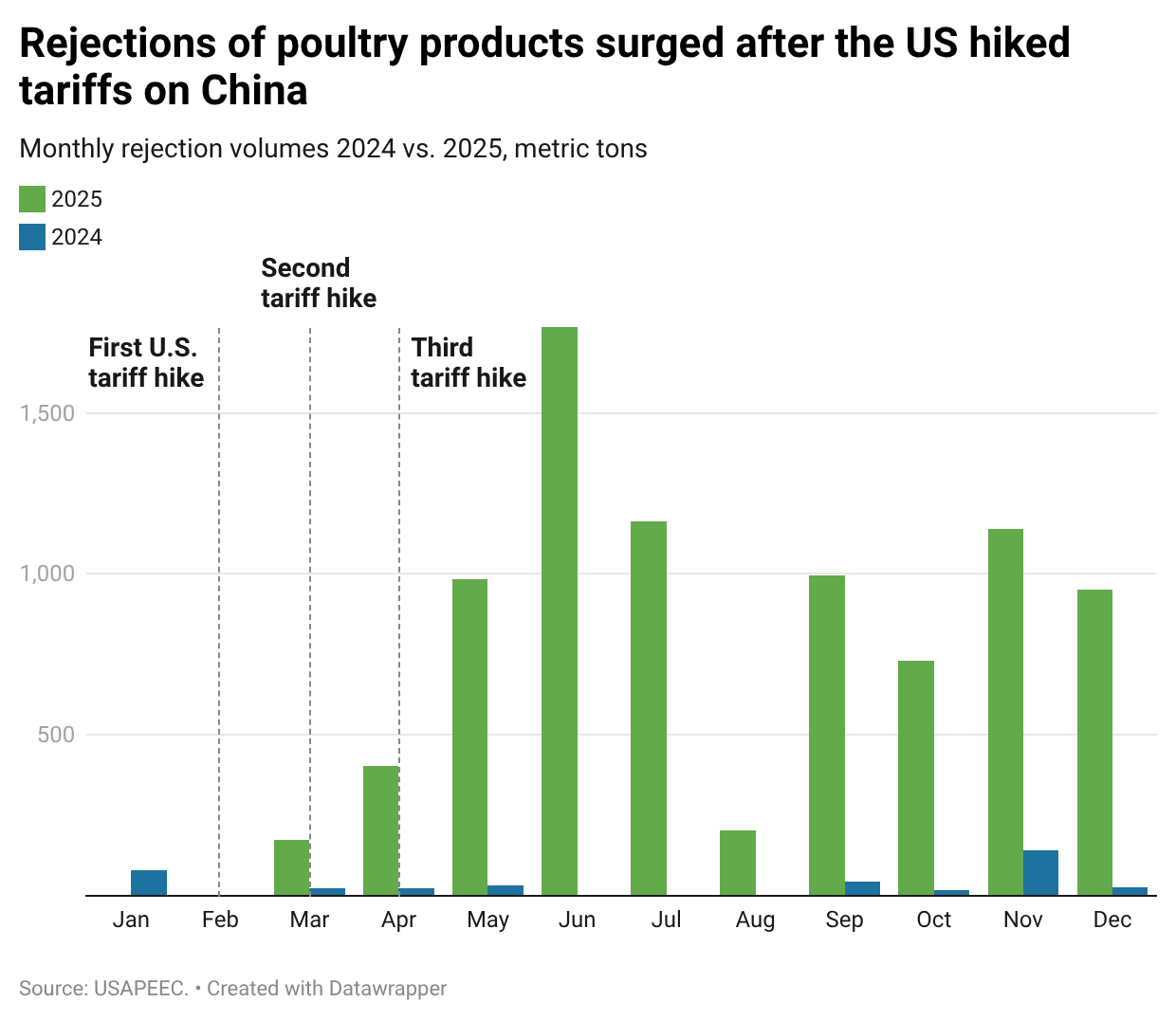 U.S. poultry exporters are also looking at the uptick in rejections through a geopolitical lens. In the months after the U.S. hiked tariffs on China in 2025, rejections of U.S. poultry at the Chinese boarder soared.
A third of all poultry exports to China were rejected in June, Greg Tyler, president and CEO of the USA Poultry and Egg Export Council, told Agri-Pulse in an interview. In July, rejections ticked higher to 35%, before falling off.
Overall, in 2025, almost 9% of all U.S. poultry exports were rejected.
The most common reasons for the rejections were for products that failed to meet sensory inspection requirements – because they had yellow skin or ammonia burns – or there was a discrepancy between documentation and the imported product, as well as evidence of furazolidone use, which is used to combat infection and is banned in China.
Tyler, however, argued that U.S. producers haven’t used furazolidone since the early 1990s.
“They're getting false positives on that,” he said. “It's definitely something that the Chinese are just using as a reason to reject product coming in from the U.S.”
The impacts for the poultry sector are particularly challenging, Tyler said, because the poultry products going to China, like chicken feet, aren't consumed in high volumes in other international markets.
Building a ‘programmable’ border
During the first Trump administration, when the U.S. and China sparred over trade issues and swapped tit-for-tat tariff escalations, China didn’t have the capabilities to weaponize border inspections and import rejections, analysts said.
Interested in more news on farm programs, trade and rural issues? Sign up for a four-week free trial to Agri-Pulse. You’ll receive our content - absolutely free - during the trial period.
Gale noted that there were some import rejections of Canadian pork in 2018 after Canada arrested an executive at Chinese communications giant Huawei. But the rejections were not in significant volumes.
Since then, however, China has made several policy changes that have allowed officials to create what Nicol calls a “programmable” border.
“Chinese border management has become flexible enough,” he said, that “enforcement intensity” can now shape trade flows as much as tariffs and quotas.
Efforts to create a flexible border management environment started in 2018 when China’s General Administration of Customs took over responsibility for food safety inspections. Then in 2021, Beijing set up its mandatory registration system for overseas ag exporters, which allowed Chinese authorities to suspend or block facility registrations.
But it was in 2025 when Beijing tightened its border operations through a string of measures across multiple ag sectors, Nicol said. In July, Chinese customs implemented new hygiene and traceability rules for edible oils, then in September came stricter record Matthew Nicol (LinkedIn photo)-keeping for procedures for bulk liquid foods and tighter animal disease controls at the border.
“It's important to remember that these are legitimate regulatory tools,” Nicol said. Every country has SPS standards and engages in inspections and documentary checks. But he added that recent data suggests that, in China’s case, “enforcement intensity isn't constant.”
“It tends to tighten around politically sensitive commodities and or during periods of trade friction,” he said. “What we see here is a very flexible trade management tool.”
Both Nicol and Gale also noted that Beijing may be using its border enforcement to support domestic industries in addition to lashing out against trade adversaries. In a recent blog post, Gale said China’s escalation in rejections of imported meat in the middle and end parts of 2025 also came in the wake of a government plan to support beef and mutton producers. Tariff-rate quotas to protect the domestic industry went into effect on Jan. 1, but border inspections and rejections gave the government a mechanism to control import volumes until the quotas went into effect.
“You can draw a straight line” from the uptick in beef import rejections and the plan to rescue the domestic industry, Gale said, arguing that the rejections were part of a multi-pronged effort to boost domestic prices.
The quotas allow set volumes of beef to enter the country at a reduced tariff rate. Out-of-quota imports now face 55% duties.
Beijing has “been upset for a long time that they were price takers, and I think that this is part of them trying to transition to a price maker,” Nicol said.
A long list of China grievances
Tyler told Agri-Pulse that he has raised the issue of Chinese rejections of U.S. poultry exports with administration officials, but he is also clear-eyed about the challenges officials face in making progress on the issue, given the long list of other grievances U.S. agricultural exporters have with Beijing.
President Donald Trump and Chinese President Xi Jinping could meet as many as four times this year – although the first meeting looks likely to be delayed. If all four meetings materialize, they would offer multiple opportunities to advance negotiations on thornier trade issues like agriculture.
“There are just so many things that are being addressed,” Tyler said. “All we can do is continuously remind [the Office of the U.S. Trade Representative] and USDA that this is an issue for us, and hope that it's going to be included at some point during these talks.”

