
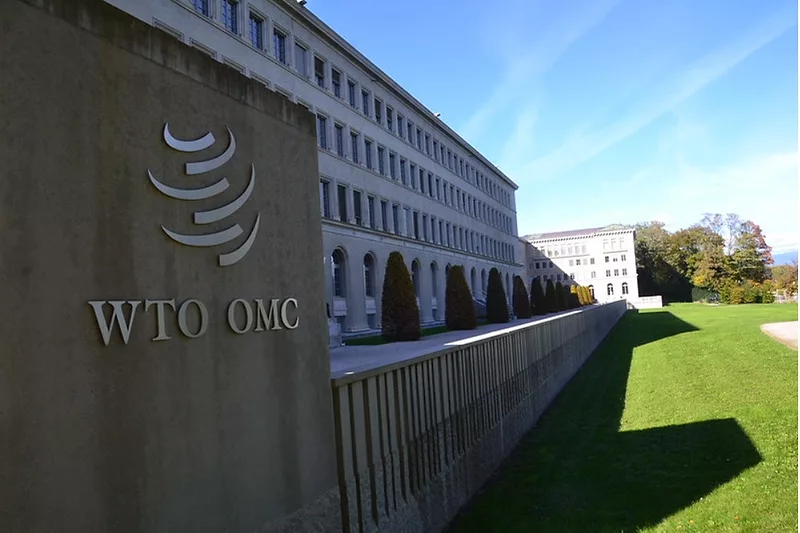
As trade ministers prepare for the World Trade Organization’s 14th ministerial conference later this week, the Trump administration outlined its thinking on several potential areas of reform for the body.
The U.S. circulated a report Monday at the WTO which argues the organization needs to bolster incentives for economies to report trade actions, create clear criteria for those seeking to qualify for special treatment under WTO agreements, find a way to incorporate plurilateral agreements among like-minded countries into the body, and revisit the most-favored nation (MFN) principle promoting the equal treatment of all trading partners, among other priorities.
“The WTO needs to change if it intends to have any relevance as the international trading system transitions to focus on reciprocity and balance,” U.S. Trade Representative Jamieson Greer said in a statement announcing the report. “The United States, with this report, continues to lead on concrete proposals to promote Member-driven reform discussions.”
Trade officials will meet in Yaoundé, Cameroon, from Thursday to Sunday where discussions around how to proceed with reforming and modernizing the body are set to take center stage.
Since members last met at the 13th ministerial conference in 2024, President Donald Trump’s trade agenda has added further strain to an institution already under scrutiny. The U.S. has blocked appointments to the WTO appellate body since 2017, hobbling its ability to resolve disputes between members.
Trump imposed a slate of tariffs which broke with the longstanding WTO most-favored nation principle by assigning the same imported good different tariff rates depending on its country of origin.
“The United States believes Members need to rethink how the MFN principle functions in its current form and embark on a frank discussion of the link between MFN and reciprocity, which itself is a bedrock WTO founding principle,” the report published Monday reads.
U.S. officials did not mention China by name but lamented that “many large trading nations” maintain economic systems that are incompatible with WTO principles. Accordingly, a “one-size-fits-all approach” to tariff policy is not serving the long-term interest of WTO members, or the institution itself.
Trump’s so-called Liberation Day tariffs presented an alternative whereby the U.S. charges different tariff rates depending on a product’s origin. An identical piece of farm equipment from the European Union suddenly faced a different tariff rate to that from China, for example, whereas before they would have been subject to the same duties.
MFN status, the U.S. argued in its report, should be made conditional based on a set of criteria, including countries’ commitments to “market openness” and “fair, market-oriented competition and transparency.”
The U.S. is not alone in questioning the continued merits of MFN. The European Union has shown signs in 2026 of a weakened commitment to the principle. Writing in the Financial Times earlier this year, EU Trade Commissioner Maroš Šefčovič also suggested that MFN perks should be reserved for economies that adopt “fair” trade practices and open markets.
Further, the U.S. has long complained that countries like China have received special rights like longer transition periods and carveouts in WTO agreements by arguing it is still a developing economy – known as “special and differential” treatment (SDT). Beijing has now agreed to forgo SDT, at the WTO, but the U.S. is pushing the body to come up with set criteria countries must meet to qualify for SDT.
“It is untenable for WTO rules to apply to some Members but not to others in perpetuity,” the report reads. “The efforts of so many Members to avoid the application of WTO rules to their own activities undermine confidence in the wisdom of such rules.”
The U.S. in 2019 put forward a proposal for a set of criteria that would exclude countries from claiming SDT at the WTO, including membership in the Organization for Economic Cooperation and Development or G20, a classification as a high-income economy from the World Bank, or if they account for more than 0.5% of global goods trade.
“The criteria need not necessarily be the ones proposed by the United States in 2019,” the U.S. wrote in its report Monday, “but that proposal is indicative of a reasonable, objective approach.”
Under WTO rules, economies are expected to notify other members of any subsidies or other trade measures, to ensure transparency. But several countries have argued that members are slow to notify the body, if they do at all.
“For certain Members, this reflects a choice not to be transparent,” the U.S. report argues. Part of a solution, the report argues, should be clear consequences for members that do not notify the membership of trade actions that are “proportionate” to any harm created.
In addition to fostering transiency from member states, the U.S. says it wants to push for more transparency in the WTO secretariat, including on how financial contributions from member states are spent and on the process for drafting reports.
The Secretariat should be guided by what is best for Members and their economies, not its view on what is best for ‘the system,’” the report reads.
Whether members can make progress on how to proceed with WTO reform discussions later this week remains unclear. The more than 100 government officials won’t be discussing actual reform proposals, just how to scope and proceed with discussions. But disagreements still remain.
The U.S. did not support a draft WTO declaration published earlier this month on how reform talks should proceed – the product of nine months of discussions. U.S. Ambassador to the WTO Joseph Barloon argued that discussions are not advanced enough to adopt a concrete work plan for how to move ahead.
Three days in Cameroon could break the deadlock. But frustrations have been palpable heading into the discussions.
“Unfortunately, the latest version of the draft is disappointing and diluted,” EU Ambassador to the WTO João Aguiar Machado said of the latest work plan draft during a general council meeting earlier this month. “It is a pale reflection of the rich discussions and work done on WTO reform and the serious engagement by the membership since June last year.”
He added, however, that “the draft is what it is – at this stage, we would encourage Members to engage on this basis in a constructive spirit.”
For more news, go to Agri-Pulse.com.

