
|
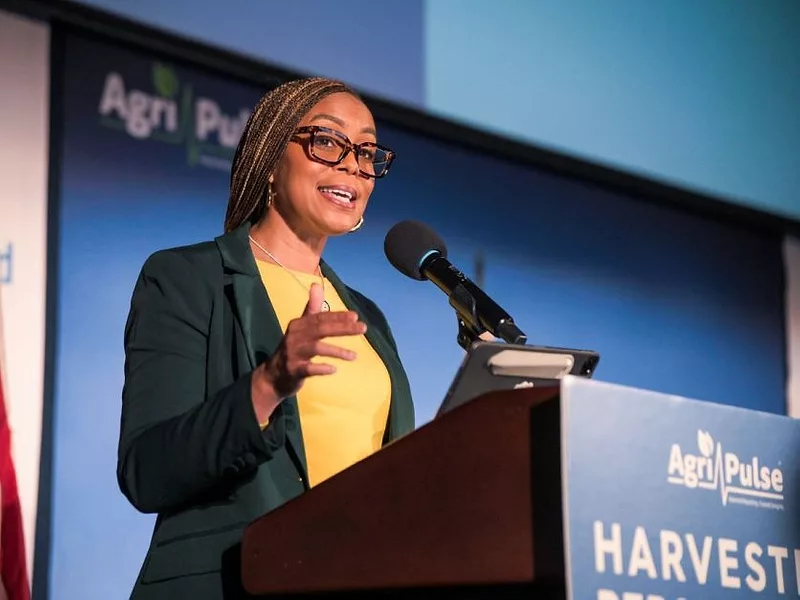
Farmers are under pressure from higher input prices and the loss of export markets, Rep. Shontel Brown, D-Ohio, said at Agri-Pulse’s annual Ag & Food Policy Summit Monday, calling on the administration to suspend duties on imported phosphates.
Commodity groups have targeted removal of the duties on phosphates from Morocco and Russia to address high prices that resulted from the war in Iran and the effective closure of the Strait of Hormuz.
“We should also be prioritizing logistics by ensuring that port capacity and transportation are not bottlenecks at the worst possible time,” Brown said.
“We are waking up to the fact that the instability around the Strait of Hormuz is not just a foreign policy issue. It is a domestic issue,” Brown told the audience at the event at the National Press Club. She is the vice ranking member of the House Ag Committee.
She also said farm bill legislation needs to delay changes to the SNAP program. She was joined in her call for a delay in the Supplemental Nutrition Assistance Program changes by Sen. Amy Klobuchar, D-Minn., and the ranking member of the Senate Ag Committee, who has repeatedly criticized new SNAP cost-share provisions in the One Big Beautiful Bill Act. Under the OBBBA, states will have to pay higher administrative costs but would be forced to shoulder even more based on their error rates.
Neither House Ag Committee Chair Glenn “GT” Thompson, R-Pa., nor Senate Ag Committee Chair John Boozman, R-Ark., indicated in their talks at the summit that they were willing to budge on rolling back the OBBBA changes.
In her speech, Brown, who represents a largely urban district in Ohio, said she wanted to be on the House Agriculture Committee in part because of the panel’s reputation for bipartisanship.
She said she has seen “flashes” of that bipartisan cooperation but questioned whether Republicans were making a serious effort to enact a new farm bill.
It’s easy to be “in the know” about what’s happening in Washington, D.C. Sign up for a FREE month of Agri-Pulse news! Simply click here
“The farm bill is supposed to be the foundation of both farm stability and food security, but what we've seen lately is a process that feels like we're going through the motions, not doing the hard work that the moment demands,” she said. “I wish we saw the same urgency around passing a farm bill that we see our other legislative priorities, because this matters just as much."
Brown said she was disappointed that an amendment she offered to delay the cost-share provisions was not adopted when the committee passed the GOP version of the farm bill by a 34-17 vote, with seven Democrats in support.
She touted an alternative farm bill offered by the committee's ranking member, Angie Craig of Minnesota, which includes tariff relief and “needed delays” to the cost-share provisions. But legislation “getting year-round E15 across the finish line is the baseline,” she said. “This is long overdue.”
Addressing the loss of personnel at USDA due to buyouts and retirements, Brown said Farm Service Agency, Natural Resources Conservation Service and Rural Development offices need to be “fully staffed [and] well resourced” so that farmers can access programs authorized by Congress.
Thompson said at the summit that he had made a point of reaching out to all Democrats on the ag committee individually to try to gain support for his bill. “In my mind, you cannot overcommunicate,” he said.
AFBF policy chief makes case for boosting domestic demand
Also at this year's summit, John Newton, vice president of public policy and economic analysis at the American Farm Bureau Federation, said there needs to be more domestic demand for farm products, noting that populations around the world are declining.
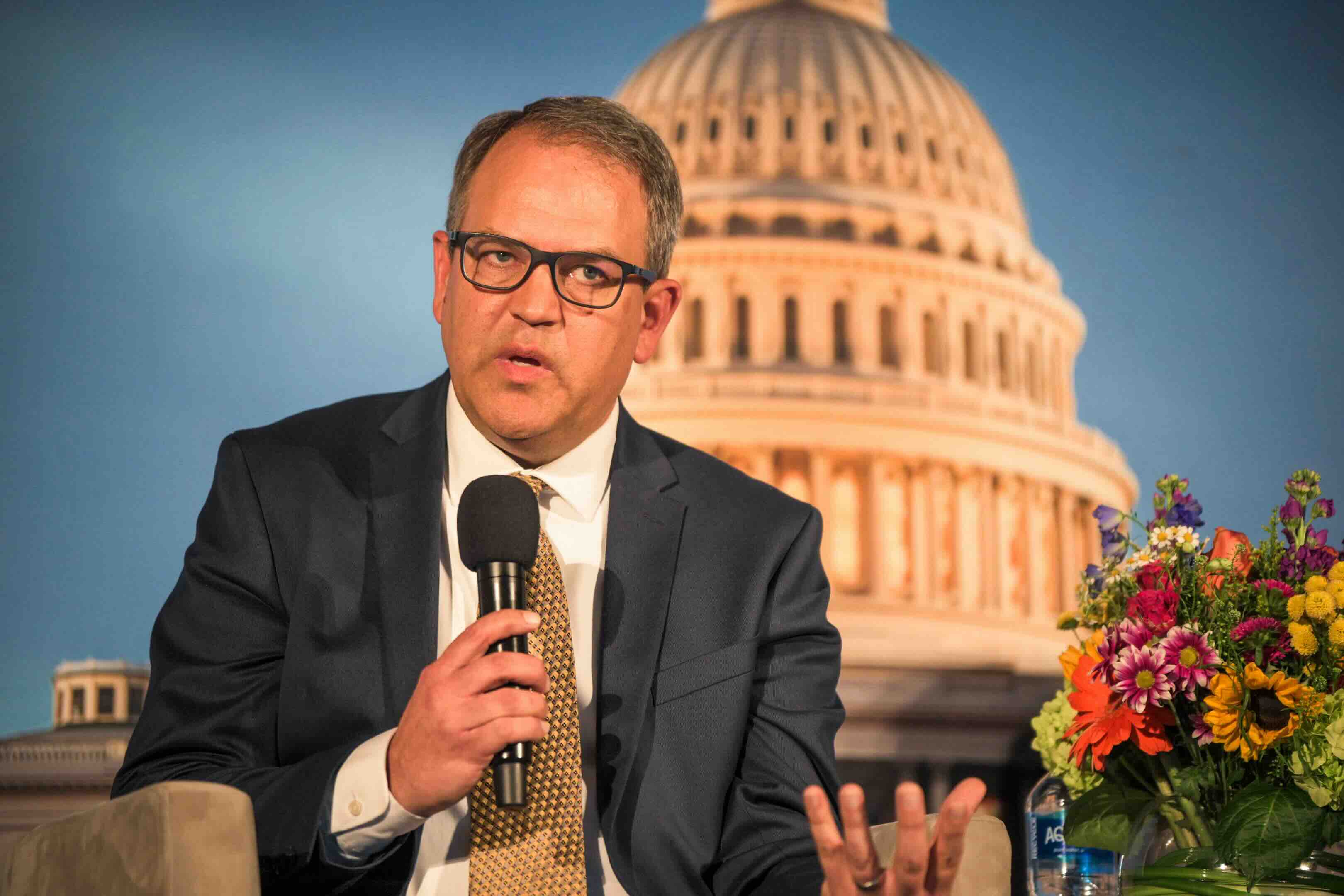 Mike Steenhoek (Agri-Pulse photo)
“We’re having fewer consumers moving forward in a more competitive global environment,” he said.
Mike Steenhoek, executive director of the Soy Transportation Coalition, said at the summit that his group is focusing on projects in the Great Lakes.
“We are going to continue to be enthusiastic about the Mississippi Gulf and the Pacific Northwest,” he said, but added that next week he’ll be doing a ceremonial check presentation at the port of Milwaukee increasing export capacity for the Great Lakes-Seaway.
Steenhoek also said of the way trade winds shift, “We certainly hope that we can still export to China. It's still a very prolific customer of ours, but the landscape has changed. It kind of reminds you of the old axiom that is applicable certainly to supply chains – don't put all of your eggs in one basket.”
Klobuchar touted two bills addressing fertilizer. The Fertilizer Transparency Act, a bipartisan bill she is cosponsoring, “which would create a mandatory price reporting structure, providing wholesalers, retailers and farmers of all sizes with comparable levels of market information on fertilizer cost.”
Another bill she mentioned is the Homegrown Fertilizer Act, “which would create a grant and loan program to expand domestic fertilizer production and improve fertilizer storage capacity.”
For more news, go to Agri-Pulse.com.

