
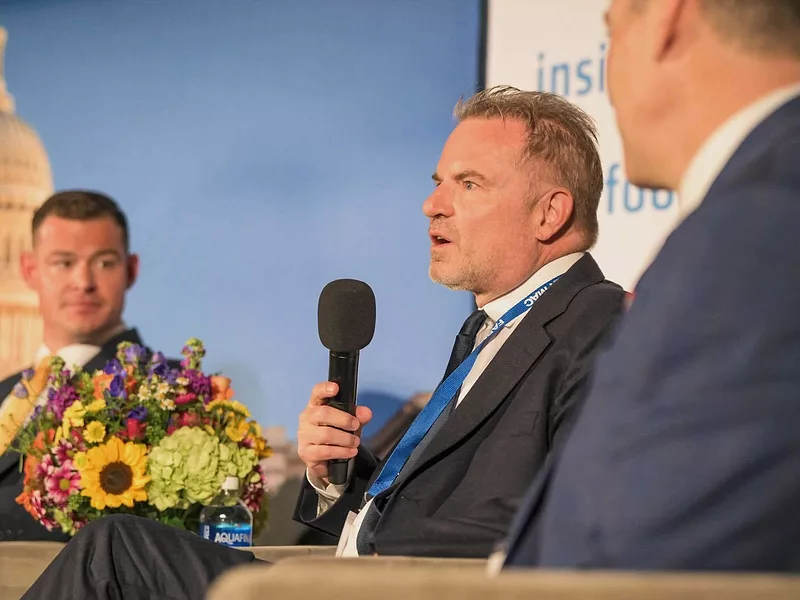
The Federal Maritime Commission's former chairman says he's optimistic global rules to cut carbon dioxide emissions from ocean vessels will include biofuels – and have the Trump administration's blessing.
"There's action right now," Louis Sola, now partner at the bipartisan government relations and lobbying firm Thorn Run Partners, said at the Agri-Pulse Ag & Food Policy Summit.
Panama, Liberia and Argentina have made a proposal that refers to biofuels, Sola said. The Trump administration hasn't weighed in yet, but Sola said he's "very optimistic" renewable fuels will end up being part of a future plan.
A lack of U.S. bunkering facilities, which supplies fuels to ships, is a problem, though the latest maritime plan, along with "billions of dollars that are going to be invested" means such infrastructure can start being built, he said.
In October, the International Maritime Organization's proposal, dubbed the Net-Zero Framework, was delayed by a year after President Donald Trump opposed it. The administration said it would have essentially imposed a tax hike on Americans through "progressive climate pet projects" of the United Nations.
Trump's rejection of the framework crafted by the UN's maritime agency put him at odds with U.S. biofuel groups that said the proposal could help financially strained U.S.farmers as well as fuel producers seeking new markets.
The Renewable Fuels Association, an ethanol trade group, has said if its industry captured just 5% of that maritime fuel market, it could see a demand boost of as many as 5 billion gallons, while American growers could see an increase of at least 1.5 billion bushels of corn.
Sola said carbon standards were not the reason the Trump administration rejected the framework.
As written, the proposal "would have benefited basically Europe and the Middle East," said Sola, who was picked for his prior role twice by Trump as well as by former President Joe Biden.
It’s easy to be “in the know” about what’s happening in Washington, D.C. Sign up for a FREE month of Agri-Pulse news! Simply click here
"What we're doing now is we're trying to advocate as much as we can so that biofuels and traditional LNG that we use here are also included," he added. "The way that it was written, it was completely discriminatory against U.S. producers of any type of fuel whatsoever."
Sola said the IMO is taking U.S. concerns into account.
He and others also pointed to what he called a major potential market for maritime biofuel in the U.S.
Ben Kruger, COO of renewables at Roeslein Renewables, said all types of renewable energy will be needed for a new age of clean maritime fuels, including ethanol, biodiesel, renewable diesel and biogas.
"Within five years, this could be a $10 billion to $15 billion a year market," Kruger, formerly at Cargill, told the summit. It's "one of the biggest opportunities we've seen in decades, and might see for decades to come.”
Sola noted the immediate opportunity to serve foreign vessels coming into U.S. ports.
"A lot of these companies that are sending their ships here, these are foreign companies, they have already made the investment into the infrastructure, their engines," Sola said. "Almost all cargo carriers, cruise ships are dual-fuel, ready for drop in bio-LNG today."
"That is the message we're trying to get across to the administration, that this is an untapped market," he said. "I think they're getting it."
.webp?t=1762183428)
