
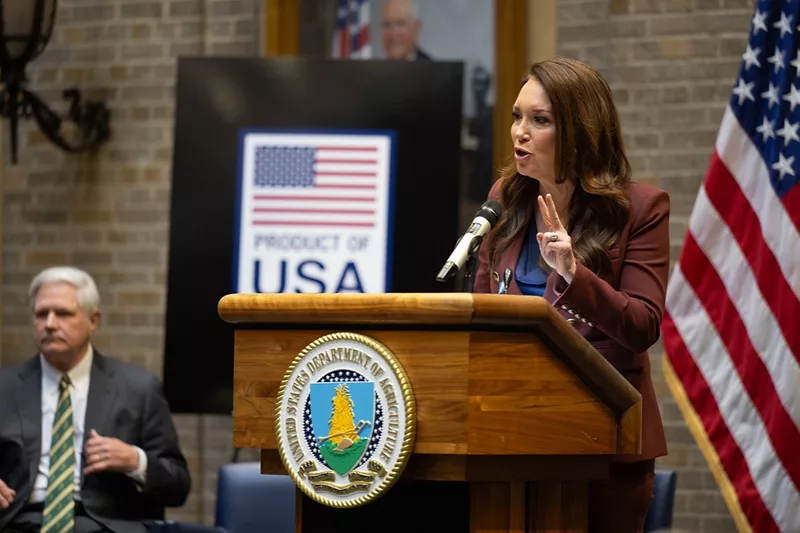
Agriculture Secretary Brooke Rollins says she is a “big supporter” of mandatory country-of-origin labeling (MCOOL) for U.S. meat products.
“It's just a transparency question,” she told reporters Tuesday ahead of a roundtable on implementing a grazing action plan.
The U.S. adopted MCOOL in 2009, but Canada and Mexico challenged the policy at the World Trade Organization, prompting Congress to repeal the law in 2015.
“There are some trade implications,” Rollins said, but added that the administration has been “looking at it.”
“We will continue to work on it, work with Congress and work with those who'd like to move it forward,” Rollins said Tuesday. “For me, it's black and white. Everyone in America should know where their food is coming from.”
Not everyone agrees: Some segments of the U.S. beef and cattle industry have been urging the administration to use a forthcoming review of the U.S.-Mexico-Canada Agreement to find a resolution on the issue. But the U.S. beef industry remains divided on the subject, with some arguing negotiating efforts would be better focused elsewhere.
Soybeans up, corn down in planting intentions report
USDA’s planting estimates show corn acreage down 3% from last year’s bin-busting crop. Soybean plantings are seen up 4%.
Total planted acres are seen declining to near 2020 lows, notes Oppenheimer analyst Kristen Owen.
All cotton planted area is estimated up 4%.
What about wheat? In its Prospective Plantings report, USDA estimates all domestic wheat will be down 3%. If realized, that would be the lowest since records began in 1919.
“The lower wheat acreage fits with what we've seen, and with a global trend,” says Arlan Suderman, chief commodities economist for StoneX Group. “The global shortage of nitrogen fertilizer created when Iran closed the Strait of Hormuz amplifies this trend toward lower global production, although the U.S. is still well supplied.”
Take note: How market disruptions from war in the Middle East might trigger planting changes later this spring is anybody’s guess.
“The debate will be whether the corn acreage comes down and soybean acreage goes up due to the effect of the war on fertilizer prices and the good news that soybeans received from the EPA on biofuel production last Friday,” Suderman says.
June 30: That’s when the next USDA planting report hits. The current estimates are based on a survey of farmer intentions.
Crop supplies: USDA said domestic corn, soybean and wheat stockpiles are all up from March of last year: Corn 11%, soybeans 10% and wheat 5%.
U.S. spirits exports fell in 2025 on trade frictions
U.S. spirits exporters recorded 2025 sales 3.8% below the previous year, a new report finds.
Interested in more news on farm programs, trade and rural issues? Sign up for a four-week free trial to Agri-Pulse. You’ll receive our content - absolutely free - during the trial period.
After the Trump administration hiked tariffs on Canada, provinces removed American products from shelves. Exports cratered by 70% year-over-year, the Distilled Spirits Council of the United States notes in its new analysis. Exports to Canada fell from $203 million between March and December 2024, to $60 million the following year.
Alberta and Saskatchewan have since reopened their markets to U.S. exporters, but other provinces maintain a ban.
Exports to the European Union also fell after importers stockpiled whiskey before Trump entered office.
Brazil, the United Kingdom, Australia and some emerging markets increased their purchases, but not by enough to fully offset the declines elsewhere, the report finds.
The report underscores “the industry’s vulnerability to uncertainty in the global trade environment,” DISCUS President Chris Swonger said in a statement. “Stable, tariff-free trade and expanding market access abroad are essential to ensuring continued growth for the U.S. spirits sector.”
Meet the lawmaker and farmer: West Virginia Sen. Jim Justice
Owner of the most farm ground east of the Mississippi River, West Virginia Governor-turned-Senator Jim Justice joined Agri-Pulse's Meet the Lawmaker to discuss his experience before entering Congress and some of the top issues he's looking to tackle in Washington.
A member of the Small Business, Aging, Agriculture, and Energy committees, Justice warns of a coming energy crisis as decisions loom over whether to support industrial or residential energy in the near future.
"You've got to pick one or the other, and America can't do that. They can't afford to do that," Justice said. "You have to take care of the homes, but if you turn your back on AI and data centers and all that, you're just handing our national security over to China. So the energy meltdown is coming."
Watch the interview to hear more about Justice's farming operation, how he began growing for the National Corn Growers Association yield contest awards, and the story of how he was gifted and named his beloved English Bulldog, Babydog.
Luján wins James Beard Impact Award
Sen. Ben Ray Luján, D-N.M., is a James Beard Impact Award honoree for his efforts to “protect and strengthen SNAP, the most effective anti-hunger program in the nation,” the James Beard Foundation says.
Luján, ranking member of the Senate Agriculture Subcommittee on Food and Nutrition, will be acknowledged at awards ceremonies in mid-June at the Lyric Opera of Chicago.
Watch Luján on the March 13 Agri-Pulse Newsmakers
Final Word:
“We don't see a need to change our policy. The Chinese want stability. We want stability. I actually see a positive agenda with China going forward, where we learn to manage our trade with each other, where we pick the kinds of things we want to be selling to each other – things that are mostly not sensitive – to avoid some of the national security elements that prove challenging in these negotiations.” – USTR Jamieson Greer on Bloomberg TV Tuesday.
For more news, go to Agri-Pulse.com.
.webp?t=1762183428)


