
Agriculture Secretary Brooke Rollins says the administration is still analyzing whether to reopen the southern border to live cattle trade. She also hinted Wednesday at a potential announcement during an upcoming Texas trip.
“Closing these ports is not an easy decision, and it's one that we're analyzing every single day now,” she told Agri-Pulse. “We'll be heading down to McAllen to break ground on the big sterile fly facility within the next month, and we'll probably have a little more to talk about then.”
Rollins told a cattle raisers convention in Texas on Saturday that the administration is considering a phased reopening of the border and that it would make a decision in the coming weeks.
USDA earlier this month announced a construction contract to build a new facility to produce sterile flies to combat New World screwworm at Moore Air Base. Dispersal efforts for 100 million sterile flies a week are currently supplied by a facility in Panama.
Give farmers E15 instead of more aid, Grassley says
Sen. Chuck Grassley has a solution for avoiding another government rescue package for farmers: Give them E15 instead.
As lawmakers mull additional aid of roughly $15 billion, the Iowa Republican is pointing to a study that says allowing year-round sales of higher ethanol blends, known as E15, would spur $13.8 billion worth of increased corn demand.
Farmers are feeling an even bigger financial squeeze lately due to war in the Middle East that’s driving up fuel and fertilizer costs, Grassley notes. “It would be very appropriate” to add E15 to a military-spending bill, he told reporters.
It makes more sense to combat increasing farm bankruptcies by expanding crop-based biofuels, “particularly when you hear Iowa farmers say they would rather get their money from the marketplace instead of from the federal Treasury,” Grassley says.
When asked how Congress can pass E15 and a partial farm bill this year given the political gridlock and midterm elections: “Obviously, it’s going to be very, very difficult,” he answered.
ITC votes to advance fatty acids probe
The International Trade Commission has determined that imports of fatty acids from Indonesia and Malaysia are hurting U.S. industry, allowing countervailing and antidumping duty probes to proceed.
Interested in more news on farm programs, trade and rural issues? Sign up for a four-week free trial to Agri-Pulse. You’ll receive our content - absolutely free - during the trial period.
Indonesia is the world’s largest exporter of industrial fatty acids, oils and alcohols, which are used in food products, cosmetics and rubber production. A U.S. chemical company filed antidumping and countervailing duty petitions in January arguing that producers in both countries are benefitting from government support and selling their products below fair value in the U.S.
The investigation will now advance to the Commerce Department, which will assess any subsidies and dumping below market price. If Commerce finds evidence of either, the imports could face additional tariffs.
B20 blending regulation implemented in Illinois
B20 will now be the minimum biodiesel blend required to qualify for a tax exemption in Illinois, under new regulations that kicked in Wednesday.
A 2022 law exempts “qualifying biodiesel blends” from the state’s 6.25% state sales tax, “creating a powerful market incentive to drive adoption," a press release from Clean Fuels Alliance America says. The exemption initially applied to B17 blends.
The release points to a study that suggests the biofuel industry currently generates $3.2 billion in annual economic activity in Illinois.
A press release from the Illinois Soybean Association says the biodiesel industry saw a 924-million-gallon decrease, or 45%, in biofuel use in 2025, but that Illinois specifically saw an increase of 10 million gallons, or 5%. It attributed this to the tax exemptions, saying the policy "creates stable growth for the biodiesel industry in Illinois while there is extreme uncertainty nationally.”
In a statement, Illinois Agriculture Director Jerry Costello II said the B20 policy change "expands market certainty for soybean farmers still suffering from the impacts of tariffs, while also providing national security through domestic production.”
Means says school meals can be improved without new money
The Trump administration says the amount of money spent on school meals is sufficient to transform the suite of foods offered to kids.
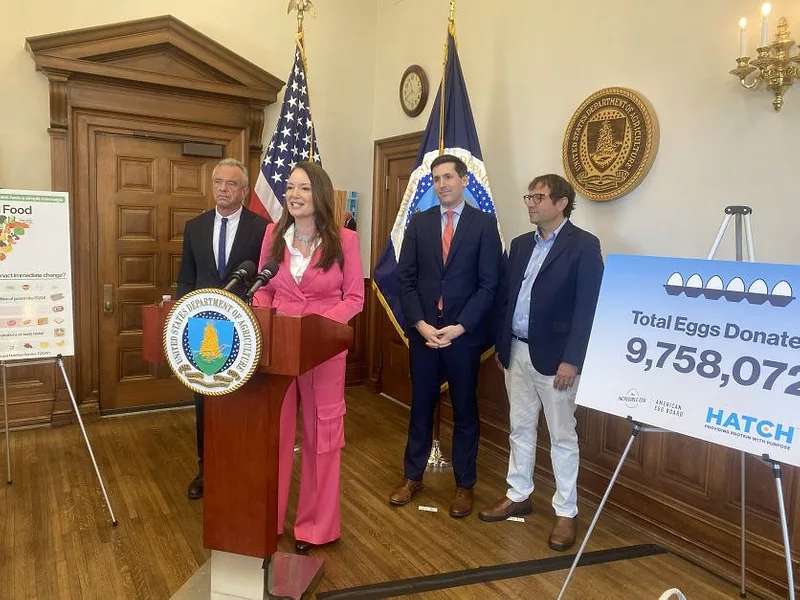
White House Senior Adviser Calley Means told Agri-Pulse after an event at the Ag Department Wednesday that school meal directors face challenges offering high-protein meals to students.
“We absolutely acknowledge there's tremendous logistical considerations which we are working on, and challenges that schools face,” he says. “But we also would ask every stakeholder to come to us with solutions, and not immediately just come asking for more money. We can improve school lunches significantly with the current budget we have.”
“When you look at school lunches, can we find and bulk-buy high-quality whole food, protein, fruit, vegetables, whole grains? Yes, we can do that,” Means says.
School meal directors overwhelmingly say they need more money to expand scratch cooking offerings. The new Dietary Guidelines for Americans stress the importance of eating whole, not ultraprocessed, foods. The federal reimbursement rate for school lunches is $4.60, which covers food and labor costs.
Asked whether there would be new money to buy equipment for scratch cooking, Means said, “Come to us with solutions, not problems. We should all be agreeing that we can improve school lunches and get more whole food on the child’s plate.”
He added, “Two eggs is less expensive than the … doughnuts, the pastries, the cereals. It’s less expensive.”
Final Word:
“We are going to hit them extremely hard over the next two to three weeks.” – President Donald Trump in a televised address to the nation Wednesday night about the U.S.-Israeli war in Iran. He said the U.S. military will soon “finish the job” but offered no clear timeline for an end to the war.
He also claimed, “When this conflict is over, the strait [of Hormuz] will open up naturally. … Gas prices will rapidly come back down.”
.webp?t=1762183428)


