
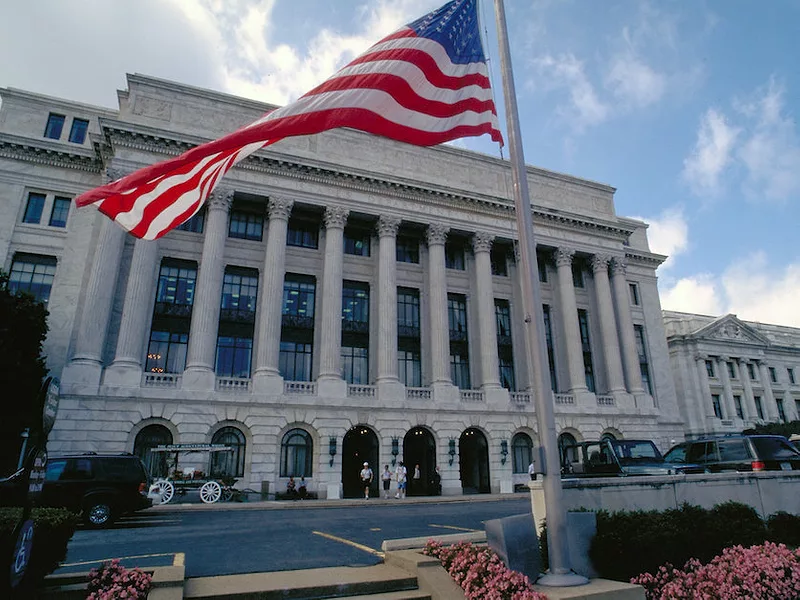
The Department of Agriculture is a “bloated Washington, D.C., bureaucracy,” the Trump administration’s fiscal 2027 budget request says, proposing to cut USDA spending by $4.9 billion, or 19%, from current funding levels and eliminate international food aid programs.
The department has “multiple management layers and many extraneous programs that are irrelevant to supporting an America First agricultural policy,” the document says.
The White House budget once again takes aim at international food aid. As it did last year, the administration's request for FY2027 would scrap the Food for Peace and McGovern-Dole assistance programs, which send U.S. commodities and food products to recipients overseas.
“The Food for Peace program spends $1.2 billion to ship food overseas, which takes an average of 4-6 months to arrive at its destination, and does so at exorbitant rates, defeating the purpose of providing expeditious emergency food aid and wasting taxpayer dollars,” the budget says. “The program also distorts and undermines local and regional markets where the food could be grown and purchased for less.”
Some food aid practitioners have long called for food aid dollars to be spent more efficiently and for more reliance on locally or regionally produced commodities. But others see the program’s purchases of U.S. products as a positive, providing a win-win for both American farmers and aid recipients
The budget also would cut the $240 million in spending for McGovern-Dole, calling it “a wasteful and inefficient foreign aid program. Food often takes months to arrive at intended destinations and does so at an extremely high cost.”
The budget seeks $50 million for USDA's reorganization plan, which would move employees out of Washington, D.C., to five regional hubs. "Relocating many of USDA’s headquarters employees to regional hubs will bring USDA closer to the Americans it serves and eliminate unnecessary bureaucratic layers, honing in on the administration’s priority to increase the efficiency of the federal government."
One agency targeted in USDA is the National Institute of Food and Agriculture, whose approximately $1.07 billion budget would be cut by $510 million.
Interested in more news on farm programs, trade and rural issues? Sign up for a four-week free trial to Agri-Pulse. You’ll receive our content - absolutely free - during the trial period.
“The budget significantly reduces formula grants that act as pre-determined earmarks for university pet projects,” the request says. “USDA research will instead be competitively awarded to projects in the national interest, as opposed to the woke radical left projects these grants previously funded.” One of the examples cited is a grant titled “Clothing Needs of Transgender People.”
The request also goes after $659 million in community facilities grants provided by the Rural-Business Cooperative Service. “What was historically a program providing low-cost credit to rural communities has morphed into a pork-barrel spending program for wasteful earmarks to areas that are arguably the least in need,” the request says. “The budget fixes this, restoring the program to its intended purpose — promoting low-cost lending that is awarded based on objective criteria.”
The FY2027 budget also reiterates calls for cuts to the National Oceanic and Atmospheric Administration’s educational grants programs and consolidating oversight of the Endangered Species Act and Marine Mammal Protection Act in the Interior Department.
The administration also proposes increasing the budget for trade enforcement efforts, as it did last year. It is seeking an additional $110 million for Commerce’s International Trade Administration, with $100 million going to efforts to stand up a “United States Investment Accelerator.”
HHS spending also would be cut
The proposed budget requests $111 billion for the Department of Health and Human Services, a $15.8 billion, or 12.5%, decrease from the 2026 enacted level. For the second consecutive year, it proposes creating a new Administration for a Healthy America as part of a broader HHS reorganization — an effort Congress rejected last year.
The restructuring is framed as a shift toward programs focused on nutrition, food and drug safety, and chronic disease prevention, while consolidating or eliminating existing programs, including some within the Centers for Disease Control and Prevention. The proposal also includes a $5 billion reduction to National Institutes of Health funding and again calls for eliminating the Low Income Home Energy Assistance Program, or LIHEAP, continuing a pattern from previous budget requests.
The budget prioritizes investments for Secretary Robert F. Kennedy Jr.’s “Make America Healthy Again” agenda. This includes $19 million to “expand access to nutrition services” at health centers.
It also proposes $55 million for new infection prevention and food safety initiatives at the CDC, targeting antimicrobial resistance and micro- and nano-plastics. In addition, the budget allocates $57 million to modernize the Food and Drug Administration through artificial intelligence and machine learning, alongside efforts to remove “unsafe chemicals from America’s food supply” and develop alternatives to animal testing. The proposal does not specify a total funding level for the FDA.
Budget looks to slash EPA funding
Trump seeks to slash the Environmental Protection Agency’s budget by 52% to $4.2 billion from fiscal year 2026’s enacted level, OMB says.
The administration is continuing its push for “common sense environmental policy" while scrapping what it deems “wasteful, radical Green New Scam spending and regulatory overreach.”
The White House’s budget blueprint calls to eliminate Diesel Emissions Reduction Act (DERA) grants, arguing that the program is wasteful and getting rid of it would save taxpayers $90 million. EPA issued guidance last week seeking to ease regulatory requirements on diesel exhaust fluid.
The administration seeks $1 billion for EPA’s FY27 budget to restore the Great Salt Lake of Utah. The investments would support global aquaculture and ensure the lake is a robust domestic source of critical minerals, according to OMB.
The budget request also proposes resources to cut through “red tape hampering” on infrastructure projects. The budget seeks an additional $14 million for web-based permitting tools, such as NEPAssist, that “slash bureaucratic hurdles, reduce infrastructure permitting timelines, and alleviate burdens on project sponsors, developers, and agencies.”
Interior spending would fall by 12.9%
The budget for the Interior Department would drop from $18.2 billion to $15.9 billion, a $2.3 billion, or 12.9%, cut.
The budget proposes consolidating Endangered Species Act and Marine Mammal Protection Act permitting programs into a single program at the Interior Department, rather than spread across Interior's Fish and Wildlife Service and Commerce's National Oceanic and Atmospheric Administration.
It suggests the current division of the two programs has "resulted in unnecessary red tape, increased costs, and delayed approvals, and produced inconsistent outcomes for permittees.”
The request also suggests reforming federal wild land firefighting programs across the Agriculture and Interior departments by merging them into one U.S. Wildland Fire Service at Interior. The budget request says this would "streamline federal wildfire suppression policy, resources, response, risk mitigation eforts, and coordination with non-federal partners to combat the wildfire crisis.”
It also would create a Wildfire Intelligence Center “that would centralize and modernize fire intelligence and technology."
The budget proposes eliminating the U.S. Geological Survey’s Ecosystem Mission Area, which conducts biological research. It would also eliminate funding for some Interior Department renewable energy programs.The budget also proposes eliminating funding for WaterSmart grants for local ecosystem restoration projects, climate studies and water recycling plants at the Bureau of Reclamation, and says it will refocus the agency away from "woke projects like lining water canals with solar panels at the taxpayers’ expense.”
Criticism comes from GOP and Democrats
There was plenty of criticism of the proposal from both Republicans and Democrats in Congress. Maine Republican Sen. Susan Collins, chair of the Senate Appropriations Committee, agreed that defense spending needs to be increased, though she didn't pledge unconditional support for the president's proposed $1.5 trillion in military spending, or more than a 40% increase.
Other Republicans told news outlets they were concerned by the size of the request.
Collins herself decried "unwarranted funding cuts in biomedical research" and the proposed elimination of the Low Income Home Energy Assistance Program, "which helps low-income families and seniors to pay their energy bills during the cold winter and hot summer months."
"Job Corps, which helps students from troubled backgrounds gain the skills and education they need to enter the workforce, join the military, or pursue higher education, would also be phased out," she said.
In her statement, Collins also noted that "Congress holds the power of the purse," and that the request will be subject to "hearings with cabinet members and agency heads to review these recommendations and to explore other fiscally responsible proposals."
Sen. Patty Murray, D-Wash., ranking member of the appropriations committee, was blunter in her take on the proposal.
“The vision President Trump has outlined for America in his budget is bleak and unacceptable. President Trump wants to slash medical research to fund costly foreign wars. It doesn’t get more backward than that, and the only responsible thing to do with a budget this morally bankrupt is to toss it in the trash."
Rep. Angie Craig, D-Minn., and the ranking member on the House Agriculture Committee, issued a brief statement critical of the overall cut to the USDA budget:
“Now more than ever, farmers need our support. Their markets have been decimated by President Trump’
For more news, go to Agri-Pulse.com.
This story has been updated with reaction.
.webp?t=1762183428)


