
|
Multiple grant recipients plan to appeal USDA's termination last month of a $300 million program designed to help small-scale farmers gain access to land and marketing tools.
In interviews with Agri-Pulse, some of the grantees in the Increasing Land, Capital and Market Access program say USDA went after the wrong program, because it was designed to help underserved farmers, including beginning producers and veterans, not just those characterized by USDA as falling under the umbrella of DEI.
From the beginning, the Trump administration has cut programs it says are serving the needs of Diversity, Equity and Inclusion. ICLMA was originally passed in the American Rescue Plan Act in 2021 to serve “socially disadvantaged farmers, ranchers, or forest landowners,” a definition that includes people subjected to “racial, ethnic, or gender prejudice because of their identity as members of a group without regard to their individual qualities.”
Included in the group are American Indians or Alaskan Natives, Asians, Blacks or African Americans, Native Hawaiians or other Pacific Islanders, Hispanics and women. USDA said last year it would no longer use the definition to help target grant and loan money to individuals in those groups.
The program was amended in the 2022 Inflation Reduction Act to target “underserved farmers, ranchers, and forest landowners, including veterans, limited resource producers, beginning farmers and ranchers, and farmers, ranchers, and forest landowners living in high poverty areas.”
Equal protections violated, USDA says
In axing the program, USDA’s Farm Service Agency sent letters to grantees accusing them of “wasteful spending that did little to further lawful agricultural land purchases.” FSA Associate Administrator Steven Peterson also said “the vast majority of projects” in the program “violated equal protection principles by selecting beneficiaries based on race, ethnicity, sexual orientation or sex.”
Many of the 49 out of 50 projects canceled do appear to be targeted at groups fitting within the “socially disadvantaged” definition. However, grantees say they were prepared to serve anybody who wanted to produce food – that is, small and beginning farmers regardless of race or ethnicity.
The program “addresses what they're promoting right now – regenerative ag, helping small farmers,” says Diana Garcia-Padilla, founder of Holistic Organic Practical Education (H.O.P.E.) for Small Farm Sustainability in Harlingen, Texas. The project aimed to make three tracts of land available for small producers that would be purchased by USDA. The group plans to appeal the decision.
Interested in more news on farm programs, trade and rural issues? Sign up for a four-week free trial to Agri-Pulse. You’ll receive our content - absolutely free - during the trial period.
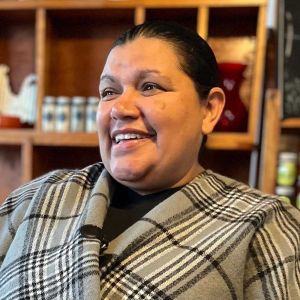 Diana Garcia-Padilla (H.O.P.E. photo)
“Our fellowship program was open to anyone,” says Jason Grimm, executive director of Iowa Valley Resource Conservation and Development in Amana, Iowa. Of the first cohort of seven fellows, three are white, he said. In all, 15 beginning farmers would have been in a two-year fellowship program, where they would have learned to manage crop and livestock enterprises and engaged with supply chain and land access networks. “Each would have developed a business plan and launched their business during this time,” Grimm said.
Grimm and other grantees said they were surprised by the accusation of waste, noting that despite a 90-day freeze on funding last year, USDA had approved reimbursement requests.
He said IVRCD has received several federal grants over the years and passed its audits “with flying colors.”
“It’s a hot mess,” Sharon Mallory, executive director of the 2020 Farmers Co-op, said of the termination. “Everybody may have their personal views, but when you come to this farming issue in the United States, and those individuals who want to tend the land as a career choice, which is very difficult, I can't find anyone who is dissenting from the mainstream of we need every program that's out there, whoever it benefits,”
She said that farmers she has spoken with, regardless of ethnicity, “are pretty much saying, if you wanted to get rid of this, this DEI privilege that you're saying is out there, finish out the contracts, because that's what was obligated. But don't just cut them off because of how you feel, or what you think."
“We never considered ourselves DEI, because we cater to all small-scale farmers,” she said. The co-op’s $13-million-plus grant was to be used provide producers in nine states “a uniform place for technical assistance” to help them with conservation practices and regenerative farming.
Then, she said, the co-op planned to “provide them with the infrastructure where these small-scale farmers can come together and aggregate their wares.” The co-op is based in Virginia but has about 780 farmer-members throughout the country.
“Ethnicity doesn't really matter with us, and our membership is indicative of that,” she said, adding that she is working on an appeal.
After terminating the program, a USDA spokesperson said in a statement that the program included no minimum requirement for direct producer support. “Instead, the program permitted the abuse of federal funds, including expenditures on the purchasing of a barbeque smoker, construction of a gazebo, massages, and for one awardee, a $20,000 budget for ink pens alone.” One grantee bought an RV.
Grantees Agri-Pulse spoke to said they weren’t involved in those purchases. Mallory, however, speculated that an RV might make sense in order to transport workers to farm sites and have a place to sleep.
“I don't know the back story to this at all, but I'm just using common sense,” she said. “They bought that RV because they want some mobile help in that particular area, and they're going to put that labor in that RV, and they're going to go from farm to farm to farm, and they're all sharing in the cost of the labor.”
“But I also say, did you really go investigate before you said ‘waste'? Think about what they're trying to do here and be a part of the solution, not just slandering and saying this is wasteful.”
The National Young Farmers Coalition, which pushed for inclusion of the program in the American Rescue Plan, said in a news release that while the termination letters claim that "most of the awards did little to improve land access" and that there was "excessive spending on outreach and technical assistance," they failed to mention that “current USDA leadership spent over a year systematically undermining the program – freezing funding, cutting off communication with awardees, and withholding the approvals grantees needed to move forward with land acquisitions, farmland down payment assistance, low-interest loans, and other core project activities.”
Grantees push back on USDA narrative
Amanda Koehler, who manages the Land, Capital, and Market Access Network, an independent group of award recipients and sub-awardees, said in a statement that the network “strongly disputes USDA's characterization" of the ILCMA program.
 Jason Grimm (IVRCD photo)
“USDA is responsible for the very problem it's now citing,” she said in an email. “The agency never approved land acquisitions, beneficiary mini-grants, low-interest loans, or other core project activities that awardees were ready to execute. Funds didn't reach farmers at the scale they should have because USDA created that bottleneck — and the department cannot manufacture a problem through its own inaction and then use it as justification for termination.”
In addition, the network said, “if USDA's real concern was the lack of a minimum requirement for direct producer support, the answer is to add that in, similarly to how they handled RCPP awards — not to cancel 49 contracts and leave farmers like the six in Kansas who were waiting for down payment assistance with nothing. Termination was a choice, not an inevitability.”
IRVCD’s Grimm said he sought help from the office of Sen. Chuck Grassley, R-Iowa. “My personal question for them is to request the USDA come back to us and work with us to amend or modify the project so it can still benefit the beginning farmers that need the support here in Iowa. But flat-out terminating it, it’s not helping anyone.”

