
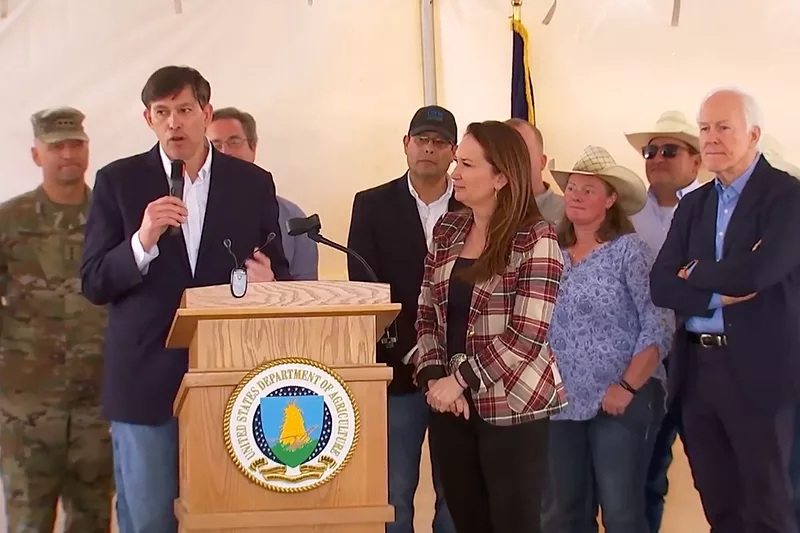
Agriculture Secretary Brooke Rollins will visit the port of Douglas, Arizona, next week as USDA considers whether to reopen any southern ports to cattle imports from Mexico, she said Friday at a groundbreaking ceremony for a new sterile fly facility in Texas.
Some elected officials and feeder cattle operations have urged USDA to reopen a crossing in Arizona, like the Douglas port, which Rollins said she would be “taking a first-hand look at. They are far along, and they’re very confident in what they’ve built there and what they’ve prepared for.”
Mayor Jorge Maldonado of Nogales, Arizona, told Agri-Pulse Thursday that the suspension of livestock trade across the border last year has dealt a blow to the local economy. Ranchers would come to the region to make cattle sales and contribute to the local economy, he said, often staying multiple days while the animals remained quarantined at the border.
“We haven't had that for over a year,” he said.
For Maldonado, the economic harm is unnecessary. There have been no cases in the Mexican state of Sonora that borders Arizona, or its neighboring state of Chihuahua. He argued that existing checks and quarantine requirements are effective at keeping the pest out, and, coupled with stringent traceability requirements, would be sufficient to safely reopen the border.
Maldonado said he has been pressing USDA officials to adopt a more regionalized approach to restricting livestock imports, speaking to Undersecretary for Marketing and Regulatory Programs Dudley Hoskins during a recent trip to Arizona.
Interested in more news on farm programs, trade and rural issues? Sign up for a four-week free trial to Agri-Pulse. You’ll receive our content - absolutely free - during the trial period.
Maldonado got his hopes up this week when reporting from Mexico suggested that a reopening of the border could come in the next few months. But Rollins and USDA dismissed the reports as inaccurate.
“We're still in the limbo,” he said.
Jourdan Bell, an independent livestock producer for Cattlemex in Arizona, said she has also been pressing for a more regionalized approach to reopening in meetings with USDA officials.
Last year, USDA announced a plan to gradually reopen ports of entry, beginning with Douglas, Arizona. But the plan was rolled back after an increase in Mexican detections. Bell said that if USDA has lingering reservations about opening Douglas, it can also open the more westerly port at Nogales and divide the cattle between the two, leaving fewer cattle in a single space.
"If we can split these cattle up between two ports, we can further ensure the safety of the cattle that are coming into the United States," Bell said. "That's why it is important that every state has two operational ports."
In her remarks on Friday, Rollins touted the fact that no cases of NWS have been found in the U.S. but noted that the parasite also has moved closer to Texas.
“I want to be very, very clear. The New World screwworm is only around 200 miles from this border, so there will not be a port opening in Texas until that significantly pushes back. But the New World screwworm has been roughly around 800 miles from the Douglas, Arizona, port and the two ports in New Mexico.”
"We have never been in a better position than we are today to a path,” she said. “As soon as we make a decision, we will let you know."
As of Wednesday, there were a total of 1,295 active animal cases of New World screwworm in Mexico, including two active cases in Nuevo Leon and 63 active cases in Tamaulipas. Both Nuevo León and Tamaulipas border Texas.
Texas Ag Commissioner Sid Miller told Agri-Pulse Friday morning that he thinks NWS will reach the U.S. sometime this summer.
The most recent northernmost case was found in a dog in Monterey, 88-miles from the Texas-Mexico border. He said that current deployments of 100 million sterile screwworm flies have not been effective enough.
"I just don't see us controlling this thing. We haven't stopped it at all in two years, still got the same number we started with even though we're dropping 100 million sterile flies a week, and it's inching closer and closer to Texas. I predict — and I hope I'm wrong — it'll be in Texas this summer.”
Miller argued USDA should consider adding fly baits containing insecticides to attract and kill flies to its treatment strategy.
For more news, go to Agri-Pulse.com.
Lydia Johnson contributed to this report.


