

|
California’s simmering fight over fertilizer regulation is breaking into the open, with lawmakers and regulators now advancing competing visions for how — and how fast — to rein in nitrogen pollution from agriculture.
At the Capitol, Asm. Rebecca Bauer-Kahan is pushing a bill that would require enforceable limits on fertilizer use within the decade. A few blocks away, state water regulators are signaling a slower, more flexible path built around regional targets and phased reductions.
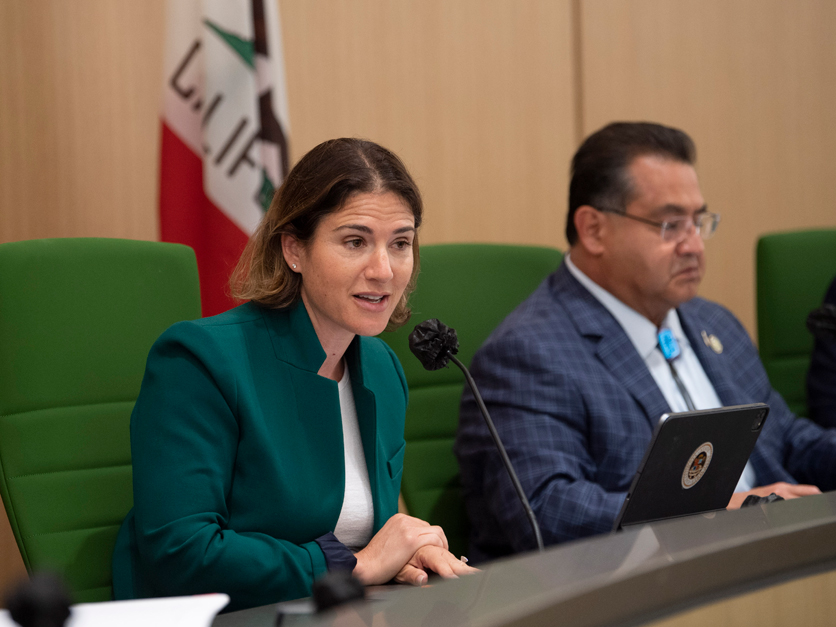 Asm. Rebecca Bauer-Kahan (office photo)
Putting hard limits on the table
Assembly Bill 2447, dubbed the Nitrogen Pollution Reduction Act, would mark a significant shift in California water policy, moving from management-based oversight toward enforceable caps tied directly to drinking water standards.
The bill would require the State Water Resources Control Board and regional boards to update agricultural discharge rules and ensure that by 2030 farms do not cause or contribute to nitrate contamination above safe drinking water levels.
Bauer-Kahan made clear at a hearing last week that she sees the measure as a response to regulatory failure.
“The program is not working, and wells continue to test above safe drinking water thresholds,” she told the policy committee. “Upwards of 600,000 predominantly low-income families currently lack access to safe drinking water.”
The Orinda Democrat leaned heavily on the public health case, pointing to serious illnesses connected to nitrate exposure.
“Nitrate-contaminated drinking water has been linked to ‘blue baby syndrome,’ higher rates of leukemia, lymphoma and childhood brain cancer,” she said.
Seeking to ease the opposition, Bauer-Kahan sought to draw a line between reducing pollution and restricting agriculture itself.
“It's important to be clear that AB 2447 doesn't seek to prevent the use of these fertilizers, which are an important part of the growing process,” she said. “It's merely about figuring out how much is appropriate.”
That reassurance did little to quiet concerns from agricultural representatives, who view the bill as a major escalation in regulatory pressure.
Advocates push urgency and defend caps
Backing the bill are environmental and public health groups that have spent years pressing regulators to move faster on nitrate contamination.
Arohi Sharma, a senior policy analyst at the Natural Resources Defense Council, framed the issue as a decades-long failure to act.
“Nitrogen pollution has been quietly poisoning air and water across California since the 1960s,” Sharma told lawmakers. “AB 2447 adds accountability to California's existing nitrogen management program by setting clear goals, adding deadlines and requiring regulators to set limits. Incentives, technical assistance and data reporting — they're all valuable parts of the existing program, but alone these efforts don't protect clean water.”
Pushing back on feasibility concerns, she claimed that “many farmers in the Central Coast and in the Central Valley are already meeting limits that are protective of drinking water quality” and held up European Union and New Zealand mandates as models of how “numeric limits drive behavior change and results.”
Akash Singh, a policy advocate at the Union of Concerned Scientists, reinforced the urgency, tying nitrate contamination to broader economic strain.
“The status quo of nitrogen pollution in California is unacceptable,” said Singh. “Every year of delay adds decades to cleanup timelines, at enormous financial and fiscal cost to California families and farmers.”
Interested in more news on farm programs, trade and rural issues? Sign up for a four-week free trial to Agri-Pulse. You’ll receive our content - absolutely free - during the trial period.
For advocates, the bill represents a long-awaited pivot away from incrementalism — and toward enforceable outcomes.
Costs, complexity and crop impacts
Rather than a necessary correction, farm groups view AB 2447 as a blunt instrument layered onto an already dense regulatory system.
Tess Dunham, a water attorney with Kahn, Soares & Conway, anchored the arguments of the opposition coalition in the existing framework.
“The [Irrigated Lands Regulatory Program] is a comprehensive, iterative program directed by the state water board and implemented through discharge permits issued by the nine regional water boards,” she explained to the lawmakers.
Dunham emphasized that permits under the program have “numerous discharge requirements and reporting obligations” for farming operations, ensuring that ground and surface waters are protected from all pollutants, including nitrates associated with nitrogen-based fertilizers.
Republican Asm. Stan Ellis, who is a farmer based in Bakersfield, stressed that the concern is not just duplication but escalation.
“If it wasn't for nitrogen, we might be lucky to get a quarter of the crop,” said Ellis. “When my crop agronomist says you need to add X amount of nitrogen, guess what? We don't produce — that's a huge economical affordability issue.”
 Tess Dunham (KSC photo)
Ag experts point in a different direction
While lawmakers debate AB 2447, regulators are weighing a different approach — one that agricultural stakeholders see as more workable.
At a recent state water board workshop, the conversation focused on recommendations from the Second Statewide Agricultural Expert Panel, which is advising regulators on how to update nitrogen rules. The panel’s draft report suggests a framework built around regional targets, phased implementation and nitrogen mass balance accounting, rather than immediate enforceable caps.
Agricultural representatives made clear they want regulators to stick with that approach.
Abby Taylor-Silva, who directs regulatory affairs at Kahn, Soares & Conway, pointed to ongoing efforts across the industry to improve nitrogen use efficiency through better irrigation management, soil monitoring and precision fertilizer applications. She called for the panel to clarify that it is not condoning the regional water board’s push for a 50 pounds-per-acre annual limit under Ag Order 4.0.
Kari Fisher, general counsel at the California Farm Bureau, supported that panel’s acknowledgement of the diversity of California agriculture and the need for flexibility.
“A one-size-fits-all program does not work in the state of California due to the variety of crops grown in the state, the different nitrogen needs for certain crops, and the areas that do not use groundwater,” said Fisher, adding that the farm bureau also supports discounts and credits for farmers adopting practices and technologies to reduce fertilizer inputs.
Both Taylor-Silva and Fisher framed nitrogen management as an evolving process — one that depends on local conditions, not uniform statewide limits.
At the forum, Dunham leaned on her decades of experience in groundwater policy, particularly with the CV-SALTs program tackling key contaminants like salt and nitrates.
“The limited focus on should there be targets or limits, is a little bit disconnected from the reality that we are dealing with,” she said. “Water quality in our groundwater aquifers is not going to recover at a snap of a finger. … That groundwater would still take decades to recover.”
Water district representatives pushed a similar message.
Bruce Houdesheldt, who directs regulatory affairs at the Northern California Water Association, underscored that agriculture and water districts have been working hard to understand the impacts and find solutions.
“We're all in this together,” said Houdesheldt. “The worst thing that could happen is that you lose the agricultural community as a financial partner, as an educational partner.”

