

|
Corteva Inc. this year is marking a century of its flagship Pioneer seed brand as both the company and U.S. agriculture are at a crossroads.
About 1,500 local employees, retirees and industry leaders, along with thousands of others joining virtually worldwide, gathered in April to commemorate Pioneer’s 100th anniversary in Johnston, Iowa, the former ag settlement where seed innovator Henry Wallace founded what would eventually become Pioneer. Attendees were greeted by workers dressed up as gold and white paper seed bags, a 62-year-old design breakthrough that moved the company away from cloth bags and introduced Pioneer’s iconic green trapezoid, shaped like a flower, symbolizing the brand’s “vigor and unending growth.”
Johnston, today a bustling suburb of Des Moines, later this year will become headquarters of Vylor, the name of one of the new companies to be formed when Corteva splits its seed and genetics business from its crop protection operations based in Indianapolis.
“Today, we close a chapter,” Corteva CEO Chuck Magro said at the April 20 event. “Tomorrow, we start again, but I believe that the future is even brighter than where we've been.” Magro will lead Vylor, which will include the seeds and genetics business.
‘Ribbon that started it all’
Wallace – who served as U.S. vice president and head of the Agriculture and Commerce departments under President Franklin D. Roosevelt – is credited with commercializing hybrid corn, a game-changer that allowed farmers to achieve much higher yields. In return for bigger harvests, producers had to start buying new seeds each season.
In the late 1920s, Wallace, along with college student Raymond Baker, entered a corn yield contest in Iowa, leading to a first prize gold ribbon, Corteva’s Dean Podlich, a digital seed lead, and David Bowen, a research data lead, told Agri-Pulse. Baker went on to quit school, join the company and lead research for 40 years.
“That ribbon started it all,” Podlich said while touring Pioneer’s trove of historic awards, photos, signage and other memorabilia. The so-called "Baker inbred" genetics can be traced through to the world’s record corn yield of 623 bushels, set by Virginia farmer David Hula in 2023, he added.
The world had been stuck at corn yields of roughly 25 bushels an acre as of the mid-1920s. That shot up to around 60 bushels in the 1960s and last year, the average U.S. corn yield was an all-time record of 186.5 bushels an acre.
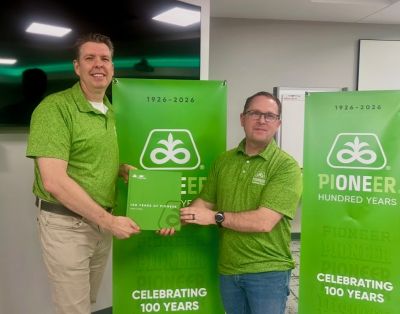 Dean Podlich, Digital Seed Lead, and David Bowen, Research Data Lead (Agri-Pulse photo)
“We started with corn, but then we get into sorghum, in alfalfa, then wheat, and soybean, and the principles that help build a lot of that genetic improvement in corn were then adapted to these other crops and then other regions,” Podlich said. “Every country around the world has their own equivalent story of how this technology has increased yield.”
The seed technology also opened the door for raising crops with significantly greater ability to withstand the elements. Pioneer soon cemented its place in ag history with the success of a drought-tolerant hybrid seed, Pioneer Hi-Bred 307, during the North American ecological Dust Bowl disaster of the 1930s.
‘A thousand bushels per acre’
Fast forward to Pioneer’s centennial celebration last month, where executives voiced their expectations for 21st Century seed breakthroughs.
“With new technology, like the gene editing and AI that we're just now starting to apply to this system, we're going to be talking about 300-bushel national averages,” said Sam Eathington, Corteva’s executive vice president, chief technology and digital officer. “We're going to be looking at corn record yields approaching a thousand bushels per acre. Imagine that.”
It’s easy to be “in the know” about what’s happening in Washington, D.C. Sign up for a FREE month of Agri-Pulse news! Simply click here
The prediction comes not only amid major corporate change for Corteva, but during a pivotal moment for U.S. agriculture.
Increased global competition in fast-growing farming regions like South America is intensifying pressure on the U.S. for new innovations as growers of corn, soybeans, wheat and other crops grapple with a raft of economic headwinds, both globally and domestically.
The average U.S. farmer is also growing older, and it’s increasingly difficult to attract young people to the profession, especially with members of Congress busy trying to get more federal financial aid to producers in what’s expected to be another tough year in key ag markets.
As far as short-term ag economy issues, Magro last week acknowledged the challenges, but also said producers have weathered high production prices before.
Seed outlook
Corteva’s seed business is either first or second biggest in all its key corn and soybean markets, with growth potential from global licensing, Magro said. The biggest opportunity is expanding soybean seed operations in South America, where Brazil is the world’s biggest producer, he said.
“We'd like to have about a third of the Brazilian soybean market by the end of the decade, so that's where a lot of our growth is going to come from,” Magro said.
The company’s overall licensing prospects recently brightened with a resolution of all lawsuits with rival Bayer. Corteva has said this will bolster efforts to generate $1 billion in net royalty income by 2035.
Corteva also plans to launch its hybrid wheat product in the U.S. next year.
“We hybridized corn about 100 years ago,” Magro said. “We've got some phenomenal technology that is another billion dollars of growth opportunity, probably not in the next decade, probably in the next 10 to 15 years, as we ramp that up and we take that technology around the world.”
Also in the pipeline is Corteva’s version of short-stature corn to compete with Bayer’s product. Reduced plant height is aimed at boosting yields and making the plant more resilient to high winds, and easier for farmers to do field work while crops are still growing.
The shorter corn is expected to be on the market in 2028, with both natural and gene-edited versions. Corteva also plans to bring gene-edited corn to market in 2028 that will have “significant disease resistance built into the genome,” Magro said.
The technology is so new that it’s not even clear yet how to ultimately price for it. “What happens if we can eliminate complete fungicide application sprays? That’s worth incrementally more,” Magro said. “We’re not sure how to price for that yet.”
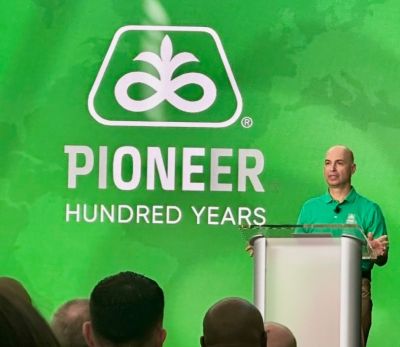 Chuck Magro (Agri-Pulse photo)
Another possibility with gene editing is driving up profit per acre by getting more oil content from crops used to make biofuels.
“We can have multiple sources of revenues for farmers,” Magro said. “Yes, we'll get paid for that, but it diversifies their business, and it allows them to make more profit per acre with the modification of the genetics. I think that that is huge, and it's not only a win for us and a win for farmers, I think it takes global food security to the next level.”
The potential gains for the agriculture industry from gene editing are a natural next major step after the massive output advancement that came from hybrid corn a century ago, Judd O’Connor, executive vice president of Corteva’s seed business unit, told Agri-Pulse.
“We think about the potential of what gene editing can do in terms of bringing more yield, more disease resistance, maybe more drought tolerance, maybe more nitrogen efficiency,” O’Connor said. “There's a lot of things in that space.”
Artificial intelligence is also a key part of how to feed more people on fewer acres.
“It's all about data and how you combine that data really quickly and get to the answer quicker,” he said.
O’Connor compares the shift to how people previously looked at corn prior to hybrids, when part of a nice-looking plant was kept for the following year, keeping farmers in the dark at how much more they could be harvesting.
The ag world then moved to the mindset: “We've got to use data, and we've got to leverage data,” he said. “It was all about how can we produce more with less, even back when we were first making hybrids.”
.webp?t=1762183428)
