
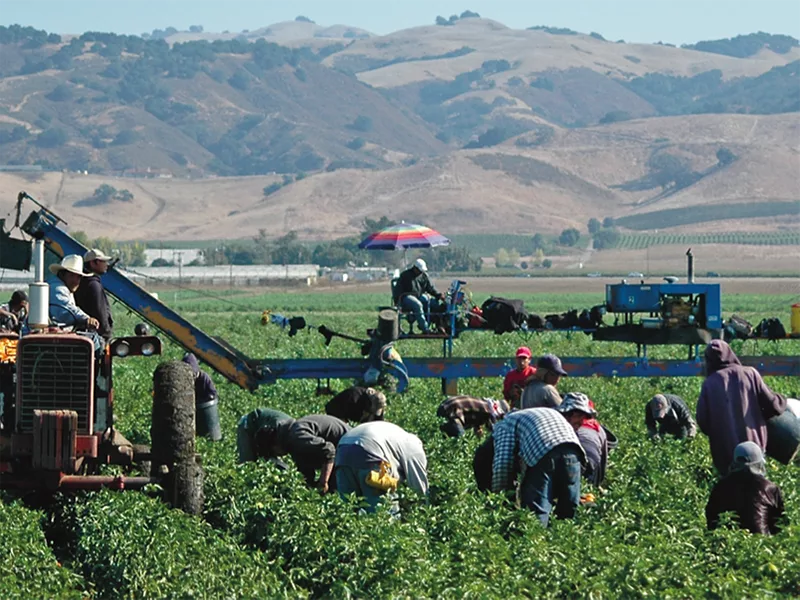
House Agriculture Chairman Glenn “GT” Thompson, R-Pa., is calling to broaden a U.S. temporary agricultural worker program under an early draft of a proposed ag labor bill.
The measure defines “temporary” as work contracted for a term of fewer than 350 days, “without regard to the approved employer’s underlying need or nature of the job,” according to the text obtained by Agri-Pulse. That would make it easier for dairies and other businesses to get longer term help despite employing temporary employees.
The expansion of the so-called H-2A guest visa program has been a divisive issue as farm owners and agribusinesses face ongoing worker shortages that some say have worsened under President Donald Trump’s stringent immigration policies. Meanwhile, some Republicans oppose allowing workers from other countries into the U.S. for any kind of employment.
Thompson has said the forthcoming bill would be informed by suggestions made in a final 2024 report by the House Ag Committee’s Agricultural Labor Working Group.
The panel’s recommendations include clarifying that H-2A admissions are both seasonal or temporary and that a “temporary worker admission is based on a requested length of employment of less than one year without regard to separately evaluating a farmer's underlying need or the nature of the job.”
“That clarification will ensure that the labor needs of today’s agriculture industry, including producers, ranchers, livestock markets, indoor agriculture, and forestry, are met,” the report said.
Politico first reported on the draft text.
Ag groups press Senate to bolster USDA staffing
A coalition of 123 agriculture and conservation groups is urging Senate appropriators to address staffing shortages at USDA’s Natural Resources Conservation Service and Farm Service Agency.
“Reduced staffing levels and office consolidations have created significant barriers for producers attempting to access USDA services,” the groups write in a June 9 letter to Senate Agriculture Appropriations Subcommittee leaders John Hoeven, R-N.D., and Jeanne Shaheen, D-N.H.
Cut through the clutter! We deliver the news you need to stay informed about farm, food and rural issues. Sign up for a FREE month of Agri-Pulse here.
They’re calling for adequate FY27 funding to prevent further office closures. The groups are also urging senators to adopt House-passed language that would block the permanent relocation of county-based employees if it would leave an office with two or fewer staff.
Signatories span major farm and conservation organizations — including the American Farm Bureau Federation, National Farmers Union, International Fresh Produce Association, The Nature Conservancy, Environmental Defense Fund, National Cattlemen’s Beef Association, National Corn Growers Association, American Soybean Association and National Milk Producers Federation.
The letter cites USDA data showing more than 20,000 employees left the department between January and June 2025, including 22% of NRCS staff, 24% of FSA employees and 7% of FSA county office personnel.
“For many American agriculture operations, timely access to USDA staff and resources can directly impact whether an operation remains financially viable during periods of economic stress or weather-related losses,” the groups say.
Reorg plans for USDA research agencies draw criticism
Fifty-one ag research and commodity groups are expressing concerns about USDA’s plans to reorganize its research agencies.
In a letter to the chairs of the House and Senate Ag Committees, the groups warned that the permanent closure or significant downsizing of ARS labs “would represent an irreversible loss, not just of physical infrastructure, but of ongoing research programs whose value compounds over time.”
They point out that during a previous 2019 relocation effort, between 40 and 60 percent of staff at the Economic Research Service and the National Institute of Food and Agriculture chose to depart rather than relocate.
The groups also are worried about staffing losses that occurred last year, noting that many vacated positions “have not been refilled.”
They say there have been delays in the distribution of federal research funding, “disrupting ongoing research projects, forcing reductions in university research workforces, and causing researchers to lose critical momentum on multi-year projects that directly support farmer productivity and rural economies.”
The groups include the National Association of Wheat Growers, National Farmers Union, National Potato Council, and the Soil Science Society of America, among others.
Mexico halts imports of several types of U.S. livestock
Mexico is temporarily suspending imports of live animals from the U.S. amid recent detections of New World screwworm in Texas, according to Mexico’s Agriculture Ministry.
The restrictions include U.S. cattle, horse, swine, and sheep and goat exports, according to a notice on the Animal and Plant Health Inspection Service’s website.
Take note: APHIS on Tuesday announced a new detection in a calf in La Salle County, bringing total NWS cases to six.
GAO report: Probationary workers left USDA at higher rate than overall workforce in 2025
Probationary employees at the Agriculture Department separated at a rate of nearly 42% in 2025, compared with a 30% separation rate for the department's overall workforce, according to a new Government Accountability Office analysis.
USDA saw around 6,380 probationary employee separations in 2025, according to a report released by GAO on Tuesday. Overall, USDA saw a total of 24,597 separations for all types of employees, including probationary employees.
Take note: Separations count the number of employees who have left an agency, including terminations, resignations, retirements and transfers to other agencies, according to the report.
Lawsuit seeks ESA decision for Western ridged mussels
The Center for Biological Diversity is suing the Fish and Wildlife Service for failing to meet its statutory deadline to decide whether to protect western ridged mussels under the Endangered Species Act.
Western ridged mussels were once found in freshwater spanning northward from San Diego County, California, to Canada, but have lost 43% of their historical distribution, the lawsuit says. The Xerces Society, a nonprofit, submitted a petition seeking ESA protections for the mussel in 2020.
FWS issued a 90-day finding in 2021 concluding that protection “may be warranted” for the mussel, but did not issue a required 12-month finding, which could result in a proposed listing, according to the lawsuit.
Final word
“Conservation programs such as EQIP and CSP continue to experience demand that far exceeds available funding, while programs like CRP help preserve environmentally sensitive land and provide economic stability for producers. Reduced staffing capacity threatens USDA’s ability to effectively deliver these programs and support producer participation.” – Letter from 123 groups to Senate Agriculture Appropriations Chair John Hoeven, R-N.D., and Ranking Member Jeanne Shaheen, D-N.H.
.webp?t=1762183428)

