
Without new biofuel markets, America’s biggest crop could be in big trouble.
A sweeping study from S&P Global Energy says if key demand-boosting opportunities aren’t seized, corn farmers will grow 31% fewer acres by 2050, a land mass size equal to North Carolina.
The world is producing more crops on less land, yet corresponding demand is weakening amid slower population growth and declining ethanol demand due to the rise of electric vehicles, more fuel-efficient cars and changing driving patterns, according to the report commissioned by the U.S. Farmers and Ranchers in Action (USFRA), a nonprofit that advocates for agricultural producers.
The dire corn scenario assumes no new sources of livestock feed demand and that the standard U.S. ethanol-gasoline mix at fuel pumps remains at about 10%. With no changes, like greater consumption of higher ethanol blends of at least 15% (E15), and development of liquid biofuel markets for the hard-to-electrify marine and aviation industries, on-road ethanol demand could plummet almost 50% to 6.6 billion gallons by mid-century, the study says.
"For too long, important decisions have been built on the assumption that demand for food [and] fuel will naturally keep pace with rising yields, and for too long, agriculture has been treated as a zero-sum game, one where food, fuel, and other bio-based products compete against one another for limited resources," USFRA Chief Executive Officer Kevin Burkum said. "That is not what this data shows. As S&P Global Energy makes clear, sustaining investment in American agriculture will require more demand."
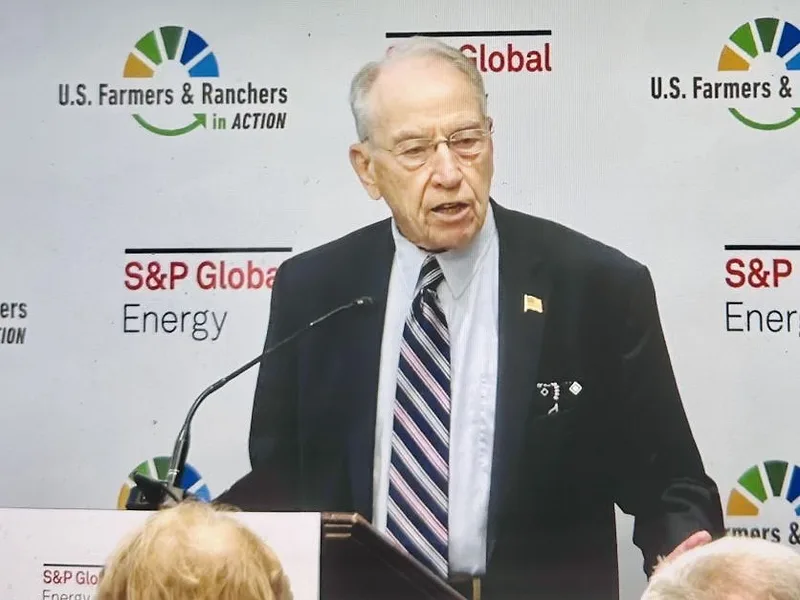
Sen. Chuck Grassley, R-Iowa, who hosted a Capitol Hill briefing on the report Tuesday, said the study's findings underscore the urgent need for Congress to pass legislation to allow year-round, voluntary E15 sales nationwide.
“Biofuels are good for the rural economy, good for national security, good for the environment, and good for American pocketbooks,” Grassley said. “In other words, good, good, good.”
President Donald Trump has repeatedly called on congressional leaders to send him an E15 bill to sign into law. Trump legalized year-round E15 in his first term, though a court later overturned it and said only Congress could make the change. The federal ban on year-round E15 stems from concerns about smog creation that are widely considered outdated now.
Cut through the clutter! We deliver the news you need to stay informed about farm, food and rural issues. Sign up for a FREE month of Agri-Pulse here.
Grassley, whose state of Iowa is the country’s biggest producer of ethanol, corn and soybean-heavy biodiesel, had sharp words for oil refiners opposed to a House-passed E15 bill due to language that would shrink the pool of companies eligible for exemptions from federal biofuel blending rules. The American Petroleum Institute backs the measure while groups representing smaller refiners are against it.
“I see an opportunity here to move it,” Grassley said, referring to an E15 bill. “But so do small refineries [looking] to get their fingers in the cookie jar to get some of the benefit."
More than a third of the yearly harvest of corn, the biggest U.S. crop, goes into making ethanol, which acts as an octane booster and oxygenate for gasoline. Biofuel supporters also tout the corn-based fuel’s ability to lower costs at the gas pump, reduce emissions from tailpipes and bolster American energy security via home-grown crops.
Burkum said the S&P study is groundbreaking because it makes clear that sustaining investment in U.S. agriculture will require higher demand.
“If we allow farmers to expand into new markets for biofuels, we can transform American agriculture, revitalize rural incomes and provide global food and energy security,” he said.
The study finds that farmers could support a threefold expansion in biofuels production by 2050 and that renewable fuels could capture more of the nearly 940-billion-gallon global liquid fuels market, including aviation and marine fuels.
U.S. corn yields could grow about 1.5% annually through 2050, enabling nearly 50% more production without expanding acreage. Production of U.S. soybeans, widely used to make biomass-based diesel that powers trucks and other heavy transportation, could increase by 45%, or 1.4 billion bushels, according to Burkum.
“Put simply, biofuels are a game changer. We need to unlock the potential of agriculture,” he said.
For more news, go to www.Agri-Pulse.com.
.webp?t=1762183428)
