
|
Soaring farm costs that are expected to climb even higher next year are putting a spotlight on the versatility of America’s second-biggest crop — the soybean.
The oilseed — used in everything from salad dressing and jet fuel to hog feed and firefighting foams — has a long history of inspiring new markets, like the commercialization of biodiesel in the 1990s.
Growers of soybeans have been hit with a double blow over the last 12 months as trade wars further dented demand from China, pushing down prices as the cost of farm inputs spiked. USDA last week forecast that production costs for key row crops will reach the highest ever. That includes $701 an acre for soybeans, on top of an expected record high this year of $683 an acre.
“We're seeing a lot of challenges out here in farm country, the pressures are real. Farmers are feeling the squeeze financially, mentally and physically,” Kyle Durham, who farms soybeans and corn outside of Kansas City, Missouri, told Agri-Pulse.
The economic challenges are prompting groups like the United Soybean Board to step in with new tools to offer support and suggestions on ways to “squeeze more dollars out in the near term,” said Durham, a USB director. “Top of mind are high oleic soybeans.”
The high oleic trait initially started to be developed about a decade ago to help U.S. soy oil better compete against rival oils like palm and canola, according to Michigan State University. The difference between high oleic and standard commodity soybeans is that the former has a greater amount of a kind of monosaturated fat, or oleic, that's considered healthier and more stable.
The U.S. last year farmed almost 1 million acres of high oleic soybeans in 16 states, with the heaviest concentrations in Indiana, Ohio and the Mid-Atlantic region. USB projects as much as a seven-fold expansion in high oleic acres within a decade, expanding to between 5 million and 7 million acres.
The high oleic program is among resources listed on USB's online Soy Farmer Support Hub, which launched last month to offer producers help with agronomy issues, profitability and revenue, and mental health needs.
Cut through the clutter! We deliver the news you need to stay informed about farm, food and rural issues. Sign up for a FREE month of Agri-Pulse here.
“On our farm, we're looking in these tight margins and asking: 'How do we diversify? How do we bring additional value to that acre?'" Indiana farmer Don Wyss told Agri-Pulse. "One of those ways in our area in Northeast Indiana is high oleic soybeans, and getting paid a premium.”
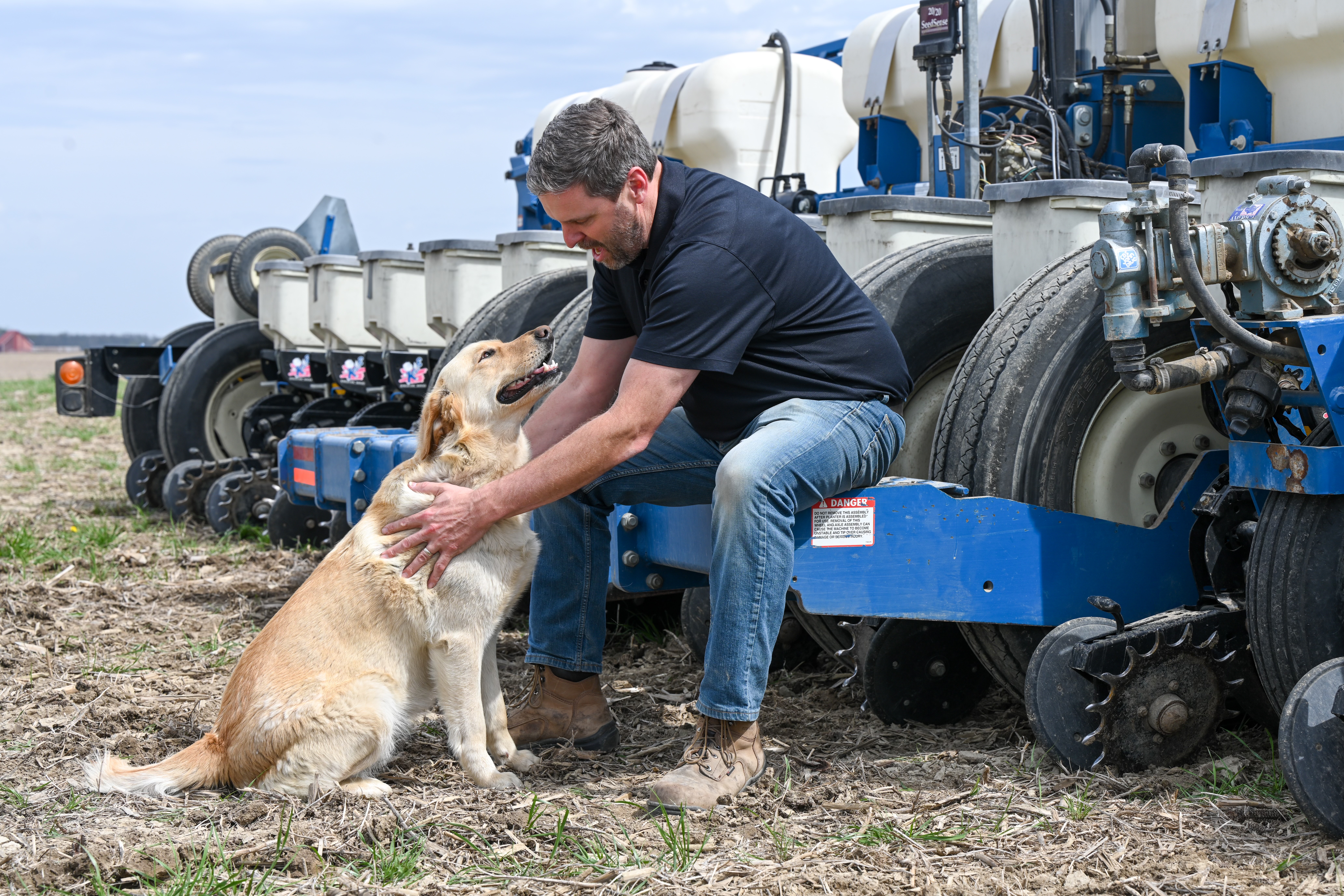 Don Wyss on his Indiana farm. (USB photo)
Higher-value oil
High oleic soy’s origin story stems from the early 2010s, with the food service industry seeking a cooking oil with a healthier fatty acid profile. Benefits of high oleic in the food industry versus commodity soy includes having up to three times the frying life and up to three times the shelf life in packaged foods, a 2024 study shows.
More recently, whole or roasted high oleic soybeans are sought after by dairy farmers. Ongoing research, including from USB and MSU, finds that high oleic soybeans, especially when roasted, increases the milk fat in dairy cattle.
“After years of data collection and analysis, not only did results support the theory that high oleic soybeans can increase milk production when fed to cows, but they also showed promise that dairy producers could decrease their feeding cost when planting the soybeans themselves — so much so that Michigan seed suppliers ran out of the soybean seed last year due to demand,” MSU professor Adam Lock said in an online post last September.
High oleic has industrial uses, including in asphalt, bioplastics and as a lubricant in electric transformers. There also are studies underway on the potential benefits high oleic soy could have in pig diets, according to Durham.
The growing uses of high oleic doesn’t mean demand for the oil in the food industry is going away, Wyss said.
“Nestlé and the Frito-Lay and other end-user companies are still interested in this as a food application and an oil application in their processes,” said Wyss, who farms near a Nestlé coffee creamer plant that uses high oleic soy oil, and a Bunge facility that handles high oleic soybeans. “But at the same time, we’re seeing the additional benefits.”
In March, Beck’s, the largest family-owned seed company, bought the exclusive licensing rights to the Soyleic soybean patents from the Missouri Soybean Merchandising Council, citing growing demand. The soybeans are the product of decades of research at USDA and the University of Missouri.
The purchase adds Beck’s to USB’s high oleic partnerships with major seed companies Corteva and Bayer.
$400 million 'home run'
Growing high oleic soy is a slight additional cost compared to growing standard beans, “but that’s why we are getting that premium,” said Wyss, who began growing high oleic in 2015 with about 100 acres. This year he's raising between 400-500 acres, he said.
Growers typically see between 75 cents and $1.25 a bushel more for high oleic than conventional varieties, at prices locked in by contracts before planting, according to USB, the farmer-led group that manages the U.S. soybean checkoff program.
The over $130 million USB has invested in working to develop high oleic traits has led to more than $400 million in premiums to soybean farmers, said USB board member and Indiana farmer Matthew Chapman, who over four seasons has gone from 20% of his soy crop being high oleic to 100%, with a purchaser just about 50 miles away.
“The project’s really been a home run for the whole soybean industry,” Chapman said in an Agri-Pulse webinar last month. “Our customers are excited about the product, they want more of it, they demand more of it than we can produce, so that puts us in a great spot to be here in East Central Indiana.”
Durham doesn’t currently grow high oleic soy on his farm in Missouri, citing a lack of major buyers in the area. He expects that to change as demand from dairies grows.
“You're putting yourself out there to say that you're going from a million acres to close to 7 million acres. That's pretty adventurous, and the rise in dairy is going to drive that a lot, so we expect to see high oleic programs springing up," he said.
Demand from dairies in areas like Florida or the southwest, without ample soybeans nearby, also is seen as a growth driver, according to Durham.
"There's going to be opportunity for farmers in the Midwest to ship those beans out."
-Corrects spelling of Don Wyss throughout.
.webp?t=1762183428)
