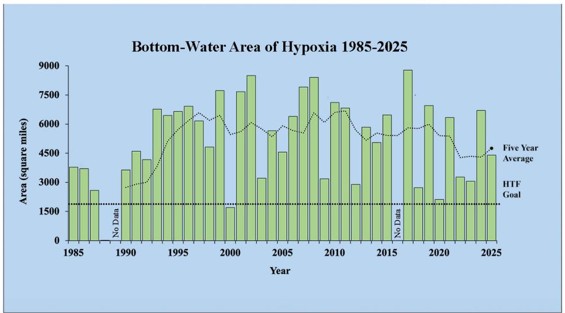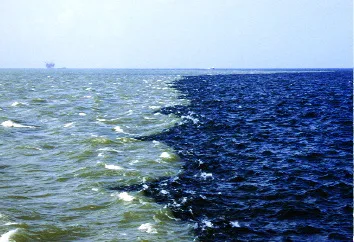
Progress is being made toward voluntary goals to reduce nitrogen loads into the Mississippi River and Gulf of Mexico, but the “dead zone” in the Gulf is projected to be larger than average this year.
Nutrients like nitrogen and phosphorus are often introduced to the river – and then the gulf – through fertilizer runoff and production, municipal waste and natural factors.
To control for streamflow levels, EPA and USGS evaluate nitrogen and phosphorus using a “flow-normalized” method to control for varied streamflows and other changes to the watershed. Provisional flow-normalized nitrogen loads have been steadily decreasing since 2016, although 2025’s nitrogen loads are the highest they have been since 2020. “Higher flows generally deliver more nutrients; lower flows deliver fewer,” said Gretchen Oelsner, a USGS hydrologist and the Department of the Interior representative to the Coordinating Committee of the Hypoxia Task Force.
EPA’s target baseline average was set in the 1980s and '90s, and 2025’s flow-normalized provisional nitrogen loads are 28% below that baseline, it announced on June 11. The ultimate goal of the EPA’s Hypoxia Task Force is to reduce the dead zone to less than 1,900 square miles across a 5-year average by 2035. 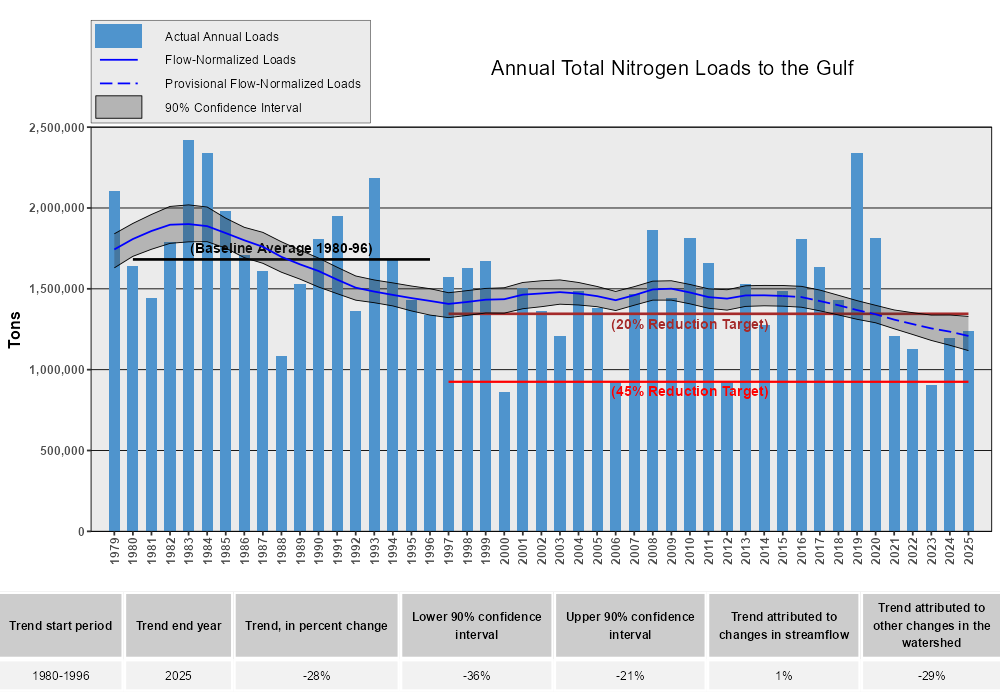 (USGS)
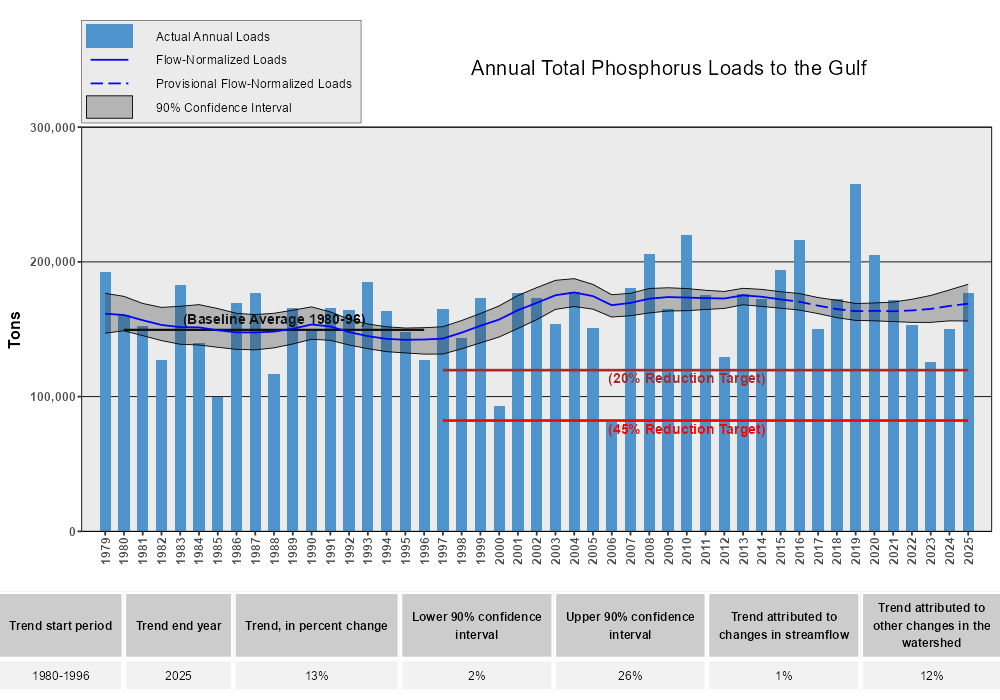
Yet, EPA said phosphorus loads are above the baseline by 13%. The flow-normalized phosphorus loads have even been slightly increasing since 2021, although there has been a 46% – or almost 8 million pounds per year – reduction in “point source” phosphorus loading, according to Trevor Sample, the agency coordinator for nutrient loss reduction strategy for Illinois EPA and member of the Hypoxia Task Force. Point sources refer to identifiable sources for pollution; non-point sources are runoff and erosion. The high phosphorus loading, Sample says, are from non-point sources.
 (USGS)
Even reductions in nitrogen loads do not always equate to a smaller “dead zone.” A dead zone occurs when nutrients that promote plant growth cause algae blooms, and when the algae die, they are consumed by aerobic bacteria. This process severely reduces the amount of oxygen present in the water. Low oxygen can make it difficult for marine life to survive. The dead zone’s size can also be affected by the flow levels of the Mississippi River and weather conditions like hurricanes.
The dead zone is scheduled to be measured again this summer, but the National Oceanic and Atmospheric Administration on June 16 forecast the dead zone to be larger than average this year. NOAA is predicting it to be 7,027 square miles, or slightly smaller than New Jersey. Last year, the dead zone was 4,402 square miles, the 15th smallest in 39 years of record.
“I'm concerned that in fact we're seeing an upward trend, as much as they're touting being below the goals of the task force,” Raleigh Hoke, campaign director for the environmental group Healthy Gulf, said. “And when you look at the dead zone that's caused by nitrous phosphorus pollution from the Mississippi River primarily, the 2025 dead zone was … twice the size of the task force goals.”
Different types of algae can contribute to the depletion of oxygen in the Gulf of Mexico, so when nitrogen is down and phosphorus is up, phosphorus-focused algae can thrive, according to Matt Rota, senior policy director for Healthy Gulf. It is “doing the same thing, just … with a different nutrient,” he said.
Healthy Gulf released a report in May covering the pollution from fertilizer production and runoff. It found that over 3 million pounds of production waste containing nitrogen and phosphorus were released into the Mississippi River in 2024. “The 2024 discharge of fertilizer production waste from the three existing nitrogen/ammonia facilities is equivalent to the fertilizer pollution that flows off 134,212 acres of agricultural land in the Midwest (approximately the landmass of Chicago),” the report said. If the fertilizer plants had discharged their legal limit, it would be equivalent to the runoff from 300,000 acres.
Ultimately, the report says, nitrogen and phosphorus loads from runoff are more substantial than fertilizer production, but fertilizer production’s concentrated discharge is “considerable.”
Fertilizer pollution discharged from production plants are nutrients that could be used for making more product, if the facilities were retrofitted with newer and more efficient technologies, according to Rota. Many of these regulations were set in the 1980s, and Healthy Gulf calls for a tighter standard. “A lot of times people think of regulations as a way just to crack down on industries or on corporations, but really, what we see is that regulations and more stringent regulations spur on innovation,” he said.
Tom Lynch, senior vice president for government affairs at The Fertilizer Institute, told Agri-Pulse that a "combination of the delay and the uncertainty" makes it difficult to get permits for upgrading fertilizer plants; additionally, building a new nitrogen facility could cost up to $5 billion without a return on investment for five years. He did, however, point to some carbon capture and sequestration efforts in fertilizer production. The largest global ammonia producer, CF Industries, and the largest ammonia/nitrogen discharger into the river and gulf, did not respond to a request for comment.
Hoke said market forces like tariffs and the conflict in Iran can lessen fertilizer production and application. He also mentioned improving soil practices as a way of reducing runoff into the Mississippi River. EPA said in the press release that “state-led actions” are a way the loads were staying below the baseline. Sample said better nutrient use efficiency is contributing to the reduction, such as from corn hybrids.
It is unclear based on current data how much fluctuations in nitrogen-phosphorus loading from year to year result from changes in agricultural practices. However, tools like the Spatially Referenced Regression on Waters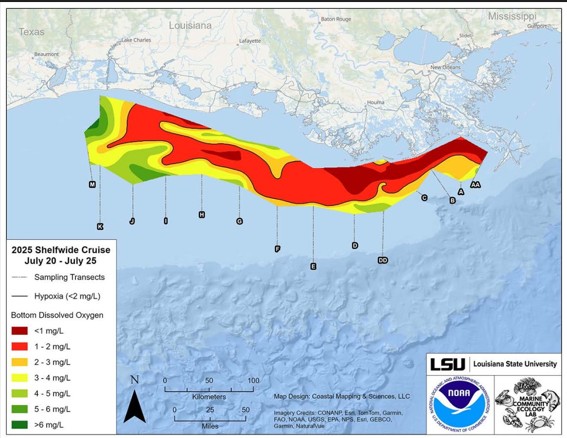 hed attributes (SPARROW) model – which uses 2012 as a base year – can help identify the role agriculture plays in nitrogen-phosphorus loading in different areas of the Mississippi‑Atchafalaya River Basin.
Sample said it is “tricky” to determine agriculture’s role, not only because of weather events, but even because there is natural mineralization in the soil or stream bank erosion can reveal "legacy phosphorus." "It's hard to parse out," he said, but computer watershed modeling and other water tests can get localized results.
Twelve states, mostly in the Midwest and Southern regions, have implemented voluntary actions, as the Hypoxia Task Force’s State Actions and Outcomes 2026 report details. Each state has different programs in place, but many are focused on water quality monitoring and identifying trends in nutrients.
Illinois created programs in 2021 and 2022 to help producers reduce nutrient losses; 940 outreach events were conducted, with over 110,000 participants. “Particularly, the agriculture sector requires a swifter and more extensive adoption of conservation practices to meet the established goals,” the report said.
Iowa signed into law "Farm to Faucet" legislation on June 1, and some of it will be used to expand the cost-share Streamside Buffer Pilot Project, Iowa's Secretary of Agriculture Mike Naig announced Tuesday. It is intended to filter nutrients before they reach waterways.
“The overall concern is that the Dead Zone Task Force ... basically doesn't have any hard deadlines or enforceable goals. It's all voluntary, and the timeline keeps moving on,” Hoke said.
With contribution from Noah Wicks.