
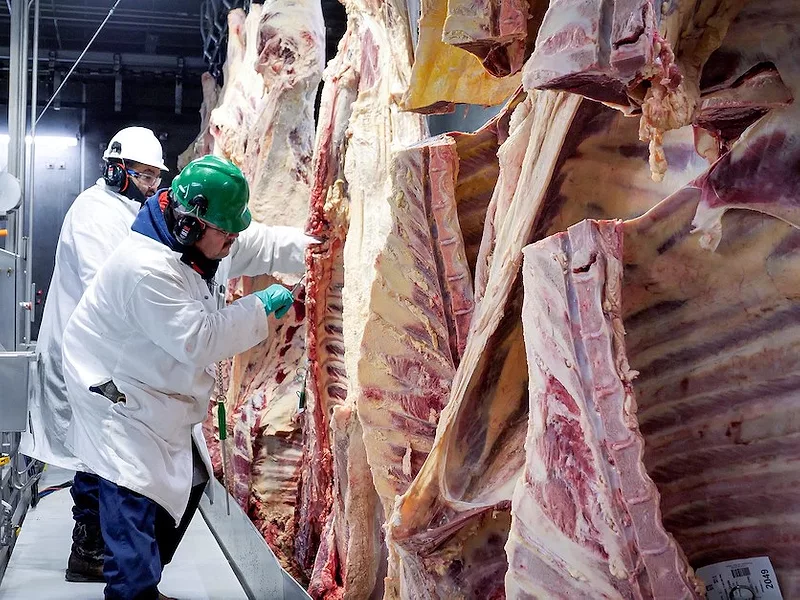
The Agriculture Department will offer small and mid-sized beef processors up to $500 million to help them weather a historic cattle shortage, Secretary Brooke Rollins announced Tuesday.
Using Commodity Credit Corporation funding, the Farm Service Agency plans to pay small and mid-sized beef processors for higher costs they face acquiring cattle due to low U.S. inventories and other market conditions through the Strengthening Processing for U.S. Ranchers (SPUR) program.
The program is designed to exclude the nation’s top four beef processors — JBS, Tyson, National Beef and Cargill. Instead it will only be available to U.S.-owned plants that are not “nationally dominant in beef processing,” according to a press release.
Additionally, funding will only be available to federally inspected plants or plants inspected under Talmadge-Aiken Cooperative Inspection or the Cooperative Interstate Shipment programs.
“Small and mid-size beef processors are essential to maintain the diversity of America’s food system,” USDA Undersecretary for Food Safety Mindy Brashears said in a release. “Supporting this processing capacity helps preserve market options for our United States ranchers, strengthens regional supply chains and ensures American families continue to have access to safe, high-quality beef produced here at home.”
U.S. producers saw cattle and calf inventories of only 86.15 million head in January, a low not seen since 1951, according to USDA’s most recent survey. Beef prices have climbed to record highs as the shrinking herd meets strong consumer demand.
David Anderson, an extension economist and professor at Texas A&M, told Agri-Pulse that tight cattle supplies are forcing packers to compete for a shrinking pool of animals.
“They’ve been losing a lot of money on the beef side, and that extends to everybody from the Big Four to small packers,” Anderson said. “I think that’s really kind of the backdrop here.”
Anderson said the top four beef processors handle about 85% of fed cattle slaughter, or steers and heifers going through a feedlot. He said smaller plants may be in "even more difficult straits" because their costs tend to run higher than those at larger operations.
He also noted that increased interest from cattle producers in local and direct-to-consumer marketing following the COVID-19 pandemic has led to a number of small plants that have come online in recent years just as cattle numbers have dropped to their lowest in decades.
Cut through the clutter! We deliver the news you need to stay informed about farm, food and rural issues. Sign up for a FREE month of Agri-Pulse here.
“In some ways, it’s bad timing, bad luck,” Anderson said. “But that’s the idea — can we help these smaller plants that have expanded or grown in just this decade … get through this and get to greater numbers and some more profits."
In a statement, Meat Institute CEO Julie Anna Potts said “beef packers from the very large to the very small, are losing millions of dollars a week due to the tight cattle supply while the industry struggles with the smallest U.S. cattle herd in 75 years.” She said packers of all sizes “are reducing shifts and some have been forced to close facilities.”
"We simply need more cattle,” she said.
However, she added that “the program USDA announced today will help some of the Meat Institute’s members, but it will not increase the cattle supply. Government policies intended to reduce the rising cost of beef for consumers should give cattle producers the certainty they need to retain heifers and grow the herd.”
Beef processing giant Tyson Foods in January closed a major beef slaughter plant in Lexington, Nebraska, and converted an Amarillo, Texas, beef facility to a single, full-capacity shift. A Tyson release said the changes are meant to “right-size its beef business and position it for long-term success.”
Earlier this month, JBS Foods, the world's largest meatpacker, announced it would be closing two of its own plants: a beef production facility in Souderton, Pa., and a value-added facility in Memphis, Tenn. A JBS press release said the closures were "part of a broader strategy focused on growth, modernization, and long-term competitiveness in the United States.”
Sam Gazdziak, the communications manager for the American Association of Meat Processors, said there are still a lot of unknowns with how the program will work, including how USDA will award funding and choose eligible recipients.
“Generally, we have a sense of optimism that it is a good thing that money is being put into the beef processing sector,” Gazdziak told Agri-Pulse in a phone call. “It’s a good thing that it is being noticed that there are opportunities to increase beef production. We just hope that the money will be put in the hands of the people who can do the most with it.”
Gazdziak said some AAMP members source their beef from larger packers rather than slaughtering cattle themselves, and those businesses have faced inventory shortages in the years following the COVID-19 pandemic. However, he said other AAMP members that do harvest their own animals aren’t necessarily seeing the same inventory struggles, noting that some instead have expressed concern about lack of capacity. He said these plants are “processing as much beef as they can, but either their facility might not allow for higher numbers or they might not have the manpower to process in higher numbers."
The agency plans to reach out to eligible entities with applications "using contact information that is currently on file with the USDA Food Safety and Inspection Service," according to the release.
For more news, go to Agri-Pulse.com.

