
|
California’s State Board of Food and Agriculture is stepping into the debate over the state’s sweeping packaging rules, as the industry warns the first deadline could arrive before growers and food companies have viable alternatives.
Senate Bill 54 could leave strawberry growers without usable clamshell packaging, impose millions of dollars in annual fees on processors, and create conflicting requirements across state lines, according to grower groups.
“I just think that stinks,” said board member Joy Sterling, decrying the initial six-month compliance deadline following the release of the new regulations in May.
The timeline concerns are gaining additional weight with CalRecycle’s SB 54 advisory board. Circular Action Alliance, the producer responsibility organization administering the law, says it is considering a three-year exemption from the first source-reduction target because the final regulations arrived in the middle of the data year used to measure compliance.
Agriculture presses for more time
SB 54 requires producers to reduce single-use plastic packaging by 10% from 2023 levels beginning in January. The reduction rises to 20% in 2030 and 25% in 2032. By then, all covered single-use packaging must be recyclable or compostable and 65% of single-use plastic packaging must be recycled.
 Bryce Lundberg, vice president of agriculture at Lundberg Family Farms (Brad Hooker/Agri-Pulse)
CalRecycle officials stressed to the board that the law includes exclusions, exemptions and enforcement discretion intended to provide flexibility. Food and agricultural packaging can qualify for an exclusion when compliance conflicts with federal food safety requirements and no alternative is available. Businesses facing other barriers can seek temporary “unique challenge” exemptions.
But agricultural representatives argued those pathways remain uncertain and may still leave producers paying fees while searching for packaging that does not yet exist.
Tricia Geringer, vice president of government affairs at the Agricultural Council of California, compared SB 54’s reach to the Sustainable Groundwater Management Act and the state’s cap-and-invest program because it touches nearly every part of the agricultural supply chain.
One processor expects annual producer responsibility fees of about $1.4 million, Geringer said. Another estimated fees of between $1.2 million and $2.7 million. Those projections do not include legal advice, additional employees, research or machinery needed to run new packaging.
The law’s $500 million annual environmental mitigation payment and the broader producer-funded recycling system are expected to cost about $21 billion over five years, according to CalRecycle’s analysis.
Geringer urged the state to dedicate some mitigation funding to packaging research and the transition to compliant materials. Food companies, she said, are already spending heavily to determine whether their packaging can be redesigned without compromising food safety or shelf life.
Board member Bryce Lundberg said his family’s rice company estimated that reporting and administrative work alone could cost between $100,000 and $250,000. Changing packaging lines could require millions more.
“This really feels like a shove,” Lundberg said, arguing producers are being pushed toward compliance rather than rewarded for improving packaging.
Gail Delihant of Western Growers said uncertainty over who qualifies as the responsible producer has left growers and shippers asking whether they should stop selling certain packaged products in California. Questions remain over plastic produce bags, tags, rubber bands and waxed cardboard boxes.
Delihant called for a fresh produce technical committee to advise CalRecycle and CAA. Produce packaging is not simply a marketing choice, she said. It protects food from contamination, bruising and spoilage while allowing companies to meet traceability requirements.
Board members embraced that proposal. They also want greater coordination with other states, warning that different definitions, recycling standards and fee structures could force California companies selling nationally to maintain several packaging systems.
Clamshell becomes the warning
California Strawberry Commission President Rick Tomlinson offered the clearest example of the potential disruption.
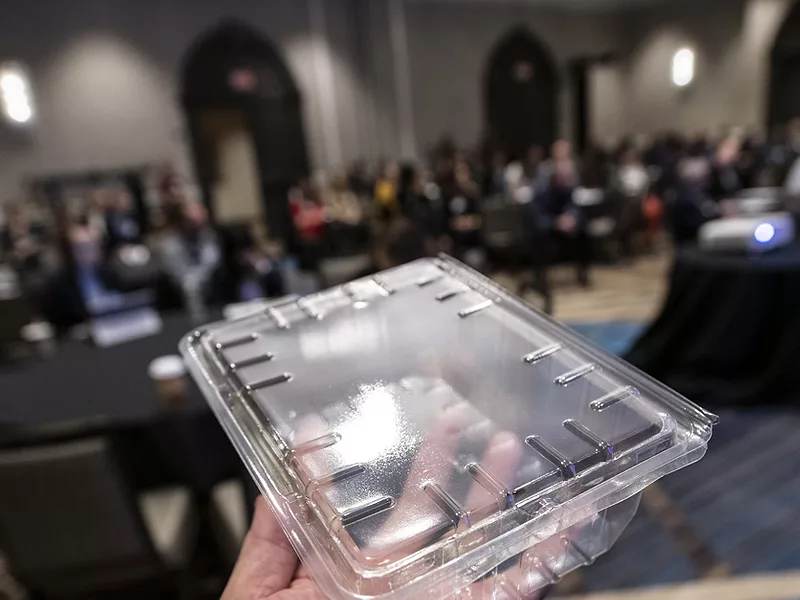
Strawberries are picked directly into clear PET clamshell packaging that remain sealed through cooling, shipping and retail display. The package limits handling and contamination while protecting highly perishable fruit.
The industry has incorporated recycled beverage bottles into the clamshells since 2000 and later switched labels to improve sorting. Because California consumers purchase only about 11% of the berries grown in the state, Tomlinson said the industry uses enough recycled PET in packaging shipped nationwide to offset more than all the clamshells entering California’s waste stream.
Before the final regulations, Tomlinson believed the package could satisfy the law’s 2032 requirements.
“The day the regulation was approved, the berry clamshell was scheduled to be banned from use in California,” he said, pointing to the first deadline on Jan. 1.
Tomlinson argued the regulations and CAA reporting system do not provide adequate credit for recycled plastic used in clamshells shipped outside California. Adding more recycled thermoformed PET is not necessarily an answer because higher percentages can make packaging brittle and unable to withstand transportation.
The Strawberry Commission has sought a food safety exclusion, contending that reusable packaging cannot be collected, sanitized and returned at the scale required for the industry. Cardboard clamshells are available but cost more and could carry a larger environmental footprint.
Tomlinson estimated supplying the California strawberry market with cardboard clamshells would consume the equivalent of roughly 10,000 acres of trees annually.
“Without that berry clamshell, we can’t harvest,” he said. “We can’t harvest, we’re done.”
The concern extends beyond strawberries. Agricultural packaging is often designed after years of testing for moisture, pests, contamination, temperature changes and transportation. Nursery operators also worry that reusable pots or take-back programs could spread pests and plant diseases.
The industry’s push for more time now overlaps with CAA’s emerging implementation strategy. The organization told CalRecycle’s advisory board it is considering two- or five-year phase-in exemptions for 41 packaging categories that are not expected to meet recycling targets on schedule. Another 15 categories, including PVC and polystyrene film, could be phased out because CAA does not see a viable compliance pathway.
CAA chief of staff Shane Buckingham said the exemptions would not allow producers to leave the program. They would continue reporting, paying fees and investing in recycling while receiving a longer runway to reach the targets.
 Gail Delihant (Western Growers photo)
Environmental groups have objected, arguing exemptions were intended for specific products rather than broad material categories. The advocacy organization Oceana and the Monterey Bay Aquarium warned that delaying the 2027 source-reduction target could weaken later requirements and asked CAA to explain the implications for 2030 and 2032.
Board seeks a middle ground
The State Board of Food and Agriculture did not call for abandoning SB 54.
Paul Towers, executive director of the Community Alliance with Family Farmers, reminded members that farms already bear costs from plastic pollution. Fragments can enter compost and accumulate in agricultural soil, threatening soil health and potentially jeopardizing organic certification.
“Everyone is paying for plastic pollution right now,” Towers said.
Most of CAFF’s small and midsized farms fall below the law’s $1 million revenue threshold and are exempt from most obligations, although they must still register. He argued the producer-funded program could expand rural recycling, support better packaging and reduce contamination in compost.
Members nevertheless questioned whether the current rules properly balance those benefits against the costs of packaging changes, higher food prices and potential crop losses.
They want CalRecycle to better quantify both sides: what the program will cost producers and consumers, and what California already spends cleaning up and managing plastic pollution.
The board further wants to stress that agriculture was not adequately considered in the final implementation timeline.
The debate is also playing out in two lawsuits attacking the program from opposite directions.
A coalition of 17 Republican-led states and the National Association of Wholesaler-Distributors is seeking to block SB 54 in federal court, arguing the law unconstitutionally burdens interstate commerce and delegates excessive authority to Circular Action Alliance.
In a separate state court challenge, the Natural Resources Defense Council, Californians Against Waste Foundation and Oceana contend CalRecycle weakened the law through regulatory loopholes involving chemical recycling and exclusions for packaging that conflicts with federal requirements.
The regulations remain in effect while both cases proceed.
For more news, explore Agri-Pulse.com.

