
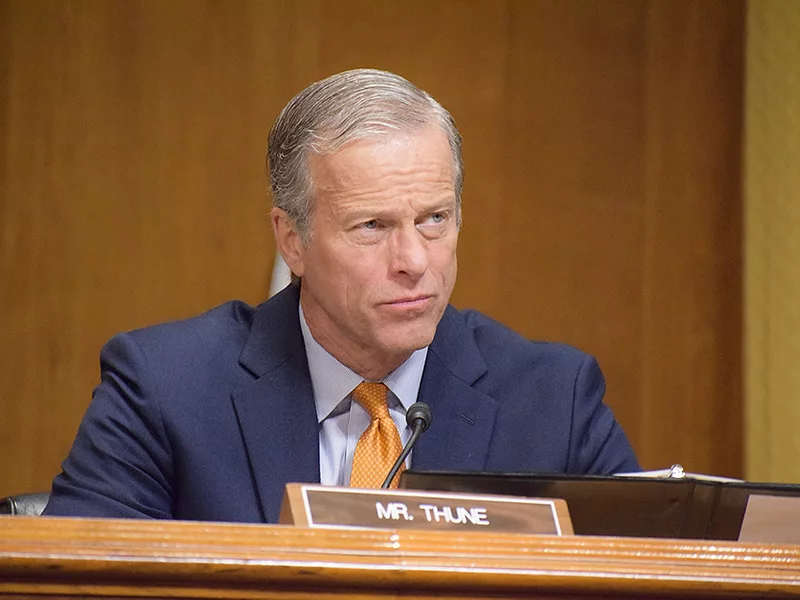
As U.S. House Speaker Mike Johnson tries to pass a $95 billion budget measure that includes money for the military and farmers, Senate Majority Leader John Thune says his chamber will hold off until Congress can work out funding the government beyond September.
“It’s a possibility that, if necessary, we could pull that budget resolution passed by the House and use it to fund government,” Thune, R-S.D., said on Tuesday. “I hope that’s not necessary. As I said, we’ve had conversations, productive conversations, on both sides of the aisle on a funding resolution that would carry us past the November election.”
Congress is facing an avalanche of competing priorities and overlapping legislative proposals, right before upcoming five-week late summer breaks to allow lawmakers time to campaign ahead of the high-stakes midterm elections.
The House on Tuesday passed what is being touted as a “clean and straightforward” continuing resolution bill that would fund the government through Dec. 4. Thune, though, said the Senate is busy working to craft its own CR.
Senate Appropriations Committee Chair Susan Collins, R-Maine, is consulting with Democrats “to find a path forward to have a continuing resolution to keep the government funded to get past the November elections, so that we don't have the specter of a government shutdown,” Thune said.
“It's going to be really important that we figure out a path forward to get a bipartisan agreement to fund the government that will keep government open and ensure that government employees are getting paid, and that is something that I intend to bring to the floor for a vote before the August break,” Thune said.
The Senate is set to go into a five-week recess starting the second week of August, while the House is scheduled to begin its late summer break beginning Friday.
Members of Congress are eager to avoid a repeat of last year, when partisan divisions over healthcare policy stalled stopgap funding attempts and triggered a six-week government shutdown, the longest in U.S. history.
Thune said it’s possible a Senate continuing resolution gets “punted into September.”
“That depends a little bit on cooperation right now,” he said.
Meanwhile, the House on Wednesday is poised to consider a $95 billion “reconciliation 3.0” measure, named for a parliamentary procedure that allows it to be fast-tracked through Congress, mainly by allowing for a simple Senate majority vote for passage as opposed to clearing a 60-vote threshold.
The prospect of combining a reconciliation bill with a stopgap government funding measure could set the stage for partisan feuding over provisions various lawmakers want to see in a final bill.
It also could provide a vehicle for provisions like year-round E15, which would allow year-round, voluntary sales of higher ethanol fuel blends, a top priority of grain farmers.
Whether the reconciliation measure has enough support to pass the House is in question, in part because it doesn’t include spending cuts to offset the proposed $95 billion in funds. Most of the proposed money would go to the Pentagon, including for the Iran war, and as much as $12 billion for farmer assistance.
For President Donald Trump, the biggest priority in the bill is the SAVE America Act, which would require proof of citizenship to register to vote and photo ID to vote in federal elections. Trump has made it clear this is his number-one goal. Johnson has called the reconciliation plan the “best shot” at passage.
Also in the mix is the request Trump made in June for Congress to pass a nearly $88 billion supplemental spending package that includes funds for the military, $11.1 billion in agricultural aid and E15.
The Senate Appropriations Committee held a hearing on the request on Tuesday. Collins stressed the need for funds to address recent natural disasters, including for ongoing recovery efforts in North Carolina due to Hurricane Helene in 2024, and wildfires in California.
For more news, go to Agri-Pulse.com.
.webp?t=1762183428)
