
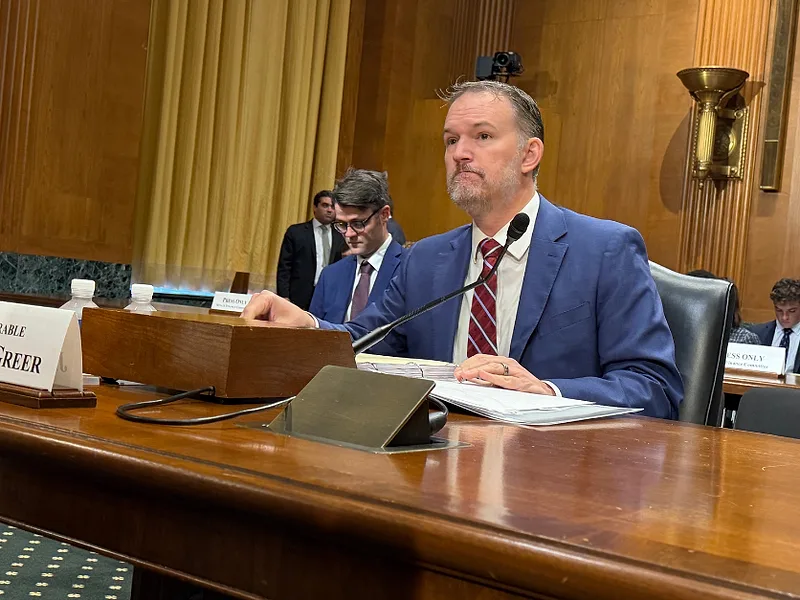
U.S. Trade Representative Jamieson Greer defended the Trump administration’s sweeping trade agenda before the Senate Finance Committee as farmers face uncertainty because of tariffs and trade retaliation.
Greer fielded questions from committee members on opening markets to farmers, negotiations on the U.S.-Mexico-Canada Agreement and tariff investigations.
Republicans and Democrats on the panel raised concerns about the current state of the farm economy as growers face elevated input costs and trade uncertainty. Greer said at the Wednesday hearing the administration is committed to leveraging tariffs to open new markets and lowering the trade deficit.
“For agricultural trade specifically, the story is even better. President Biden left office with a monthly ag trade deficit of $6.2 billion. Under President Trump, it's under $3 billion, and we are on the road to an agricultural trade surplus again,” Greer said.
Greer noted that the administration has entered into nearly 20 trade agreements and frameworks. Several of those countries have moved toward implementation, according to Greer, including Argentina, Cambodia, Malaysia and Indonesi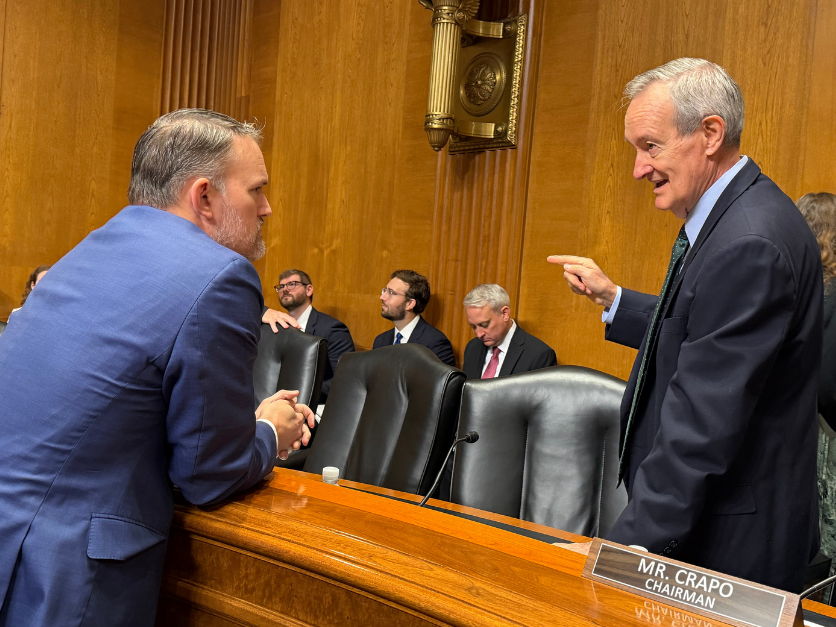 USTR Greer talks with Chairman Crapo before the start of the hearing.
Agri-Pulse, Olivia M. Bridges
a. He said the administration’s tariffs act as the enforcement mechanism for those agreements.
Chairman Mike Crapo, R-Idaho, said in his opening statement that boosting market access is a key priority. “U.S. trade policy must reflect economic realities. Market access matters. It remains a fundamental driver of American economic growth,” he said.
During the hearing, Sen. Chuck Grassley, R-Iowa, applauded the administration for signing a proclamation in June declaring an energy emergency and delaying the 18% levies on phosphate coming from Morocco. Farmers have faced increased fertilizer costs because of reduced access to the Strait of Hormuz due to the war with Iran.
Grassley pressed Greer on getting a commitment to work with U.S. trading partners to ensure there is increased availability of fertilizer as well as to remove any tariffs on anhydrous ammonia, a nitrogen fertilizer.
“We want to strike the right balance between emphasizing domestic production, which gives our farms security," Greer said. "We don't want to be relying on a country like China, which shuts fertilizer exports on and off at will, or have our producers here be subject to devastating subsidies from other countries, but we want fair competition, whether it comes from import or made domestically,” Greer said, adding that President Donald Trump has taken a “nuanced” stance when it comes to fertilizer.
Future of the USMCA
Several members of the committee asked Greer about the timeline for the USMCA negotiations. The administration on July 1 opted not to renew the agreement in its current state. The agreement will remain in place for the next decade and will undergo regular reviews and negotiations.
Crapo pressed Greer on the administration’s timeline for USMCA negotiations. Greer responded that the U.S. negotiating team is currently in Mexico City for bilateral talks, and he will be joining them after the hearing. He noted there are some issues that need to be sorted out in the USMCA, including one related to agriculture.
“We want rules of origin in USMCA to be very strong to incentivize production in North America as opposed to other regions that have a lot of excess capacity or non-market practices, but it does take time to develop these,” Greer said.
“That being said, I'm hopeful that before the end of the year, we can have at least options for President Trump and the leaders of Canada and/or Mexico to consider potential interim arrangements or things that Canada can do on the one hand and Mexico can do on the other hand to strengthen enforcement, to improve their commitments toward us, and to make sure that we're managing all of the trade issues,” Greer added.
Sen. Michael Bennet, D-Colo., got into a tense discussion with Greer over the 50% Section 338 tariffs imposed on Canada on Monday, and the possible impact on the USMCA. The tariffs will go into effect 30 days after Trump signed the three proclamations imposing levies on alcohol, dairy and automobiles.
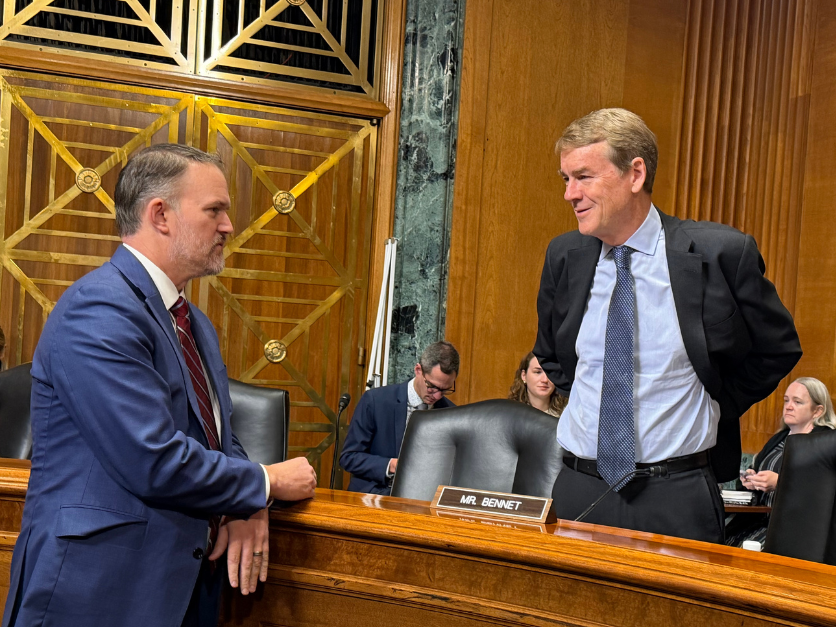 USTR Greer talks with Sen. Bennet before the start of the hearing.
Agri-Pulse, Olivia M. Bridges
“As everybody I hope knows, we’re at a moment of real crisis for our family farmers and for ranchers all over the country,” Bennet said. “And now, Ambassador Greer, after more than a century we are on the verge of losing our position as the world’s leading agricultural exporter.”
He cited a July report from the American Farm Bureau Federation that found farmers are projected to lose $32 billion in major row crops in 2027, including soybeans, corn and wheat, after a projected loss of $31 billion in 2026.
Bennet placed the blame on Trump’s trade policies. He said Canada and Mexico are the largest agricultural export markets, purchasing nearly $60 billion in U.S. agricultural products each year. He stressed that the U.S. should strengthen the USMCA.
“Can you commit that American farmers will not lose market access in Canada and Mexico as the result of your approach to USMCA negotiations, and how are you approaching the risk of retaliatory tariffs from Canada now that you’ve imposed 50% duties on a wide range of products that were previously exempt?” Bennet asked Greer.
He also asked about the economic effect on farmers.
Greer pointed to the agricultural trade surplus that the U.S. had when Trump first left office. He began to discuss the trade deficit under the Biden administration before being cut off by Bennet.
“With respect, Mr. Ambassador, that is not an answer to my question, nor is it an answer to the crisis that our farmers and ranchers are facing,” Bennet said as the two spoke over each other. “That is irrelevant to the discussion.”
“The crisis came from President [Joe] Biden,” Greer responded.
Bennet asked Crapo if he could ask his question. Bennet claimed the surplus and the deficit are the result of the fact that the administration has made it more expensive to buy products from other places.
“100% we’re maintaining that market access because we have to dig out of this deficit in ag we were left with,” Greer said in response to Bennet’s questioning on USMCA.
Global levies
The Trump administration has made global tariffs a key tenet of its trade agenda. Trump imposed a global 10% tariff using Section 122 of a 1974 trade law after the Supreme Court shot down his levies using the International Emergency Economic Powers Act, or IEEPA.
The 10% tariffs are set to expire Friday. The administration is working to replace them using a Section 301 investigation into 60 nations for allegedly using forced labor. Those tariffs range from 10 to 12.5%. The administration could also try to reup the Sec. 122 levies.
It’s unclear if there will be a tariff gap when the global tariffs expire.
“Well, I have to talk to the president,” Greer told reporters after the hearing about whether the Sec. 301 tariff investigation will conclude before the global tariffs expire. “He has to sign a directive to me, and that kind of thing. We're not focused on a particular timeline.”
Greer declined to say if he will reup the Sec. 122 levies.
“You all are just going to have to stay tuned, and you're going to be busy the next few days,” he said.
For more news, go to Agri-Pulse.com.
