
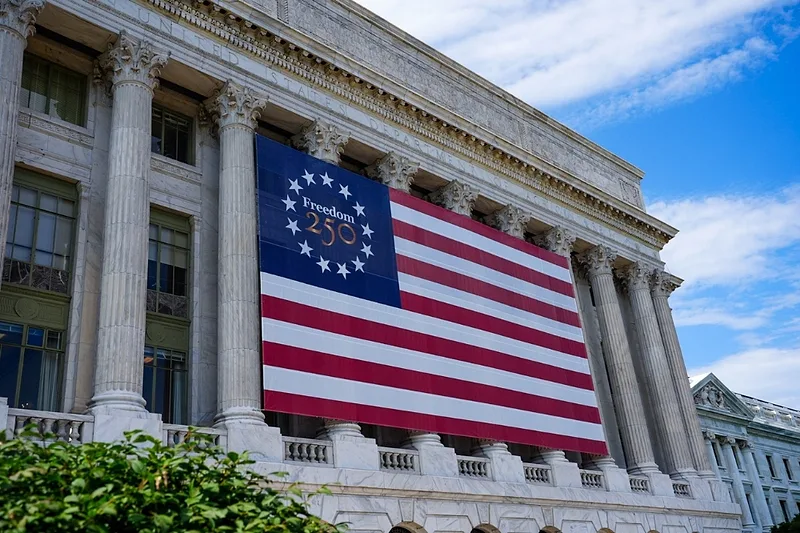
Current and former USDA employees are bashing the department’s reorganization plans, saying it will lead to massive departures, loss of expertise and diminished services.
On a call including reporters Thursday evening, employees past and present said most of the personnel directed to relocate would not do so, according to surveys conducted by their unions. A former 32-year Foreign Agricultural Service employee, Lilliana Batchelder, said a recent survey showed only 3.8% of the approximately 300 union members at FAS would relocate to Kansas City.
Chearice Vaughn, a 30-year financial and business loan specialist at USDA Rural Development, said nearly two-thirds of 45 people in the Rural Utilities Service and Rural Business-Cooperative Service who received notices to relocate from Washington, D.C., to Dallas “expect to be pushed out of their jobs.”
“This isn't about 45 names on a spreadsheet in Washington. It's about whether the next rural town waiting on clean water gets it in time,” she said. “It's about whether the next small business owner in a town with no other lender gets a chance at all. We built these things once. We're asking to be allowed to keep building them.”
“We have successfully been doing this exact job from our current duty stations for years,” Vaughn said. “Relocating us hundreds of miles away doesn't make the work better. It just adds moving costs, resignations and lost expertise. That's not good government. That's a waste of taxpayer dollars to solve a problem that does not exist.”
Other speakers addressed plans to relocate employees at the Economic Research Service, Forest Service, National Institute of Food and Agriculture and the Food and Nutrition Administration to new offices.
Kevin Shea, who led the Animal and Plant Health Inspection Service, said the current leadership at USDA “claim they're relocating employees to be closer to the farmers. Of course, over 90% of USDA employees already work somewhere other than the D.C. area, and most of the employees involved in this latest round of proposed cuts do not work directly with farmers, ranchers or others. They provide indispensable national coordination, oversight, support and analytical functions.”
A lawsuit challenging the reorganization is proceeding in federal court in California, with a hearing on a preliminary injunction set for September.
Section 122 tariffs set to expire today; Sec. 301 levies on tap
The Office of the U.S. Trade Representative on Thursday finalized its approximately four-month long investigation into 60 countries for alleged forced labor violations. As a result of the investigation, the nations will face levies ranging from 10% to 12.5%.
The action will cover 99% of all U.S. imports, according to a USTR fact sheet. Certain products will be exempt from the levies, including articles already subject to tariffs under Section 232, raw materials that cannot be obtained domestically and certain agricultural products, including bovine products, coffee and some nuts and fruits, among others.
“Today’s action will begin to correct what is both a human rights abuse and distortive trade practice to improve the welfare of workers everywhere. I am encouraged by the trading partners who have moved quickly to adopt forced labor import prohibitions, and look forward to ensuring their effective enforcement,” U.S. Trade Representative Jamieson Greer said in a statement.
The announcement came in the final hours before President Donald Trump’s global 10% tariffs expired Friday. The administration imposed the tariffs using Section 122 under a 1974 trade law – the first time in history that the authority has been used.
Sec. 122 allows the president to impose levies up to 15% for 150 days. After the 150-day period, Congress has to act to extend the tariffs. Congress has taken no steps to maintain the levies.
For more news, go to Agri-Pulse.com.
Diesel price spike added $1.4 billion to farmers' planting fuel costs in 2026, Joint Economic Committee Democratic report finds
A new report from Democrats on Congress's Joint Economic Committee suggests higher diesel prices added $1.4 billion, or 63%, to what U.S. farmers spent to fuel this year's planting of major crops compared to last year.
The report estimates that at peak diesel prices during the 2026 planting season, the average farmer spent $1,538 more to refill a typical 750-gallon onsite fuel tank than at the peak of the 2025 season.
It also suggests they spent $205 more to fill up a 100-gallon grain truck, and $250 more to fill up a 122-gallon tractor.
In terms of states, Illinois led the nation with a $163.2 million increase in planting diesel costs from 2025 to 2026, followed by Iowa at $151.1 million, Minnesota at $101.7 million, Nebraska at $99.9 million, and North Dakota at $88.6 million.
USTR allocates sugar TRQs under WTO
The Office of the U.S. Trade Representative on Thursday unveiled its FY 2027 tariff-rate quota allocation for imported raw cane sugar, refined sugar and sugar-containing products under the World Trade Organization agreement.
The TRQ for raw cane sugar is 1,117,195 metric tons raw value — the minimum amount allowable under the agreement.
USTR said of that amount, it will divvy out a little more than 1 million MTRV among nearly 40 countries, including the world’s top sugar producers: Brazil and India. Brazil produces 24% of the world’s sugar, followed by India at 16%, according to the USDA.
USTR said it will allocate the remaining 55,993 MTRV before Oct. 1.
Welch addresses FEMA and farm aid
Senate Agriculture Committee member Peter Welch, D-Vt., spoke with reporters Thursday about his efforts to “cut red tape” when it comes to getting emergency disaster funds to communities from the Federal Emergency Management Agency. Welch introduced the Disaster AID Act and the Rural Recovery Act over a year ago after communities in his home state were hit by historic floods in 2023 and 2024.
“There's an enormous amount of bureaucracy that's around essentially making certain that no money is misspent,” Welch said, noting that individual communities are not responsible for allocating the disaster funds.
Welch said his bill would provide communities with more responsibility over the emergency funds, providing an incentive to deploy the money to those in need.
He also discussed the farm aid proposals. The House on Wednesday passed a $95 billion concurrent resolution, known as reconciliation 3.0, that would provide farmers with up to $12 billion in assistance. Trump also submitted a supplemental proposal for about $11 billion in farm aid.
“I think there's a crisis, a real crisis in agriculture, and that's number one. So they do need help, but it's not just aid because some of these things have been a result of tariffs — of policies that the president has followed. So the tariffs have destroyed the markets for a lot of the Midwest corn and soybeans — destroyed the market,” Welch said.
USDA makes feral swine control funding available
The Agriculture Department is making $35 million available for partnerships to combat feral swine, an invasive species that causes billions of dollars in damage to agriculture annually.
Partners who are chosen to participate in the Feral Swine Eradication and Control Pilot Program will help landowners in restoration and on-farm trapping efforts and also provide training.
The opportunity is part of a $105 million investment for the pilot program in the One Big Beautiful Bill Act, with USDA’s Natural Resources Conservation Service and Animal and Plant Health Inspection Service working together to target feral swine.
A paper published last year in Pest Management Science estimated damage to agriculture from feral swine at least $3.2 billion, including about $1.06 billion to grain crops alone, which includes direct damage to crops, property damage and control costs.
Final Word
“Unfortunately, there’s some folks that have decided that it’s good for their agenda, it’s good for politics to go and tie cancer rates directly to farming practices — to which I would say let’s not politicize this and let’s not jump to conclusions, but let’s also be willing to do that research and do the studies and understand, and then take action if we do find things that are negatively impacting health.” — Iowa Agriculture Secretary Mike Naig on rising cancer rates in Iowa, which ranks second in the nation for cancer incidence. The issue has become a focal point in Iowa during this year’s election cycle, including the ag secretary race between Naig, a Republican, and Democrat Chris Jones, a water quality researcher and critic of agricultural runoff.

