
WASHINGTON, Jan. 27, 2016 - New labeling restrictions for
some animal antibiotics, and a requirement for a veterinarian’s prescription to
access some of the drugs, are expected by year’s end – along with potential
problems for livestock owners and the vets themselves.
For starters, fewer than half of U.S. livestock producers,
and fewer than 70 percent of vets, know about the stricter rules, according to
a recent online survey conducted by the Farm Foundation. Feed suppliers, who
frequently mix antibiotics into livestock rations to promote growth or fight
diseases, appear to be the most aware of the new requirements, which were set
by the FDA to counter bacterial resistance to some of these medically important
drugs.
But “most producers have no idea what we’re talking about,”
Phil Trowbridge, a purebred Angus breeder who heads Trowbridge Angus in Ghent,
New York, told a room packed with livestock operators, veterinarians, feed
makers and others attending a Foundation conference in Washington, D.C, last
week focused on the new rules.
While the tighter regulations may be a “pain in the ass,”
Trowbridge said he supports the mandate for tighter veterinary oversight. “We
make our entire living off our Angus cows, and I wouldn’t trade it for
anything,” he said. Trowbridge said he believes that helping to counter
antimicrobial resistance in animals is important to the future success of his
family’s business, now in its sixth generation.
In brief, FDA’s
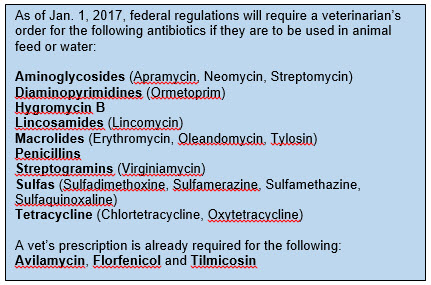
changes come in two parts. First, several antibiotics considered important
to human health (see inset) will no longer be available for promoting growth,
but only for therapeutic uses. And the labels must say as much. Secondly, a
2015 Veterinary
Feed Directive requires vet supervision and a prescription to use such
products in animal feed and water.
Those looming directives leave a lot of challenges across
the animal agriculture spectrum, says the Farm Foundation in its
report, which summarizes the 12 workshops
it held coast to coast last summer and fall with livestock managers, animal
health leaders, and feed makers to explain the new rules and examine the
challenges in implementing them.
The Foundation says education remains the first big hurdle,
despite its workshops and educational efforts by the FDA, veterinary
organizations and feed suppliers. In many locations, USDA’s Extension Service will probably play
a continuing role in educating producers and vets.
 Meanwhile, survey participants said the biggest impact from
the new regs will be the increased paperwork required to document prescriptions
and sales of medicated feed.
Meanwhile, survey participants said the biggest impact from
the new regs will be the increased paperwork required to document prescriptions
and sales of medicated feed.
Also a big challenge, especially for small livestock
operators and those with minor species such as deer and bison, will be securing
the frequent services of a vet who can prescribe appropriate dosages. (FDA
refers to this as having a veterinary-client patient relationship, or VCPR, an
acronym that livestock and feed operators will see often in the year ahead.)
“I think most of the people who are going to be using these
products already have a relationship of some kind with a vet,” says Kim
Bridges, a Blacksburg, Virginia, large-animal vet attending last week’s
conference. Although those who already have this relationship will be
contacting their vet more often to comply with the new rules, she says.
“It is going to require that we all have veterinary-client
relationships. That is the bottom line. We (vets) are going to have to be
familiar with what (producers) need these products for and whether or not it’s
a good idea to use the products.” Some livestock owners will have a struggle,
she says, but the goal is “to cut down on the extraneous use of antibiotics
just because they’ve always done it.”
Bridges and Robert Hill of Dayton, Virginia, also a
large-animal vet, are on a team being paid to get the word out with the help of
an FDA grant. Integrated poultry operators already have their own veterinarians
in house, Hill said, but for most other livestock owners and vets, “we want to
get the awareness out there that if you are or have been using antibiotics in
your feed, it’s going to be a new paradigm. You’re going to have to have a
veterinary feed directive, which is like a prescription, if you’re going to
feed an antibiotic.”
Mark J. Thomas, who manages Dairy Health & Management
Services, in Lowville, New York,
said areas that have little animal agriculture will have a
scarcity of vets ready to care for farm animals. But he expects most will find
vets to issue prescriptions.
“If there is a pocket of livestock production in an area,
there is also likely to be veterinarians in that area to serve that industry,”
he says.
#30
For more news, go to: www.Agri-Pulse.com
