
December 1, 2016 - Farm groups are laying out an ambitious
agenda that they want the Trump administration and the next Congress to carry
out for curbing the regulatory burden on agriculture. An 18-page white
paper obtained by Agri-Pulse details laws and court
decisions that the organizations believe need to be reviewed for possible
reforms.
The groups suggest, for example, that Supreme Court
decisions are causing judges to give too much deference to federal agencies
when new regulations are challenged. The white paper says Congress needs to
consider how to “re-establish equilibrium among Congress, agencies and the
courts.”
The paper also calls on Congress to rewrite the
Administrative Procedures Act to, among other things, mandate a minimum 60-day
comment period for major rules and establish special procedures for rules that
would have a “significant" economic impact.
The organizations that signed the paper include the American
Farm Bureau Federation, Agricultural Retailers Association, the National
Council of Farmer Cooperatives and a range of commodity groups.
‘Grassroots populism’ key to next farm bill. There is
probably no one in Washington who knows more about writing and implementing
farm bills than Chuck Conner, and he’s expressing confidence that producers are
going to like what see in the next bill.
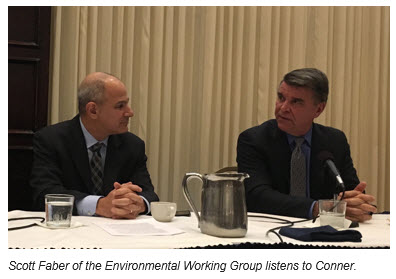
Conner, who spearheaded farm policy for the George W. Bush
administration, said at yesterday’s Farm Foundation forum that attacks on farm
programs won’t be successful so long as the sector stays united and takes
advantage of the “grassroots populism” that was key to Trump’s “shocking
victory” in November.
Conner also signaled to anti-hunger organizations that farm
groups would stand behind nutrition programs: “The agricultural community as a
whole has little interest in slogging through another farm bill debate without
working closely with our colleagues in the nutrition community.”
Former governor rumored for USDA meets Trump. Conner, who served as deputy
agriculture secretary during Bush’s second term, declined to say whether he was
being considered for agriculture secretary. But former Georgia Gov. Sonny
Perdue, a veterinarian rumored to be in the running for agriculture secretary,
was among the visitors to Trump Tower yesterday.
Perdue was asked about the USDA rumor in an interview with
Georgia’s WMAZ-TV but wouldn’t confirm the speculation.
Vilsack: Farm economy remains healthy despite income plunge.Agriculture
Secretary Tom Vilsack says the farm economy is still “strong” despite
“challenging markets” that led to another plunge in net income this year. USDA’s
latest farm economy update projects that net cash farm income will
drop nearly 15 percent this year to $90.1 billion. The new estimate is $4
billion below USDA’s August projection.
Debt-to-asset and debt-to-equity ratios have been ticking
up, but they still remain “near all-time lows, and more than 90 percent of farm
businesses are not highly leveraged,” Vilsack noted.
Farm income would be significantly worse if not for a 19 percent increase in
government payments. But crop insurance indemnities, which are down sharply
since 2013, have fallen by 36 percent in 2016. Since 2013, indemnities are down
nearly 64 percent.

USDA raises export forecast. USDA has raised its forecast for
U.S. agricultural exports to $134 billion for fiscal 2017. That’s a $1 billion
increase from USDA’s last forecast in August.
Together with an expected decrease in imports, USDA is now
predicting an agricultural trade surplus of $21.5 billion for FY17. That’s up
from the August estimate of $19.5 billion and the FY 16 surplus of $16.6
billion.
USDA forecasters raised their estimates for exports to China
and Mexico by $300 million each. China will remain the largest foreign market
for U.S. farm goods, followed by Canada and Mexico.Cotton, wheat, dairy and
soybean exports are expected to be stronger than previously forecast, while
rice, soybean oil and soymeal exports will be weaker.
But increased competition weighing on exports. Terry
Barr, an economist with CoBank, warned ag retailers at their annual conference
in Orlando yesterday, that the strong U.S. dollar, buoyed by a possible
interest rate hike by the Federal Reserve in the near future, "is going to
continue to be a problem for U.S. agriculture.”
Barr said that prospects for the farm economy are heavily
dependent on exports. "The real challenge on the export side is we have a
lot more competition now. When we made the decision to divert corn into
ethanol, we were forgoing the export market."
US knocked on obesity and food waste. The United States
ranks third lowest out of 25 countries when it comes to amount of food waste
and the prevalence of people who are overweight, according to the Economist
Intelligence Unit’s annual
food sustainability index.
The United States ranks much better - 11th out of the 25
countries - on overall food and nutritional sustainability. That is the third
of three areas in which the EIU index attempts to measure national
progress.
He said it. “Farmers and ranchers and the people of
rural America feel like they’ve been under attack the last several years, and I
believe it had a huge impact on how they responded in the last presidential
election.” Chuck Conner, president of the National Council of Farmer Cooperatives.
Daniel Enoch, Bill Tomson and Steve Davies contributed to
this report.
#30
For more news, go to: www.Agri-Pulse.com
