
WASHINGTON, Dec. 2, 2016 - There's an intriguing new twist
in President-elect Donald Trump’s search for an agriculture secretary. North
Dakota Sen. Heidi Heitkamp will be meeting today in New York with Trump and
Vice President-elect Mike Pence and the Agriculture post is expected to be on
the agenda.
A Trump spokesman wouldn’t discuss the meeting, and Heitkamp
insisted that she didn’t know what Trump wanted to talk to her about. But North
Dakota’s Republican congressman, Kevin Cramer, who has ties to the Trump
operation, told Agri-Pulse that the meeting is about USDA. Cramer
said he learned about the meeting from the Trump team earlier in the week.
Heitkamp told Agri-Pulse that she planned to talk
to Trump about the “economic uncertainty” in rural America “in a period of low
commodity prices.”
Heitkamp faces a tough re-election race in 2018, but taking
the cabinet post would clear the way for Cramer to take it even earlier by
running it in a special election. Trump spokesman Jason Miller said Heitkamp
would be an asset to the Trump administration “in any role or capacity.”
Vilsack weighs in on next USDA secretary. Agriculture
Secretary Tom Vilsack’s criteria for his successor hasn’t changed. He thinks
Trump should choose a governor or someone with experience at USDA.
“It takes someone who understands the whole portfolio of the
department … and balance multiple priorities in multiple areas,” Vilsack said
at a rural housing event yesterday. “That’s why I’ve suggested that a governor
… would be a good person to run this place.”
Vilsack, who was speaking before the announcement of the
Heitkamp-Trump meeting, told Agri-Pulse that Chuck Conner would be a
good fit for the department because of his experience there. Conner, the
president of the National Council of Farm Cooperatives, served as deputy
agriculture secretary during the George. W. Bush administration.
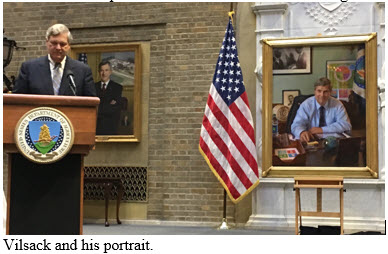
Later in the day, Vilsack
attended the unveiling of his official portrait, which will hang in the
atrium of USDA’s Whitten building. The portrait, painted by Iowa artist
Rose Frantzen, includes a poster of the My Plate dietary guide developed
under his watch. There's also a plant-based water bottle to represent the USDA
Bio-Preferred Program.
Walden gets key House committee post. Republican Rep.
Greg Walden, who represents an agricultural region of eastern Oregon, will take
over the chairmanship of the House Energy and Commerce Committee, succeeding
the term-limited Fred Upton.
The GOP steering committee selected Walden over Illinois
Rep. John Shimkus, a staunch advocate for ethanol. Energy and Commerce has
broad jurisdiction over food safety and energy and environmental policy.
Walden’s victory was seen as a reward for his successful
chairmanship of the Republican congressional campaign operation this year.
Walden, who grew up on an orchard, was named a “Champion of Agriculture” this
year by American Agri-Women.
Sage grouse rider falls off defense bill. Congressional
negotiators scrapped a provision in a defense authorization bill that would prevent
the federal government from carrying out a sage grouse management plan in
states that have their own. The provision had been holding passage of the
defense bill.
The issue has lost some of its urgency now following Trump’s
election. A spokesman for House Natural Resources Chairman Rob Bishop, R-Utah,
said the issue will be raised with the next interior secretary
FWS adds candidate species for endangered list. The
eastern population of the gopher tortoise is one of 30 species the Fish and
Wildlife Service is
classifying as candidates for listing under the Endangered Species
Act. Candidate species are those for which the service has enough information
to propose for listing, but cannot do so because of deadlines under existing
court agreements and a lack of funding.
The agency says habitat fragmentation, destruction, and
modification is the primary threat to the gopher tortoise’s continued existence
-- in particular, conversion of longleaf pine forests “to incompatible
silvicultural or agricultural habitats.” Urbanization and the spread of
invasive species are other threats.
The number of species on the ESA waiting list is now the
lowest it has been since the candidate list was created in 1975.
Pew poll finds consumer skepticism of GMOs. A new poll by
the Pew Research Center illustrates the continued challenges that the farm and
food sector faces in reassuring consumers about the health and safety of
conventional agriculture.
According to the poll, 55 percent of American believe that
organically grown produce is healthier than conventionally grown varieties.
There also is a large minority - nearly 40 percent of the country - that
believes that genetically engineered foods are less healthful than conventional
products.
That may be because consumers believe there is less
consensus among scientists about the safety of GMOs than there really is.
According to the poll, only 14 percent of consumers believe that almost all
scientists believe that biotech foods are safe. And fewer than one in five
consumers, or 19 percent believe that scientists understand the health effects
of GMOs “very well.”
“The divides over food do not fall along familiar political
fault lines,” the researchers say. “Nor do they strongly tie to other common
divisions such as education, income, geography or having minor children.
Rather, they tie to individual concerns and philosophies about the relationship
between food and well-being.”
Bill Tomson and Steve Davies contributed to this report.
#30
For more news, go to: www.Agri-Pulse.com
