
China’s purchases of American cotton have cratered in early 2025 as weak domestic consumption and trade uncertainty weigh on U.S. exports and prices, analysts tell Agri-Pulse.
Cotton sales to China, typically the best U.S. cotton customer, opened 2025 with the worst January since 2016, exporting just $31 million worth of product. While data is still coming in for February and March, analysts say China has significantly scaled back U.S. cotton purchases.
“China is not buying,” Darren Hudson, a professor at Texas Tech’s Cotton Research Facility, told Agri-Pulse. “They've basically been holding off on the sidelines.”
The U.S. cotton industry relies on export markets, with more than 80% of domestic production shipped overseas. China – which consumes around a third of all cotton bales grown globally – has been the preeminent buyer since the pandemic, purchasing around a quarter of all U.S. exports last year, according to Commerce Department data. Accordingly, China’s retreat from U.S. purchases leaves a sizeable hole in U.S. exports that other buyers can offset only partially.
A slowing Chinese economy
A number of factors are driving China’s retreat, analysts said, but chief among them could be a slowing domestic economy. Beijing has been grappling with a long laundry list of economic challenges, including high local government debt burdens, a near collapse of the property sector and low consumer confidence.
GDP growth has officially slowed from more than 10% a decade ago, to around 5% in 2024 – but unofficial estimates suggest actual growth could be around half as much.
Economic malaise weighs on demand across agricultural sectors but is often felt more swiftly and keenly in cotton.
In a tight economy, consumers can go without new clothes, said Kent Lanclos, chair of the USDA Interagency Commodity Estimates Committee for cotton. But they can’t go without food.
“When things are tough, I can still wear those blue jeans. They may look ratty, may have a hole or two, but I can still wear them,” Lanclos said. “Food is less sensitive to the economy than is cotton and textile consumption.”
But China’s economic slowdown is only part of the story, analysts said. Demand remains robust in countries, like Vietnam, that export yarn and textile products to China.
“We're still shipping cotton to Vietnam and Bangladesh and Thailand and Indonesia and other places,” Hudson said, which may suggest that trade uncertainties inhibit U.S. exports to China.
 Darren Hudson (Photo by Texas Tech)
The U.S. has increased tariffs on imports from China twice since President Donald Trump took office – in one instance with only a few days' notice. Beijing retaliated with new duties on U.S. goods on both occasions.
With sea freight to China taking weeks to organize and deliver, Chinese buyers may be scaling back U.S. purchases to avoid getting caught with product on the water should new tariffs hit abruptly, Hudson added.
Kevin Brinkley, president and CEO of Plains Cotton Cooperative Association in Texas, agreed that renewed U.S.-China trade tensions are likely contributing to China’s retreat from U.S. cotton.
Until there is more certainty around the future of U.S.-China trade, Brinkley said, “you'll probably continue to see just very start-stop sales there.”
Waiting for Brazil
Chinese buyers may also be waiting for the Brazilian cotton harvest. Brazil has been increasing its foothold in the Chinese cotton market in recent years. The Brazilian cotton industry has received substantial investments to improve production and in 2024 the country surpassed the United States as the world’s largest cotton producer.
This is reflected in the country’s exports to China. Brazilian cotton now accounts for around a third of Chinese imports, up from less than 10% five years ago. As with many other agricultural commodities, Brazilian producers can offer Chinese buyers a lower-priced product.
“They can sell it cheaper because it's a second crop for them,” Hudson said, reducing input costs. Many Brazilian producers plant cotton after the soybean harvest. China has also invested in Brazilian infrastructure, which helped develop agricultural supply chains that export to Asia.
It’s easy to be “in the know” about what’s happening in Washington, D.C. Sign up for a FREE month of Agri-Pulse news! Simply click here.
Brazilian producers harvest in June and July, so their main cotton exporting months are August through December, according to USDA, forcing Chinese buyers to wait for their cheaper cotton. In years gone by, U.S. exports have met Chinese demand in the early part of the year, outpacing Brazil’s exports from January to August.
But this year, Chinese importers can afford to wait and ride out trade turbulence. Its cotton-producing Xinjiang region has a bumper crop this year, Lanclos said, and the country is sitting on healthy cotton reserves.
“The spinners have pretty sufficient supplies to meet their own needs,” Lanclos said, reducing import demand.
“They don't need immediate shipment. So, they're just waiting,” Hudson added.
Accordingly, Lanclos said USDA’s latest estimate anticipates China will import just 6.8 million bales this year, less than half of the nearly 15 million bales it imported last year.
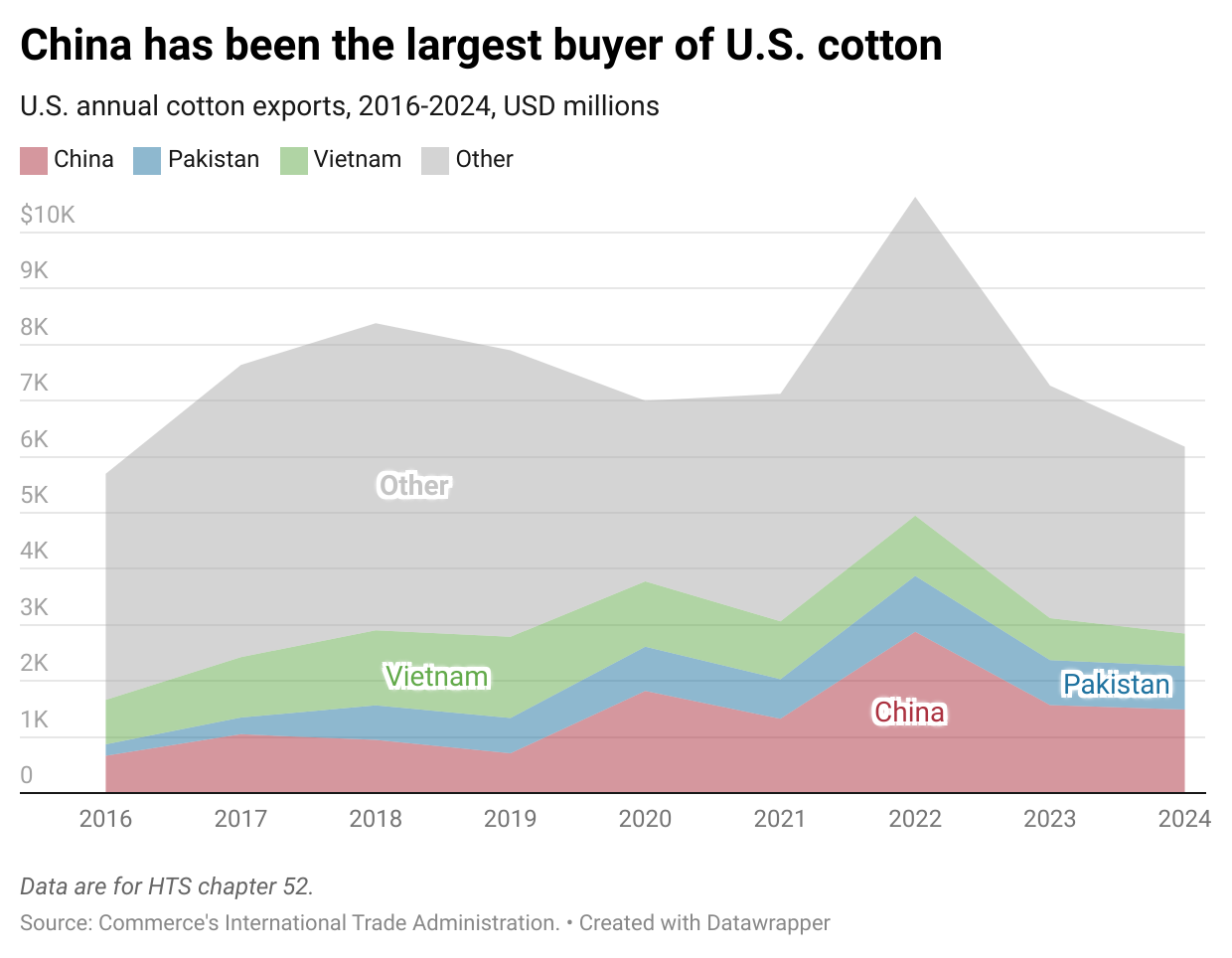
Some of the volume that China has forgone will be diverted to other markets. USDA is projecting Vietnam will slightly increase its imports of U.S. cotton by around 800,000 bales in 2025-26. Recent Chinese investments in Vietnam to turn cotton into yarn to be exported into China duty-free have been slowly increasing Vietnamese cotton demand. Pakistan is also set to increase imports slightly.
But Lanclos said that neither can fully replace the Chinese pullback, and the reduced demand from a major importer could put even more downward pressure on prices, Hudson argued.
The global price of cotton has been falling since last October, according to the International Monetary Fund, retreating from 86 cents per pound to 78 cents in February, the last full month of data.
USDA is already anticipating lower cotton acreage in the U.S. for the 2025-26 season. Total planting is projected at 10 million acres, a 10% reduction from last year. An estimate from a National Cotton Council survey suggests planting could be as low as 9.6 million acres.
“You’d think all that should drive up price,” Hudson said, “But the fact is, there's just no demand globally to try to lift that.”
Instead of prices climbing to reflect reduced supply, Hudson warned that “supply is adjusting downward to meet demand.”
For more news, go to Agri-Pulse.com.

