
|
The Trump administration has been looking into whether to mount a trade investigation into the impacts of the impacts of sugar imports on domestic producers, according to three people familiar with the situation, which could result in new trade protections.
Officials have several vehicles for a potential trade probe. If they suspect imports are hurting U.S. industry, the administration can direct the International Trade Commission to mount what is known as a Section 201 safeguard investigation. The commission then determines whether the domestic industry is being seriously injured or threatened by rising imports and can recommend trade relief.
“People have been putting together economic analysis, both in USDA and in other circles,” a person familiar with internal discussions said.
Sen. John Hoeven, R-N.D., has also been pushing for the administration to look at other potential trade tools. North Dakota and Minnesota are home to more than half of all sugar beet growers, and the industry has been warning of growing economic headwinds amid rising input costs and low global prices.
“We’ve asked USTR to look at all available trade remedies,” a spokesperson for the senator told Agri-Pulse, referring to the Office of the U.S. Trade Representative.
In a phone interview Tuesday, Hoeven said that he had raised the issue with USTR Jamieson Greer directly and that others on Capitol Hill, including Senate Agriculture Committee Chair John Boozman, R-Ark., are supportive of the idea.
It’s easy to be “in the know” about what’s happening in Washington, D.C. Sign up for a FREE month of Agri-Pulse news! Simply click here
In addition to Section 201, Hoeven has been pushing the administration to consider a Section 301 probe, used to examine unfair trading practices employed by U.S. partners, or a Section 232 investigation – which weighs whether imports threaten U.S. national security.
Any of the statutes can be used to justify higher tariffs or a slate of other trade actions.
USDA directed Agri-Pulse’s request for comment for this story to USTR. USTR, however, did not respond to multiple requests.
Weakening protections
The U.S. imports more than 3 million tons of raw sugar each year but uses tariff-rate quotas to control how much can enter the country at a reduced duty to protect domestic producers.
 U.S. World Trade Organization (WTO) commitments require officials to award quotas to sugar-producing countries that allow at least 1.36 million tons to enter at a reduced tariff rate. The U.S. also has a suspension agreement with Mexico that allows some sugar to enter at a lower duty.
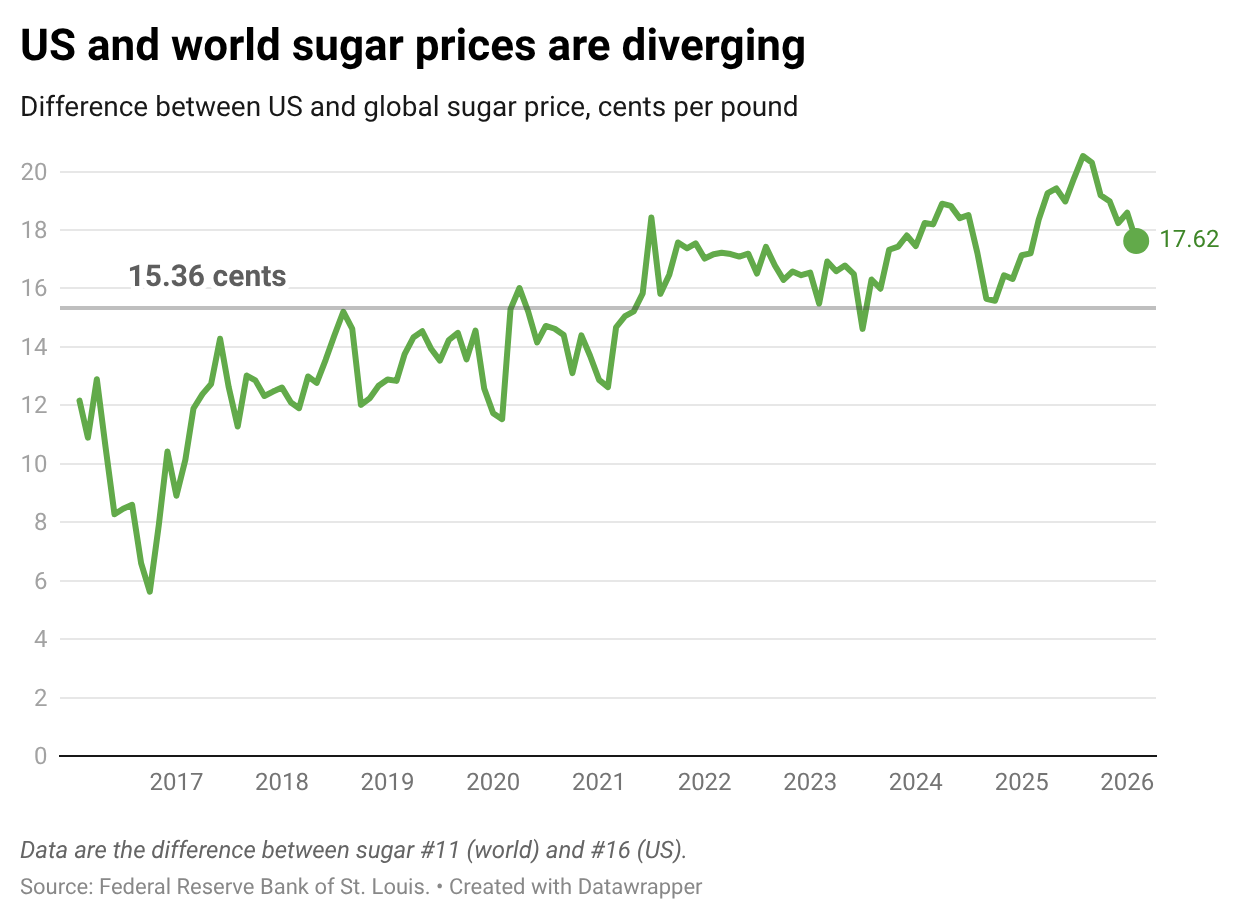
Imports above these quota volumes are subject to a tariff rate of 15.36 cents per pound. When the tariff rate was adopted in 2000, it was a high barrier for would-be importers, offering significant protection to the domestic industry. But inflation has eroded the potency of the tariff over the last two decades.
USDA estimates that almost a third of U.S. sugar imports were subject to the high tariff rate last year.
“The tier two tariff rate is no longer effective,” Hoeven told Agri-Pulse.
Domestic producers are also eyeing low global prices with trepidation. If the global price falls more than 15.36 cents per pound below the U.S. price – plus 3-5 cents for transportation costs – it may make economic sense for sugar users to import product and just pay the higher tariffs.
In the last five years, the difference between the U.S. price and global prices has almost always been greater than 15.36 cents per pound.
A ‘tough argument’
More sugar may be entering the U.S. at a higher tariff rate, and importers may be facing stronger economic incentives to import, but, overall, U.S. sugar imports have been falling in recent years, not growing. As high-tariff imports have risen, sugar imports from Mexico have fallen, more than offsetting the surge.
This could present a challenge for officials looking for avenues for potential trade actions. For an affirmative Section 201 determination, the ITC needs to find evidence that there is harm to domestic producers and that increasing import quantities are to blame.
“It’s kind of a tough argument to make,” if imports aren’t actually increasing overall, one of the people familiar with the internal discussions told Agri-Pulse.
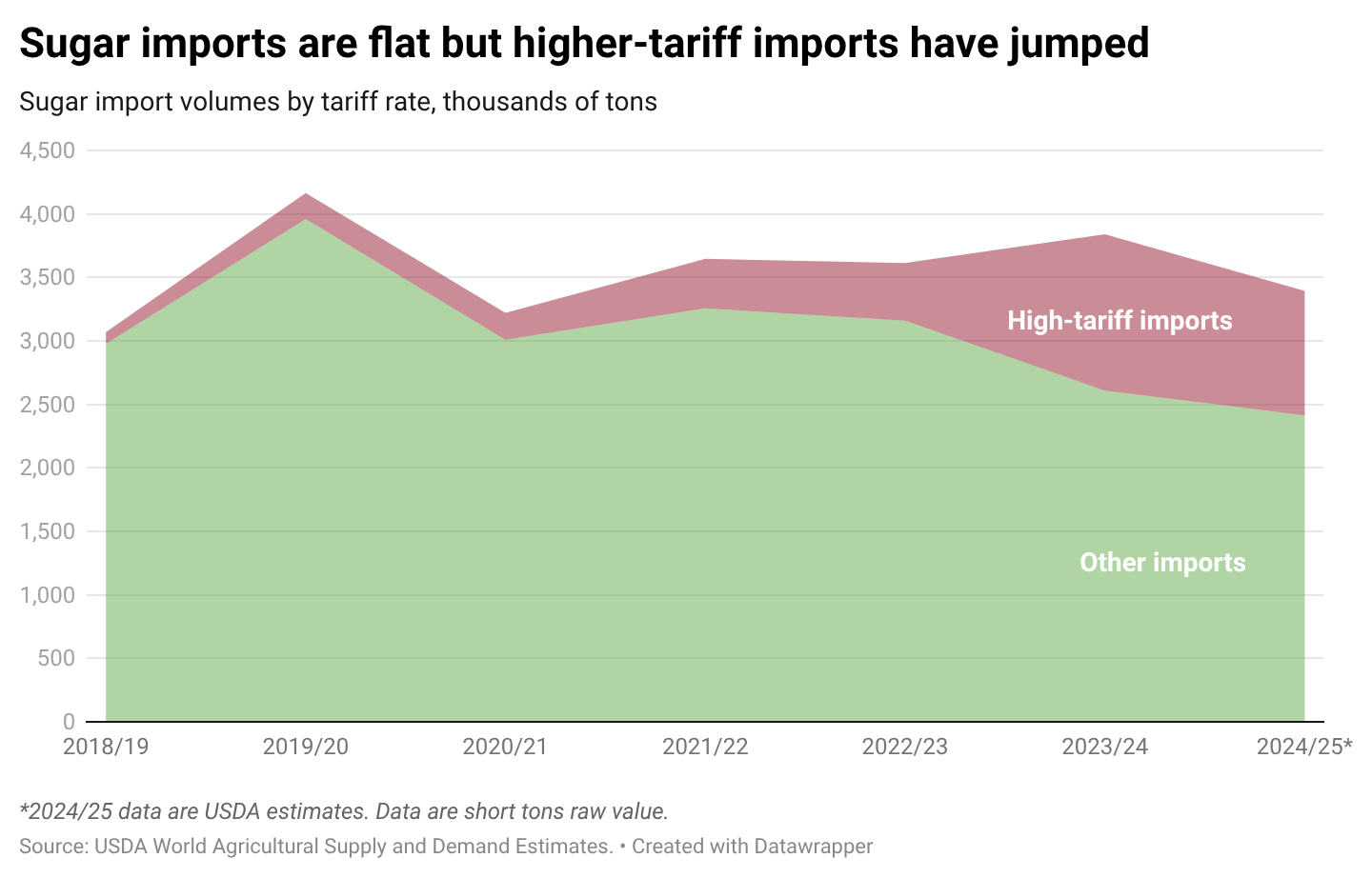
In fact, raw sugar imports have fallen from more than 4 million tons in the 2019-2020 marketing year to an estimated 3.3 million tons in 2024-2025.
“One could try to make the case that you're judging it by tier-two imports,” the person said, referring to the higher-tariff imports, but it’s not clear that the ITC would agree with that reasoning.
A more likely vehicle?
The Trump administration has indicated that it is planning on mounting additional trade investigations in other sectors under Section 301 of the Trade Act of 1974.
In February, after the Supreme Court struck down a President Donald Trump’s emergency tariffs, USTR signaled that it would launch investigations into several unfair trade practices, including countries’ subsidies to their domestic rice industries and practices in the seafood sector, which could be used to replicate the lost tariffs.
Hoeven says that the administration is also exploring whether to include sugar in some of those efforts to investigate unfair trade practices from U.S. trading partners.
“They were looking at some different things. I think they settled on 301,” Hoeven said Tuesday. “I think we're going to do it.”
The U.S. has long complained that countries, particularly India and Brazil, are providing subsidies for domestic sugar producers that give them an unfair advantage in international markets. In 2021, a dispute panel at the WTO ruled that India’s sugar subsidies ran afoul of global trade rules, but India appealed the decision and without an appellate body, the ruling is not binding.
In 2024, the U.S. and Australia once again accused India of violating its WTO commitments in its support for domestic producers and criticized its lack of transparency around the issue.
Brazil, India and Thailand alone account for around 70% of global exports, Rob Johansson, director of economics and policy analysis at the American Sugar Alliance, told Agri-Pulse. “For a country like India, where you have so many farmers, their way of providing rural support is often tied to ag supports. And sugar is a big one.”
The industry also benefits from ethanol supports in Brazil, Johansson said.
When these countries have a good growing year, Johansson said, a surplus of product hits the global market and global prices falter.
Accordingly, Hoeven said, a 301 probe “makes sense.”
“If we don't do it,” he added, “You could see sugar forfeitures, and then we not only lose some farmers – very important farmers – but also some of our processing plants here at home, so you lose industrial workers.”
“I don't think that's a trade-off that anybody particularly would want.”

