
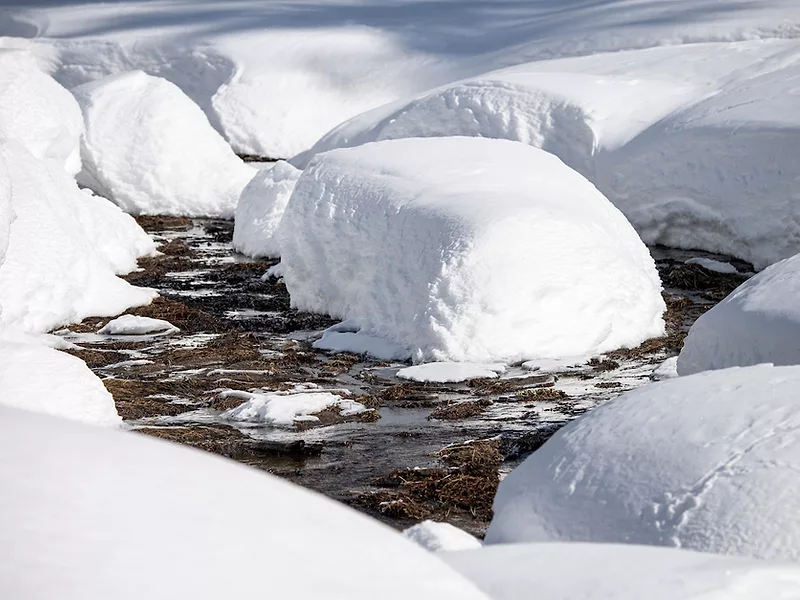
California is headed into spring with well-stored reservoirs and an average snowpack, though statewide conditions may dry out heading deeper into the season. Experts are now keeping a close eye on Southern California conditions and the potential for reduced rangeland forage production.
While Northern California received a well-above-average accumulated precipitation that surpassed average levels by January, the Central and Southern Sierra regions consistently lagged behind, leaving them vulnerable during an anticipated dry spring.
Daniel Swain, a University of California Agriculture and Natural Resources climate scientist, said the wet Northern and dry Southern California conditions are “remarkable.”
He explained that strong El Niño events change the trajectory of the winter jet stream southerly, making those years more favorable to Southern California. Swain added that California almost always experiences a late fall and early spring “flailing” effect within the jet stream. Since the jet stream returns far north each summer, Southern California almost never receives late season rain.
As of April 1, when California typically sees its peak snowpack before it declines due to warming temperatures, the state hit 100% of average-to-date amounts. This marks the third consecutive year California has achieved a near-average snowpack.
Reservoirs are overall in a strong standing, with Lake Oroville and Shasta reservoirs sitting at 89% and 92%, respectively. As of Tuesday, allocations through the State Water Project remain at 40% of contracted amounts, though they could be adjusted through June.
At the California Department of Water Resources’ final snow survey of the year, snow surveys and water supply forecasting unit Manager Andy Reising predicted the last few days of March would supply enough precipitation to push the state toward near-average pack levels.
Reising and DWR Director Karla Nemeth agreed that rapidly shifting wet-to-dry patterns from November through March demonstrate California’s increasingly unpredictable water conditions.
It’s easy to be “in the know” about agriculture news from coast to coast! Sign up for a FREE month of Agri-Pulse news. Simply click here.
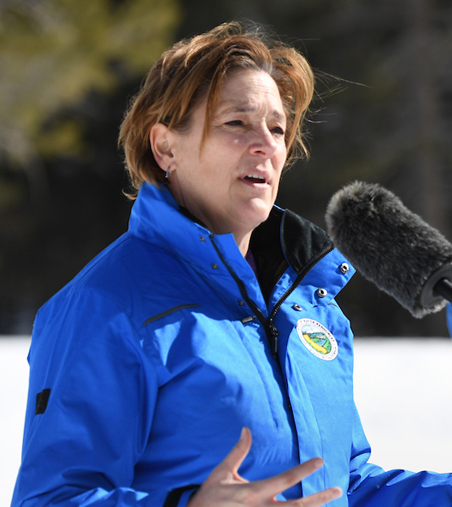 Karla Nemeth (Photo: DWR)
During a Senate Budget Subcommittee on Resources, Environmental Protection and Energy meeting, Nemeth updated members on current water conditions and urged the importance of improved and expanded infrastructure, especially the Delta Conveyance Project.
Nemeth said that warm storm conditions are causing the snowpack to melt early, leading to heavy reservoir inflow that forces water managers to release thousands of cubic feet of water.
“Fundamentally — and it's something we've known for a very long time in California — [the locations of pumps] in the southern Delta really aren't good for fish,” she said. Last year, a group of steelhead were killed after getting pulled into Delta pumps, leading to minimalistic State Water Project and Central Valley Project allocations despite positive snowpack levels.
Looking back on the series of atmospheric rivers that pounded California in 2023, Nemeth said aging Sacramento Valley levees were at risk of breaking, but the storms avoided them. Following each storm event over the last few months, DWR took every opportunity to describe how much water could have been stored if the Delta Conveyance Project were operational.
“All of this to say, we are on year three of a pretty decent water year, so my Spidey senses are all about dry conditions returning,” said Nemeth.
The department is also in the process of getting permits for the West False River Drought Salinity Barrier Project, a temporary preventative tactic against southern Delta saltwater intrusion. Delta salinity can worsen during prolonged droughts, which Project Manager Ibraheem Alsufi warned of during the March Delta Stewardship Council meeting.
Though the barrier project has only been initiated three times in the last three decades, it was most recently used in 2021. Alsufi said this permit request is especially preemptive based on the frequency and intensity of recent statewide droughts.
“We’re planning for the worst and hoping for the best,” he said.
Agricultural impacts
During the bimonthly California-Nevada Drought Early Warning System webinar, Leslie Roche, a University of California, Davis professor of cooperative extension in rangeland management, said rangeland conditions will likely be affected by coming drought periods.
Operated by the National Oceanic and Atmospheric Administration, the system uses state, federal, local and academic partners to make climate conditions more accessible.
Roche said that since California's annual rangelands are largely under private ownership, they play a vital role in optimizing statewide prescribed grazing. State rangelands are typically challenged by the misalignment of temperature and moisture conditions; ideal plant growth conditions often do not align with hydroclimate realities.
 Leslie Roche (Photo: UC Davis)
Using remote sensing tools combined with on-ranch monitoring, Roche and a team of UC Cooperative Extension and UC Davis researchers found that precipitation amount and timing are the key factors driving long-term rangeland forage production.
Compared to previous years, Roche said Northern California’s dry January conditions will likely have implications for peak forage production.
But forage production varies heavily from region to region. For example, Siskiyou County still has curtailment orders in place from the 2021 drought proclamation, despite receiving heavy precipitation this year.
Similar to snowpack patterns, Roche said, Northern California rangeland conditions are near normal, while further south rangelands have lacked needed precipitation. Forage production could deteriorate even further if drought persists into the spring.
“This is all to say that growing grass, and particularly in grasslands in California, is much more complicated than just looking at what are your [precipitation] totals,” said Roche.
Rapid April snowmelt is another key factor in California’s drought planning, according to Dan McEvoy, a Western Regional Climate Center associate research professor of climatology.
McEvoy is working on a Reclamation-funded project to incorporate snow temperature measurements into the federal snow survey.
“The snow temperatures can tell you a lot about when the snow path is ready to melt in spring, and also when it can melt in terms of flooding in the middle of the winter,” he said, noting that warmer storms can also cause early snowmelt.
He said early Northern California runoff estimates are looking above normal, but the opposite is true of the south.
The NOAA Drought Early Warning System is piloting an early drought warning system for Southern California, providing sector-specific information about agriculture, public health and water utilities. Andrew Hoell, an NOAA senior research meteorologist, predicts that low forage production will especially be an issue for Southern California.
Hoell also expects that the precipitation season will not extend into April, making water level rebounds across Southern California unlikely.
Steven Ostoja, director of USDA’s California Climate Hub, announced the new CalAgroClimate resource. The tool targets users spanning crop consultants to ranchers, allowing for up-to-date advisories on heat, pest and crop phenology conditions.
“You can simply google ‘climate’ and we'll pop right up as the first hit,” said Ostoja.
The California Climate Hub is hosting a series of climate management workshops in collaboration with the National Institute of Food and Agriculture. The first will be hosted on June 18 at the University of California, Merced’s Smart Farm and is designed for Central Valley-based technical assistance providers.
For more news, go to Agri-Pulse.com.

