
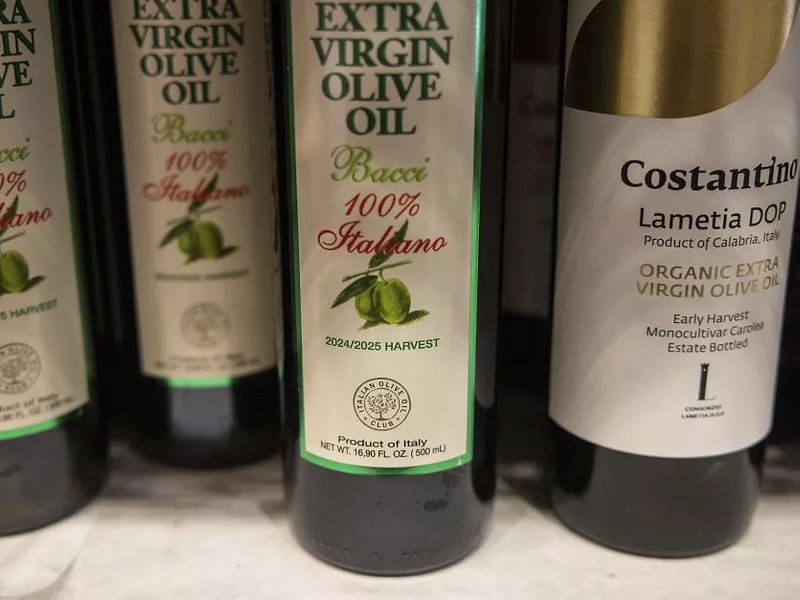
Tariff critics’ latest arguments against higher duties have been on display this week at a multi-day hearing on an unfair trade investigation into countries’ manufacturing overcapacity. Multiple food industries are now making the case that it pits the administration’s trade policy against its Make America Healthy Again objectives.
The administration’s dietary guidelines published in January promote the consumption of whole food sources and “healthy fats.”
“The nation will never come close to making this MAHA recommendation a reality if seafood products are priced out of the reach of American families – as they soon may be,” the National Fisheries Institute’s Robert DeHaan said in a panel discussion Tuesday.
The administration is pivoting to alternative tariff authorities after the Supreme Court in February struck down duties imposed using emergency powers.
On Tuesday, Joseph Profaci of the North American Olive Oil Association made a similar argument.
“Tariffs that raise prices or reduce availability discourage consumption and undermine national efforts to reduce chronic disease,” Profaci said.
Take note: In a Federal Register notice Wednesday, the administration announced it is kicking off a second review of the tariffs imposed on China during Trump’s first term. It is the second such review of the duties – which were imposed using a separate Section 301 investigation into unfair trade practices.
Fertilizer hearing set for May 12
The Senate Agriculture Committee has set a date for its previously announced fertilizer hearing. Titled “Perspectives on the Fertilizer Industry: Ensuring a Stable and Affordable Supply for American Producers,” the hearing will be next Tuesday.
On its website, the committee says the hearing would feature Andy Green, a principal and senior adviser at Center Market Strategies; Trent Kubic, vice president of South Dakota Corn Growers; Eddie Melton, president of the Kentucky Farm Bureau Federation; Joshua Westling, CEO of J. Westling & Co., Andy Green, and Corey Rosenbusch, president and CEO of The Fertilizer Institute.
Green was senior adviser for fair and competitive markets at USDA during the Biden administration.
Greer argues European Union needs to drop deal amendments
U.S. Trade Representative Jamieson Greer is taking issue with several amendments the European Parliament made to a U.S. deal.
When lawmakers advanced the deal through the European Union Parliament in March, they added a “sunrise clause” placing conditions on when the deal could kick in, as well as an expiration date and safeguard mechanisms.
The amendments, Greer said on Bloomberg Wednesday, were not approved by the U.S. in negotiations.
They could “place limits on U.S. exports to Europe,” Greer said, adding that they need to be “resolved.”
The deal is now in EU trilogue negotiations where the Commission, Parliament and the European Council reconcile their positions.
Some, like Germany, are keen to get the deal approved quickly, particularly after Trump issued a fresh threat to hike auto tariffs last week. But some lawmakers, including the international trade committee chair, Bernd Lange, have been reluctant to approve the deal without additional safeguards.
Greer was in Paris, France, this week for a G7 meeting, where he met with European Trade Commissioner Maroš Šefčovič.
It’s easy to be “in the know” about what’s happening in Washington, D.C. Sign up for a FREE month of Agri-Pulse news! Simply click here
Greer declined to put a firm deadline on when the administration needs to see the deal approved to avoid further tariff hikes.
New biofuel outlook revives old fuel-vs.-food debates
The highest-ever U.S. blending quotas for biomass-based diesel are prompting fresh concerns about using food crops like soybeans to make fuel.
“The big question the market is struggling with is what I call a little bit of the battle right now between traditional users of soybean oil – the food, feed and industrial uses – and the need to ramp up biofuel production,” Scott Irwin, ag economist at the University of Illinois, said at a Fastmarkets conference in Chicago. “There's a lot of uncertainty in exactly how that's going to play out.”
As biodiesel producers and soybean processors work to ramp up output to meet new demand, debate on food vs. fuel stirs memories of massive protests in 2007-08 over expansion of corn-based ethanol. Such concerns have faded considerably but not gone away.
A surge in green diesel investments that began about five years ago led to a shift in the economics of crushing whole soybeans for oil used in food, fuel and consumer products, and soy meal that’s largely used to feed hogs and chickens.
Meal is no longer the most valuable part of the crush, meaning there’s a lot more of the protein-heavy product these days at a lower cost. That translates to less costly poultry and pork at the grocery store, according to Mogler.
“It’s really affordable to eat chicken and pork right now,” he said.
FDA pilots one-day ‘assessments’ of facilities
The Food and Drug Administration will begin piloting a program to conduct one-day “inspectional assessments” of low-risk food and other facilities, the agency says.
In an announcement Wednesday, FDA said the data gathered through the pilot program, such as “recurring compliance themes, facility-specific risk scores, and discrepancies between registered and actual operations, can be used to better target future oversight activities.”
FDA Commissioner Marty Makary told the annual conference of the Food & Drug Law Institute that if any issues are found at the manufacturing facilities, inspectors have the leeway to extend the assessment beyond a day.
They’re hiring: Makary also said the agency is in the midst of a hiring spree, after cutting more than 3,000 employees from the rolls last year.
“We are hiring 3,000 scientists. We are about 1,000 individuals into that hire, and we have a very aggressive and bold reform agenda, so we want to be well-resourced for it,” he said.
New AFIDA rule to be released in coming weeks, Vaden says
The Agriculture Department will be moving forward with a rulemaking to “modernize” the system it uses to collect data on foreign farmland purchases, Deputy Secretary Stephen Vaden said Wednesday.
At an event hosted by the National Agricultural Law Center and the National Association of State Departments of Agriculture, Vaden said the agency would be issuing a proposed rule on Agricultural Foreign Investment Disclosure Act data collection “in the next several weeks.”
Under AFIDA, foreign investors must file documentation with USDA detailing land acquisitions and dispositions. Congress included language in recent years’ appropriations bills requiring the agency to create an online portal and streamline the electronic submission process under the law, which previously relied on a paper-based system.
“We're now a quarter of the way through the 21st Century. We need a modernized, computerized reporting system that is able to accurately track what foreign interests own our agricultural land here in The United States,” Vaden said. "That has to be the baseline.”
Final word
“I think the timing of all of this is going to be hard, and I think the bipartisan product that you have to have in the Senate faces significant challenges in the House, given the current dynamics. … The question then is: are there enough folks who say, regardless of outstanding big-picture politics, this is important for my constituents and we need to get this done now? So I don’t want to say it’s impossible.” – Jessica Schulken, the Russell Group’s chief advocacy and external affairs officer on the prospects of a farm bill heading to the president’s desk this year.
For more news, go to www.Agri-Pulse.com.
.webp?t=1762183428)


