
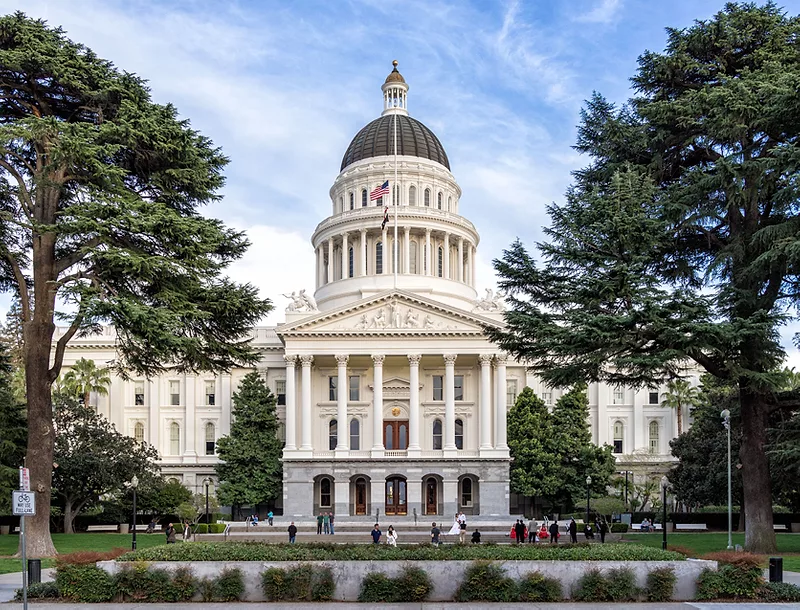
Gov. Gavin Newsom and Attorney General Rob Bonta are suing President Donald Trump over his use of emergency powers to enact broad tariffs. Filed in federal court in San Francisco, the lawsuit counters Trump’s use of the International Emergency Economic Powers Act to enforce broad duties.
Read our full report at Agri-Pulse.com.
Burgum blasts California’s drop in Delta pumping
Interior Secretary Doug Burgum lashed out against the Newsom administration on Wednesday over California’s water policies.
Burgum posted on X that the Bureau of Reclamation is attempting to follow Trump’s January executive order to maximize water deliveries to farms and cities. But “a 30-year old burdensome state [regulation] based on outdated science” is blocking the move. Burgum called on state leaders to “act immediately so that residents & farmers can get the water they need.”
Remember: To protect endangered fish species, the Department of Water Resources has cut Delta pumping in half for the State Water Project through May. DWR anticipates the additional freshwater coursing through the Delta will improve habit and food availability for Delta smelt and longfin smelt, along with migratory conditions for Chinook salmon.
The department hopes the state water board will adopt a voluntary agreement pathway in its Bay-Delta Plan that would provide alternatives to the pumping policy next year.
Reaction: Applauding Burgum’s post, the Friant Water Authority issued a statement calling the water policy one of the many reasons why “people talk about a broken water system that is incapable of meeting the basic needs of people and farms.”
Keep in mind: Trump also ordered federal agencies to override “disastrous California policies,” indicating the administration may have more actions planned on this issue. But a stronghanded intervention by the Trump administration could upset the delicate trust exercise the water board is undertaking with the voluntary agreements.
U.S.-Japan negotiations kick off, with Trump in the midst
Negotiations between the U.S. and Japan on a possible deal to lower reciprocal tariffs kicked off in Washington this week, with the president personally involved.
“Japan is coming in today to negotiate Tariffs, the cost of military support, and ‘TRADE FAIRNESS,’” President Donald Trump said on social media Wednesday. Trump attended a meeting Wednesday with the Japanese team and his key cabinet members.
Why it matters: At least one ag sector is pushing for better market access as an outcome from the talks. National Potato Council CEO Kam Quarles told Agri-Pulse that the group has met with the National Economic Council and pressed U.S. Trade Representative Jamieson Greer and Agriculture Secretary Brooke Rollins for potatoes to be part of negotiations.
Market access for U.S. potatoes is limited as Japan drags its feet on pest risk assessments, the group says.
Quarles said opening the Japanese market would be an “easy win” for the administration, “if you can get past the politics.”
Take note: South Korea’s finance minister is expected in Washington for talks next week; Italy’s Prime Minister Giorgia Meloni is flying in this week to try and advance U.S.-EU negotiations. A European Union spokesperson told reporters Tuesday that officials remain unsure of what the U.S. wants out of the negotiations.
Economists warn of inflation, slower growth, shrinking trade from new tariffs
The larger-than-expected tariffs Trump slapped on U.S. trading partners April 2 are set to ripple across the U.S. and global economies, spurring price spikes, economic slowdowns and lower trade volumes, economists say.
“Tariffs are highly likely to generate at least a temporary rise in inflation,” Federal Reserve Chair Jerome Powell warned on Wednesday. Powell said how long the inflation spike will last will depend on the ultimate size of the tariffs and how long they take to pass through to consumer prices.
Growth has already slowed from last year, he added.
The World Trade Organization said Wednesday it’s anticipating a slowdown in global trade. Global goods trade is set to fall 0.2% in 2025, with North American exports contracting 12.6%. If the higher U.S. country-specific tariffs return after the 90-day pause and uncertainty persists, the global trade slump could worsen to 1.5%.
The Center for Strategic and International Studies estimates that the reciprocal tariffs will slow U.S. GDP by 0.8% and drive overall prices 7% higher. Meanwhile, it says wages could grow only 6%.
Rollins reassures Texas farmers
Ag Secretary Brooke Rollins was back in her home state of Texas Wednesday, this time in Lubbock, the center of the nation’s largest cotton-growing region. Farmers there have been reeling from depressed prices and prolonged droughts, and now they face a trade war with China, their biggest export market.
It’s easy to be “in the know” about agriculture news from coast to coast! Sign up for a FREE month of Agri-Pulse news. Simply click here.
At a short press conference, Rollins reiterated her hope that farmers won’t need compensation from USDA for trade losses. But if they do, she said, “The president is resolute in his commitment to back our farmers and our ranchers. Just as he did in Trump I, he will do it again. USDA is preparing for that moment if it is necessary.”
Ag groups: U.S. must step up at WTO
A coalition of 30 ag industry groups is urging the congressional committees that oversee trade policy to stress the importance of U.S. leadership at the WTO.
“Without the WTO, our country will lose critical market access for American food and agricultural exports, but more importantly, we will lose the opportunity to build rules that allow us to feed the world,” the groups say in a letter to the House Ways and Means and Senate Finance committees.
The groups argue that the U.S. retreat from the organization in recent years has emboldened China. The U.S. suspended its payments to the WTO last month and Trump has previously threatened withdrawal.
The ag groups urge lawmakers to “adamantly oppose U.S. withdrawal” from the WTO.
Take note: The American Farm Bureau Federation, Corn Refiners Association, National Grain and Feed Association, North American Export Grain Association and USA Poultry & Egg Export Council are among the signatories.
‘Harming’ endangered species may become easier under rule change
The Trump administration wants to scrap a key protection for endangered species, proposing to narrow the prohibition against “harming” species to actions that actually result in the death of wildlife.
The Fish and Wildlife Service and National Marine Fisheries Service have proposed replacing the regulatory prohibition against “harm,” which includes “significant habitat modification or degradation where it actually kills or injures wildlife.”
Instead, the agencies have proposed using the ESA definition of “take,” which the law says can mean “to harass, harm, pursue, hunt, shoot, wound, kill, trap, capture, or collect.”
Take note: Environmental groups said they would fight the proposal. “Given that habitat destruction is the biggest cause of extinction, this definition of harm has been pivotal to protecting and recovering endangered species,” the Center for Biological Diversity says in a press release.
Trump-aligned think tank launches ‘Farmers First Agenda’
The America First Policy Institute, a conservative think tank launched by Ag Secretary Brooke Rollins in 2021, has unveiled a “Farmers First Agenda” closely aligned with the Trump administration’s priorities.
“We feel like there is somewhat of a void of pro-farmer, pro-rural think tank leadership in our nation's capital,” said Tate Bennett, director of rural policy at AFPI.
Christie Mullin, wife of Sen. Markwayne Mullin, R-Okla., will serve as chair of rural policy. Indiana farmer and former ambassador to the United Nations Agencies for Food and Agriculture Kip Tom will serve as vice chair, and Illinois farmer and entrepreneur Sarah Frey is a senior adviser.
Bennett outlined three broad priorities for the initiative: drive rural policy, resize and reorient government, and generate responsible nutrition policy.
The initiative includes promoting international trade opportunities by expanding export markets and lowering trade barriers. That includes promoting “policy tools like reciprocal tariffs to eliminate other countries’ tariff and nontariff trade barriers,” Bennett said.
The group also is prioritizing healthier eating habits and working to “eliminate diet-related chronic disease further,” mirroring a central priority of the “Make America Healthy Again” movement.
Final word
“It seems our future hangs in the balance.” — Estelle Clifton, Daniel Suenram, Pat Burns and Martin Pozzi, who are farm bureau presidents for Mendocino, Lake, Sonoma and Marin counties, respectively.
The farm leaders are asking the Trump administration to prevent a PG&E dam removal. They argue the utility’s decision “threatens the region’s water accessibility, economic stability and disaster preparedness.”


