
USDA is raising alarm about negotiations between the United Kingdom and the European Union that could leave the UK more closely aligned with EU food standards. Analysts argue that such a move is set to curtail the possible benefits to U.S. agriculture from a future UK-U.S. trade deal. But some doubt that market opportunities U.S. exporters are eyeing were ever really there.
USDA’s Foreign Agricultural Service warned last month that although the UK is pressing ahead with negotiations on both a U.S. trade pact and a new sanitary and phytosanitary agreement with the EU, the latter could hamstring discussions on the former.
If the UK aligns with substantial portions of the EU’s current and future food safety rules, FAS said in a report, it could constrain “the UK’s flexibility in negotiating the agricultural chapters of other FTAs.”
London's Financial Times reported on Tuesday that the U.S. and UK could sign a trade pact to lessen the impact of U.S. tariffs as soon as this week. The UK has offered to lower tariffs on U.S. agricultural products as part of those discussions, the FT says, but the UK government will not include food standards, which U.S. agricultural producers have argued remains a major trade obstacle, among the concessions.
The White House declined Agri-Pulse's request for clarification on the timing and scope of a potential UK-U.S. deal.
Since leaving the EU in 2020, the UK has kept many EU food standards, according to the UK Food Standards Agency, but it has diverged in important ways that have erected new agricultural trade barriers with its largest trade partner. The UK has raised the maximum residue level for some pesticides, for example, and adjusted definitions of genetically modified organisms.
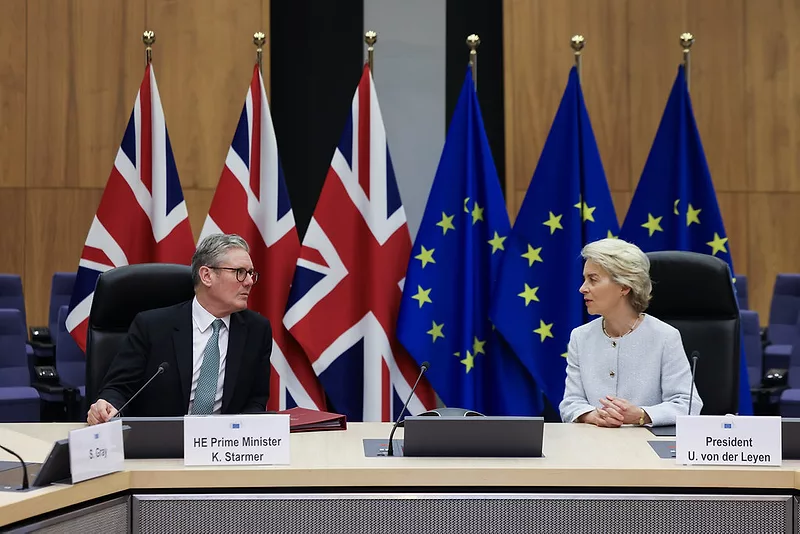
Keir Starmer’s Labour government pledged to streamline trade with the EU during the election campaign last year, and the UK and EU are expected to unveil an agreement that includes SPS regulations at a joint summit slated for May 19, analysts told Agri-Pulse.
David Henig, director of the UK Trade Policy Project at the European Center for International Political Economy and a former UK trade official, told Agri-Pulse that although the final deal will take several years to negotiate, the initial announcement should give a strong indication of how the UK is planning to align with EU standards.
“What I'm expecting is this will be a sort of ‘agreement in principle,’” Henig said, that will set the scope of the deal before negotiators dive into the details.
The extent to which the UK-EU deal affects ongoing U.S.-UK negotiations will depend on how much regulatory alignment the UK accepts from the EU, FAS said in its report. The least obtrusive from the U.S. point of view would be a simple mutual recognition agreement – like the veterinary agreement the EU cut with New Zealand, which simplified trade processes but left many border checks in place.
However, FAS argues that a “Switzerland-style” deal could pose some challenges. All border checks for agricultural products between the EU and Switzerland were abolished in 2009 after Switzerland agreed to maintain “similar legislation leading to identical results.” Switzerland also applies the same rules as the EU to all imported products.
“It’s not quite clear where on that kind of spectrum” the UK and EU will land, John Clarke, former EU chief agricultural negotiator, told Agri-Pulse. “My feeling is that the ambition will be quite high.”
 ECIPE's David Henig (LinkedIn photo)
Nick Thomas-Symonds, the UK minister responsible for UK-EU relations, has indicated that the UK government wants “an ambitious” deal, but he has also suggested that it could seek a “bespoke” deal unlike any that the EU currently maintains.
Dynamic discussions
Of particular concern to USDA, according to the report, is the prospect that the UK agrees to some form of “dynamic” regulatory alignment that would see the UK incorporate any future EU regulatory reforms.
While the EU-Swiss deal states that Switzerland needs to adopt legislation that fosters identical results, there is no built-in mechanism to update Swiss laws when EU standards are updated or reformed. This has fueled consternation in the EU that divergence is gradually creeping in, according to analysis from UK in a Changing Europe, a London-based think tank.
Ed Barker, head of policy at the UK’s Agricultural Industries Confederation, told Agri-Pulse that the EU could look to correct this in a UK-EU SPS deal and push for more dynamic alignment.
Such terms could “bring the EU into the agreement,” Barker said. The EU may also have the upper hand in negotiations.
“It's been no secret that exporters to [Great Britain] have arguably had fewer barriers to trade than exporters from GB to the EU,” Barker said. “There may well have to be consideration for the wider industry as to what potential countermeasures are asked for, or even what the final proposals look like, which is why the scope is extremely important.”
Clarke agreed that a dynamic arrangement is likely to be among the EU’s trade asks, and argued it could also be palatable for the UK if Starmer's government can sell the arrangement less as a concession and more as a logical step to ease trade frictions.
Cut through the clutter! We deliver the news you need to stay informed about farm, food and rural issues. Sign up for a FREE month of Agri-Pulse here.
“It's all about political salesmanship,” Clarke said. Most of the British public “don't know what dynamic alignment means,” he added, “it's not too difficult to organize if the government is smart.”
But Meredith Broadbent, a former U.S. trade negotiator and senior adviser at the Center for Strategic and International Studies, says the UK would be much better served to wait and see how U.S. negotiations play out, arguing that agreeing to dynamic alignment would only serve to “tie their hands” in transatlantic negotiations.
The UK Department of Business and Trade did not respond to Agri-Pulse's request for comment on the EU negotiations.
A not-so-special relationship
If the UK agrees to dynamic alignment, it would preclude a U.S.-UK trade agreement from adjusting UK food standards, Clarke said.
 John Clarke (LinkedIn photo)
For meat exporters eyeing opportunities in the UK market, this would deliver a blow. At a recent hearing before the U.S. House Ways and Means Committee, Robby Kirkland, chairman of the Texas Cattle Feeders Association, complained that UK non-tariff barriers limited U.S. beef sales. He urged U.S. officials to push for “science-based trading” in upcoming negotiations.
Clarke and Henig, however, doubted whether the UK holds the market opportunities U.S. meat exporters are craving, even absent a UK-EU deal. UK Business and Trade Secretary Jonathan Reynolds told Sky News last month that SPS standards were never up for negotiation as part of a U.S.-UK trade pact – a point he said he’d conveyed to U.S. officials.
Reynolds pointed out that parts of the U.S. meat industry already met British standards on a voluntary basis, however, suggesting that there could be some opportunities for tariff reductions.
“Hormone-fed beef, chlorinated chicken, there's massive public opposition to that,” Clarke said, referring to the outdated UK public perception that U.S. poultry producers rinse chicken products with chlorine. The UK and EU, however, don’t allow any chemical treatment of poultry, which has limited U.S. exports to the region.
But even those American food products that meet UK standards are unlikely to be competitive in the UK market, according to Henig.
“Even if everything could be exported the UK, I actually don't think that a lot would be exported,” Henig said. “It's just not a natural market.”
The long transportation distance across the Atlantic, Henig said, introduces supply chain vulnerabilities and added cost. And the UK has a large meat producer on its doorstep in Ireland.
“It would be incredibly difficult for U.S. producers to displace the Irish from that market,” Henig added.
Broadbent was skeptical, however. Part of the pushback from UK farmers has been focused around the damage U.S. exports could do to the domestic industry. This wouldn’t be such a talking point if U.S. products couldn’t compete in the UK market.
“Our ag exports are pretty darn competitive,” Broadbent told Agri-Pulse. “Part of the UK’s objection is they come from bigger facilities that are more efficient.”
But Henig pointed to a UK-Australia trade deal that went into effect in 2023 that illustrates the challenges new entrants face in the UK meat market. Under the deal, Australian producers received a quota of beef products that can enter duty-free. But in 2023, Australia filled just 11% of its quota, rising to 15% in 2024, the UK Agriculture and Horticulture Development Board reports.
That is not to say that an agriculture chapter in a UK-U.S. trade deal couldn’t unlock benefits for U.S. exporters, Barker said, but they would likely come from industries that may not have been the most vocal in calling for a deal.
“The U.S. is a significant supply of seeds, of critical minerals, of fertilizers – feed additives is a big focus for our sectors as well,” Barker said, as has horticulture. The UK has eliminated tariffs on multiple products that benefit domestic producers, but he said there are areas for further cuts.
“Opportunities are there, but they're probably in smaller sectors or specific sectors,” Barker said.
For more news, go to www.Agri-Pulse.com.

