
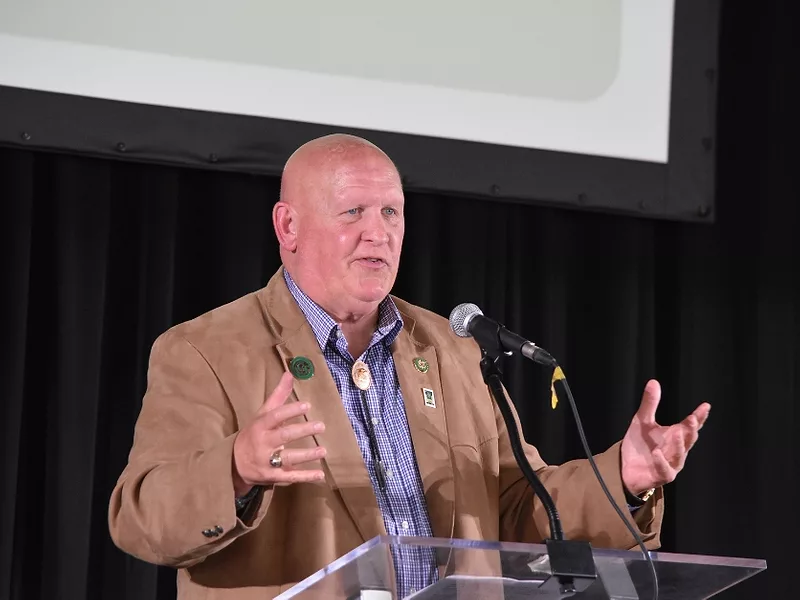
Republicans on the House Agriculture Committee are expressing confidence they can hold a markup early next week on their portion of the GOP's massive budget reconciliation bill, despite continued wrangling over potential cuts to the Supplemental Nutrition Assistance Program.
Committee Chair Glenn "GT" Thompson, R-Pa., said Tuesday he expects bill text to come out as early as this weekend.
Still, some members are drawing red lines on proposals that Thompson said are essential to reaching the necessary level of cuts to SNAP. The committee is tasked with finding $230 billion in net savings, but the cuts to SNAP would have to be higher than that to offset the cost of farm bill programs Republicans want in the bill, including increased spending for commodity programs and crop insurance.
One of the more controversial measures is a proposal to implement a state cost-share for SNAP. Currently, states pay some of the administrative costs, but the federal government funds benefits.
The committee has discussed implementing a 10% to 25% cost-share on states, which some members argue would spell disaster for their states' budgets.
One of those members, Rep. Derrick Van Orden, R-Wis., has proposed an alternative method for calculating the state cost-share based on SNAP payment error rates.
“I want to be explicitly clear, I will not vote to have the citizens of the state of Wisconsin pay 10% cost-share to make up for other people's just blatantly horrible management,” Van Orden said following a Tuesday morning meeting of House Agriculture Republicans.
He pointed out other states that have lowered their SNAP error rates since 2019, including Rhode Island and Minnesota. He said it doesn’t make sense to penalize states that are showing progress.
Wisconsin’s SNAP overpayment rate was 4.74% in 2023, according to USDA. The national error rate for the same year was 11.7%, including under and overpayments. This equates to $10.5 billion, according to the Government Accountability Office.
Rep. Mark Harris, R-N.C., said he believes the committee will ultimately move forward with a state cost-share tied to the SNAP error rates.
“We’ve got to get reconciliation passed,” Harris said. “It’s important that people realize that states have skin in the game, and that’s really at the heart of what we’re trying to do, is just making sure that it’s administered well, it is administered right and everybody is participating.”
Cut through the clutter! We deliver the news you need to stay informed about farm, food and rural issues. Sign up for a FREE month of Agri-Pulse here.
Thompson said his team is working on both state cost-share options and that the White House is “very supportive” of the concept. He added he doesn’t think he could reach the $230 billion and more in cuts without the cost-share option.
Despite the policy divide, Republicans were projecting confidence that the markup will happen next week.
“Got a handful of folks, typically members who would perhaps prefer more dramatic changes, one or two who don’t want any change, but we have reconciliation instructions we have to match,” said Rep. Frank Lucas, R-Okla. “So, it should be interesting next week.”
Thompson said he’s still wants to move parts of the farm bill into the reconciliation measure, although lawmakers are limited by the Senate's Byrd Rule to including provisions that either raise or lower spending.
One thing the committee is toying with is working conservation funding from the Inflation Reduction Act into the reconciliation measure. But Thompson said he’s still determining if it would be better to leave that funding for a separate farm bill.
“It would work well either way,” Thompson said.
Oliver Ward contributed to this story.
For more news, go to www.Agri-Pulse.com.

