
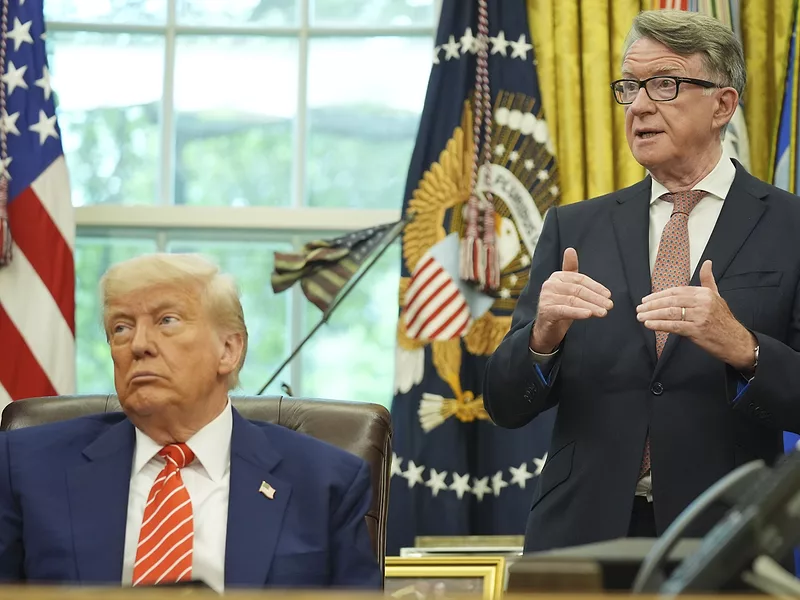
The U.S. and United Kingdom unveiled the outline of a trade deal that covers U.S. beef, ethanol, and other agricultural exports, President Donald Trump said Wednesday, but leaves the 10% baseline tariff on the UK intact.
“I think it’s going to be something special for the UK and special for the United States,” Trump said.
The president touted increased market access for U.S. beef and ethanol under the agreement, arguing it would allow “billions of dollars” in exports from increased market access. While Trump did not elaborate on what the market access for beef would entail, Agriculture Secretary Brooke Rollins said, and a UK government statement confirmed, that the UK would remove its tariffs on ethanol.
Under the terms of the deal, published Thursday evening, the UK will eliminate duties on the first 1.4 billion liters of ethanol imports.
“I think a really important part of this deal isn't just the ethanol, reducing of tariffs from 19 to zero, which for our row croppers is a huge deal, but also for beef," Rollins told reporters during a press briefing in the Oval Office on Thursday. "This is going to exponentially increase our beef exports.”
A statement from the UK's Department of Business and Trade on the contours of the US-UK deal says that the U.S. and UK agreed to "reciprocal market access on beef," with UK farmers to receive a U.S. export quota for 13,000 metric tons. Accordingly, U.S. exporters will be able to send a comparable amount to the UK tariff-free, according to the agreement text.
A Commerce Department statement also lists fruits, vegetables, animal feed, tobacco and shellfish among the products covered by the agreement.
Asked whether the deal would address any of the nontariff barriers U.S. beef faces in the UK market, which include a ban on growth hormones, Trump said only that the UK will “take what they want.”
U.S. Trade Representative Jamieson Greer added that the U.S. had been stressing to the UK that rules need to be “based on science.”
“That's our expectation. We know the UK believes that too. So, we want to come to an accommodation,” he added.
The UK government has said publicly it would not budge on sanitary and phytosanitary measures as part of a U.S. deal, despite U.S. producers pushing for reductions in SPS-related trade barriers. The UK is pursuing a food and veterinary agreement with the European Union to streamline agricultural trade between the two partners that is expected later this month and is likely to move closer into alignment with EU standards, analysts say.
The DBT statement says that the UK maintained "protections on food standards."
Cut through the clutter! We deliver the news you need to stay informed about farm, food and rural issues. Sign up for a FREE month of Agri-Pulse here.
"There will be no weakening of UK food standards on imports," the statement reads.
Even so, Commerce Secretary Howard Lutnick estimated that the agreement in principle could unlock $5 billion in export opportunities for U.S. products. A White House fact sheet argues that the measures would lead to an additional $700 million in U.S. ethanol exports and $250 million in other agricultural products. The fact sheet adds that both countries committed "to work together to enhance industrial and agricultural market access."
In return, the UK will be able to export some vehicles at a lower tariff rate and the two sides will continue to negotiate an arrangement for steel and aluminum exports, the fact sheet says.
The UK is subject to a 10% U.S. baseline duty, imposed as part of Trump's "Liberation Day" tariff package. The country's exports have also been affected by U.S. tariff hikes on autos and steel and aluminum imports.
The baseline tariff, however, will remain in effect, Trump said.
“I think that’s set,” Trump said. He also suggested that future deals would not involve negotiations to lower that across-the-board tariff.
“The template of 10 is probably the lowest,” he added, referring to potential future deals.
Both U.S. and UK officials indicated that future negotiations would need to take place to flesh out the deal and build on the framework unveiled on Thursday.
“We can finish hammering out some of the detail, but there's a fantastic platform here,” UK Prime Minister Keir Starmer said Thursday. He spoke at the Oval Office press conference via phone.
Officials from both sides of the Atlantic suggested that Trump himself had played a role in the negotiations, reaching out to Starmer in an “eleventh-hour” phone call on the deal. Agri-Pulse understands that aspects of the deal were still being negotiated as of Tuesday afternoon.
Earlier in the day, Trump touted the deal as the first of many his administration would be cutting in exchange for providing tariff relief.
“[I]t is a great honor to have the United Kingdom as our FIRST announcement,” the president wrote in a post to Truth Social. He added that numerous other deals are in “serious stages of negotiation.”
Treasury Secretary Scott Bessent and Greer will be in Switzerland this weekend to meet with Chinese officials. Trump also said he intends to make a deal with the European Union.
The U.S. beef and corn industries reacted warmly to the announcement of the UK deal.
"With this trade deal, President Trump has delivered a tremendous win for American family farmers and ranchers,” said National Cattlemen's Beef Association President Buck Wehrbein. "For years, American cattle producers have seen the United Kingdom as an ideal partner for trade. Between our countries’ shared history, culture, and their desire for high-quality American beef, securing a trade agreement is a natural step forward."
"When countries agree to do business with each other by lowering trade barriers, American farmers and ranchers win time and time again," Corn Refiners Association President and CEO John Bode said in a statement. "We hope this agreement will be the first of many to open new markets for U.S. agriculture."
Senate Agriculture Committee Chairman John Boozman, R-Ark., also touted the deal's potential for agricultural producers in his home state.
"The United Kingdom is an important potential market for increased exports of key Arkansas products like rice, and early reports of this deal demonstrate serious wins for our nation’s beef and ethanol producers," he said in a statement. The committee was not briefed on the contents of the deal beforehand, according to a committee staffer.
But even before the details of the UK deal had been announced, some were skeptical that it would lead to meaningful benefits for U.S. exporters. In an interview on CNN Thursday morning, Senate Finance Committee ranking member Ron Wyden, D-Ore., doubted “there is much there.”
“About 2 percent of our imports come from Great Britain,” Wyden said. “So put me down as kind of skeptical.”
Justin Wolfers, a professor of economics and public policy at the University of Michigan, called the deal, “a photo op, with little macroeconomic significance,” in a post to X.
He pointed out that the UK already has a very low average tariff rate, so the deal has “limited upside.”
For more news, go to www.Agri-Pulse.com.

