
President Donald Trump has unveiled what the administration says is the first of a series of deals with trade partners to secure concessions in exchange for relief from U.S. tariffs. The deal with the United Kingdom could shed some light on future arrangements and the administration’s approach to dealmaking, experts say.
The outline of the U.S.-U.K. deal calls for the U.K. to eliminate duties on a chunk of U.S. ethanol exports and grant some U.S. beef products tariff-free access to the U.K. market – providing they meet U.K. food standards. In exchange, the U.S. eased tariffs on some U.K. auto exports and agreed to work towards implementing a quota for steel and aluminum.
“It was noteworthy that two of the big gets for the United States were related to ag,” Brian Kuehl, executive director of Farmers for Free Trade, told Agri-Pulse.
Senior U.S. trade officials have repeatedly said that opening new markets for U.S. agriculture products is a major focus of the second Trump administration. But agriculture had been a key sticking point in previous U.S.-U.K. negotiations and, with agricultural voters often representing a powerful voting bloc, remains a sensitive issue for many governments around the world.
It’s easy to be “in the know” about what’s happening in Washington, D.C. Sign up for a FREE month of Agri-Pulse news! Simply click here
But for Kuehl, the positioning of agricultural demands at the front and center of the U.K. deal illustrated this administration’s commitment to advancing farmers’ interests.
“That shows that the administration knows that it has to help farmers, and it wants to lean in and try to find ways to help,” Kuehl said.
Whether the deal actually leads to increased exports, however, is another matter, particularly for U.S. beef. Under the terms of the deal, U.S. exporters will have to meet U.K. standards to sell into the market, leaving myriad nontariff trade barriers in place. Kuehl is skeptical the reduction in beef tariffs alone will be enough for U.S. exporters to gain a foothold in the U.K. market.
“Ethanol on the other hand, that seems unequivocally good,” Kuehl said, adding that he would expect to see reducing barriers to ethanol trade also play a part in future trade deals.
“We should be trying to sell our ethanol overseas. That seems like a place where we can see some gains,” Kuehl said. India, which currently limits ethanol imports for on-road uses, should be a particular priority, Kuehl said.
 Brian Kuehl (Pinion Global photo)
“Hope springs eternal,” he added.
Another nail in the WTO’s coffin?
Successive U.S. administrations have shown indifference to World Trade Organization rules. Ever since Trump blocked the appointment of new judges to the organization’s appellate body during his first term, the U.S. has embarked on a series of policies that have undermined the principles underpinning the global trade system.
But multiple parts of the U.K.-U.S. deal represent a further departure from WTO principles, analysts said. As part of the deal, for example, the U.K. pledged to reduce tariffs on U.S. products “on a preferential basis” for a range of goods yet to be negotiated, according to the agreement’s terms.
“It's no secret that the U.S. is no longer interested in allowing WTO rules to constrain its behavior. But by agreeing to this deal, it appears to me now that the U.K. is following our lead,” Wendy Cutler, vice president of the Asia Society Policy Institute and former acting deputy U.S. trade representative, told Agri-Pulse.
International trade rules have long required countries to set product tariff rates that apply evenly to all partners that don’t have a comprehensive free trade agreement with the country, with only a narrow set of exceptional circumstances. The U.S. seemingly departed from this norm in its announcement of country-specific tariff rates last month. The U.K. could soon do the same under the terms of the deal.
“That will cause a lot of consternation around the world,” Cutler said. She anticipated that “other countries are going to be forced to make those types of decisions as well,” as part of ongoing U.S. negotiations.
The U.S.’ handling of its beef import quota also further breaks with established WTO procedures.
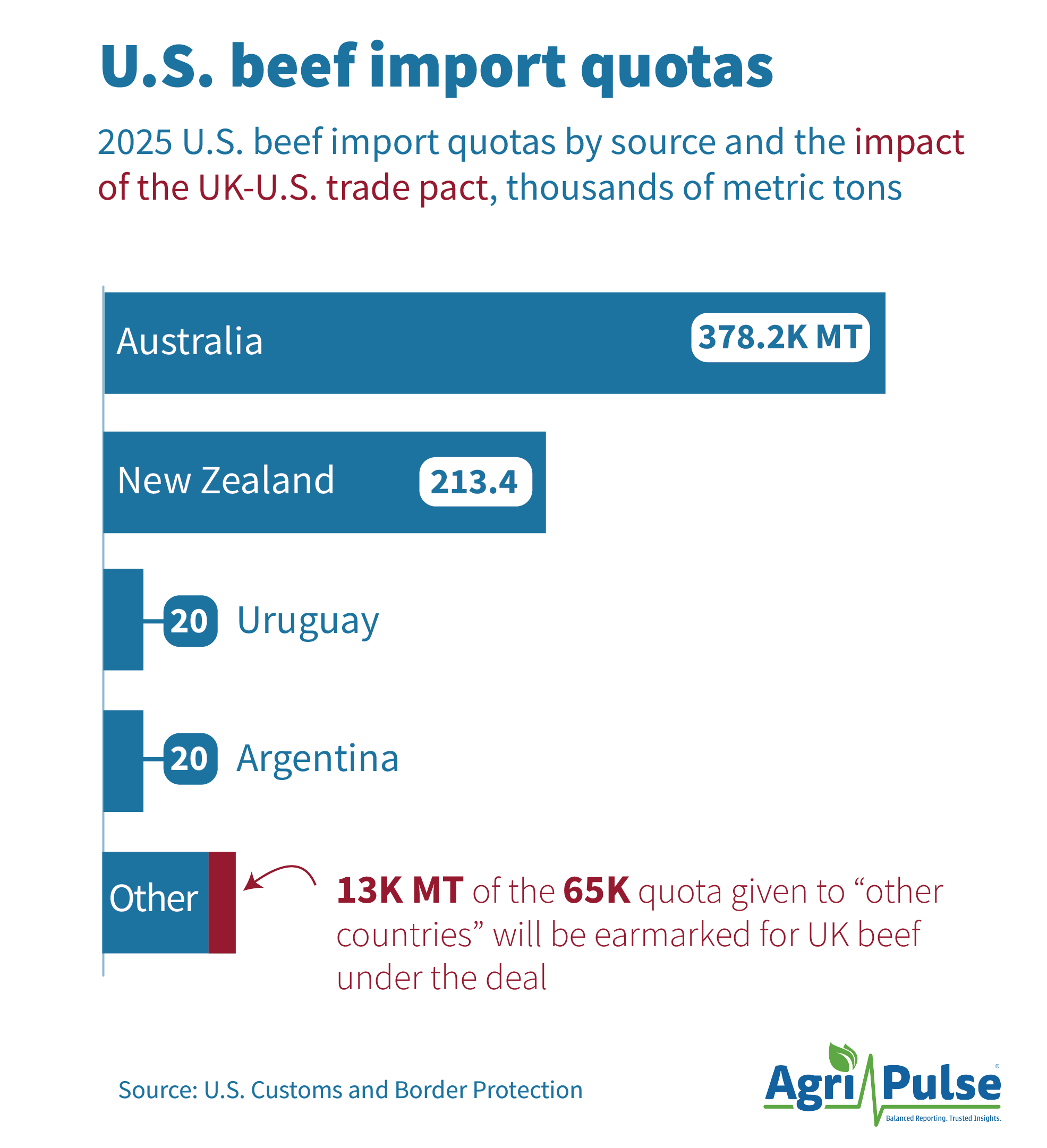
Both countries agreed to reciprocal cross-border beef trade arrangements. In return for granting U.S. exporters duty-free access for 13,000 metric tons of beef annually, the U.S. will ease tariffs for a similar quantity of U.K. beef. Rather than creating a new quota or adding 13,000 metric tons to an existing quota — which could require congressional approval or spark backlash from domestic producers, according to former USTR General Counsel Greta Peisch — the U.S. will allocate 13,000 MT of an existing 65,000 MT quota that is currently available to a group of countries, including Brazil.
This quota reallocation could also run afoul of WTO rules. The beef quota was negotiated at the WTO, and WTO rules require countries to consult with quota users before making any adjustments and to administer quotas in a nondiscriminatory way.
“There is a mechanism,” Peisch said, who is now a partner at the Wiley Rein law firm. “You will go in, you present the change, you have conversations about it.”
Alan Wolff, a former WTO deputy director-general, told Agri-Pulse that cornering off 13,000 MT specifically for U.K.-produced beef from a quota that is open to multiple U.S. trading partners could also be seen as discriminating against other quota users.
“That strikes me as nothing that can be squared with the rules,” Wolff said, concluding that “these deals are not designed to be WTO consistent.”
The bulk of the 65,000 MT 2025 quota went to Brazilian exporters, who maxed it out in just 17 days.
Brazil’s Ministry for Agriculture did not reply to multiple requests for comment on the issue.
A baseline tariff is here to stay
The administration’s messaging around whether it is open to negotiating individual countries’ tariff rates below the 10% baseline rate has been mixed. In the wake of the U.K.-U.S. deal’s announcement, Trump told reporters that the U.S. would “always have a baseline,” but also said that “there could be an exception,” if a negotiating partner offers something “exceptional.”
Meanwhile, Commerce Secretary Howard Lutnick told CNN on Monday that he expects a 10% minimum tariff for “the foreseeable future.”
But multiple analysts told Agri-Pulse that if the U.K. – with its goods trade deficit with the U.S. and close diplomatic alliance – couldn’t negotiate its tariff rate below 10%, others are unlikely to be successful, and many could land on final tariff rates significantly higher.
“It looks like the administration is holding firm on that 10%,” Peisch said. “That's where countries should sort of assume that they're going to be ending up.”
With the administration keeping the 10% off limits in negotiations, Trump’s tariff goals have come more clearly into focus, said Everett Eissenstat, who served as deputy director of the National Economic Council during Trump’s first term.
“The 10% is more about revenue raising,” Eissenstat told Agri-Pulse. The sector-specific tariffs, like those applied to steel, aluminum and automobiles, are designed to promote reshoring and spur domestic manufacturing.
Meanwhile, the country-specific reciprocal tariffs are being wielded to address unfair trade practices. “That seems to be the one that has greatest flexibility,” Eissenstat noted.
Skinny deals with long tails
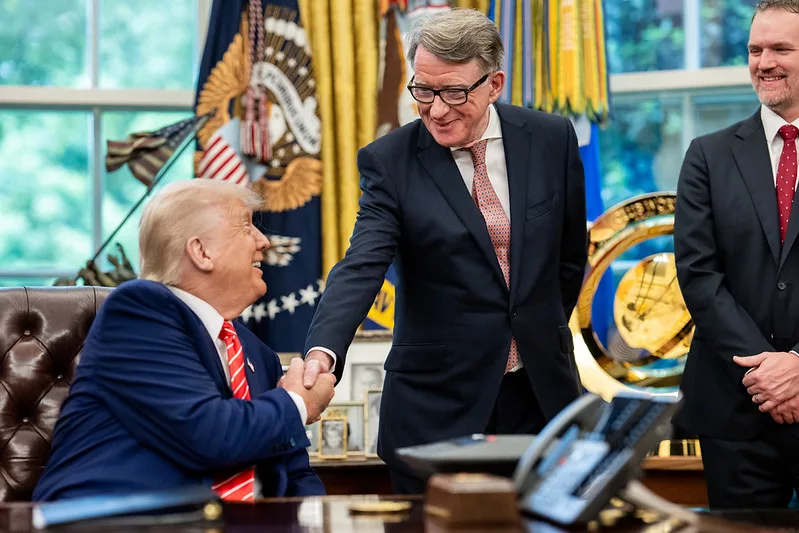
Trump unveiled the U.K. announcement with a press conference in the Oval Office with U.K. Ambassador to the U.S. Peter Mandelson, with U.K. Prime Minister Keir Starmer calling in via phone. Both sides emphasized that the two countries had been working towards a trade deal since Trump’s first term, after the UK public voted to leave the European Union.
But even with the long negotiating history, the agreement published Thursday was scant on specifics and left many of the finer points to be ironed out in later negotiations, Cutler said.
 Wendy Cutler (LinkedIn photo)
“When one looks at the text and scrutinizes it, it seems to be very prospective,” Cutler said. “It envisions a much longer, detailed negotiation ahead,” which she argued is unlikely to be straightforward.
“When I read this text, I almost think if they had 30 more days, it would have been a lot stronger,” Cutler added.
But the administration is against the clock and has a long waitlist of countries seeking tariff relief. Treasury Secretary Scott Bessent told lawmakers last week that the U.S. is negotiating with 18 countries; since then, officials have also entered into discussions with China.
With fewer than 90 days until the president’s pause on higher country-specific tariffs is due to expire, officials may have little option but to use early talks to hammer out a loose framework for discussions and leave the deals’ specific for later negotiations.
The U.K. deal, for example, includes language that says both sides agree the deal can be expanded over time to cover additional areas, and that both countries will support further talks on strengthening agricultural trade.
Bespoke Britain
One trade lawyer cautioned against drawing too many conclusions from the U.K. deal, however. The country, they reasoned, has a unique economic relationship with the U.S., given the goods trade surplus and specific industry interests.
“Each agreement will probably look pretty different,” the trade lawyer said. “Japan may look more like this one,” he added, given Japan’s similar concerns around steel, aluminum and vehicle exports. But the administration has suggested it would pursue bespoke arrangements with each country, and the trade lawyer said in the case of the U.K., they might have succeeded.
Bespoke “might be a little too sophisticated, given the kind of time frame they're on, but I think it is unique for the U.K.”
For more news, go to Agri-Pulse.com.

