
A segment of the beef industry is planning to petition the Trump administration to use a forthcoming review of a North American trade pact to revive mandatory country-of-origin labeling. But the industry remains divided on the issue, and some argue negotiating efforts would be better focused elsewhere.
The U.S.-Mexico-Canada Agreement comes up for its six-year mandatory review in 2026 and officials are expected to solicit feedback from industry in the fall. R-CALF USA, a group based in Billings, Montana, is planning to press officials to use the talks to disarm Mexican and Canadian opposition to MCOOL.
R-CALF CEO Bill Bullard told Agri-Pulse that the organization plans to ask officials to negotiate with Canada and Mexico to ensure that they would not launch a trade dispute if the U.S. were to revive its MCOOL regime in the future.
The U.S. required country-of-origin labeling on a slate of ag food products, including meat, fish and fruit and vegetable products, beginning in 2009. But Congress repealed MCOOL in 2015 after Canada and Mexico successfully challenged the policy at the World Trade Organization and threatened to impose some $1 billion in retaliatory tariffs.
The National Cattlemen's Beef Association opposes MCOOL and has long questioned the benefits of the policy for the U.S. beef industry.
An NCBA-led letter to congressional leaders in 2019 complained that updating product packaging to display the country of origin could cost the domestic beef sector “hundreds of millions of dollars to implement” and bring little benefit given “the vast majority of consumers never paid attention to it.”
Kent Bacus, NCBA’s executive director for government affairs, told Agri-Pulse through a spokesperson that a new lobbying effort for MCOOL is “highly unlikely” to succeed.
“Canada and Mexico are resolute in their opposition,” he said because of the “market-distorting effects” of the policy. Bacus also argued that tighter rules around which ag products can claim to be “made in the USA” or a “product of USA” has obviated the need for MCOOL.
“There’s no need to fight this battle again,” Bacus said.
But a third cattle industry group, the U.S. Cattlemen's Association, has endorsed a Senate bill that would revive mandatory labeling. Jess Peterson, senior policy adviser for USCA, said in an email that his group is "pushing to advance COOL in every level possible."
At a recent webinar hosted by the Institute for Agriculture and Trade Policy, IATP’s Director of Trade and International Strategies Karen Hansen-Kuhn also touted the USMCA review’s potential for smoothing MCOOL’s reinstatement.
“We could consider inserting something into the USMCA process where the countries would have a sort of 'peace clause,'" Hansen-Kuhn said. Such a clause, she added, would see the three countries agree to refrain from retaliating or challenging the policy in international forums.
It’s easy to be “in the know” about what’s happening in Washington, D.C. Sign up for a FREE month of Agri-Pulse news! Simply click here
While Mexico and Canada were quick to take MCOOL to a WTO dispute panel in 2009, arguing that the U.S. was unfairly discriminating against foreign ad products, they may be more accepting of the policy today, analysts said. Mexico is embracing more descriptive labeling on products in its own market, Hansen-Kuhn pointed out. Last year its government enacted a law to require the labeling of products that contain genetically engineered ingredients.
High-profile congressional backing amid industry discord
MCOOL draws support from both parties, especially from lawmakers who represent northern Plains and Rocky Mountain states. Senate Majority Leader John Thune, R-S.D., has introduced the legislation that would reinstate the policy for beef, with four Democrats among the bill’s seven cosponsors.
"This legislation puts U.S. producers first and we look forward to collaborating with Senator Thune and lawmakers on both sides of the aisle to uphold integrity in the domestic beef market," USCA President Justin Tupper said in a Senate press release.
In the House, Reps. Harriet Hageman, R-Wy., and Ro Khanna, D-Calif., introduced a similar bill during the last Congress. Bullard said that R-CALF has been consulting with Hageman’s office about reintroducing that bill or something similar this Congress. Hageman’s office did not respond to a question from Agri-Pulse on whether she would do so.
In addition to lawmakers, Bullard has been courting other industry groups. The cattle industry has long been divided over the utility of MCOOL, with groups like NCBA arguing that the cost of implementing the packaging requirements outweighs any benefits.
Bullard has been in conversations with the National Family Farm Coalition and the Western Organization of Resource Councils. Bullard said the groups are “in general agreement” that MCOOL should feature in USMCA negotiations.
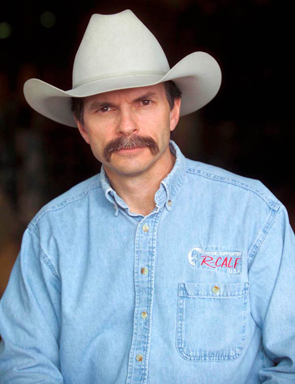 Bill Bullard (R-CALF photo)
Even with industry split on the policy, Bullard expresses optimism about MCOOL’s prospects. He pointed out that NCBA and its state affiliates have long opposed the policy, yet it was still included in the 2002 farm bill and ultimately implemented in the face of industry opposition.
But a 2015 study from the Agriculture Department’s Office of the Chief Economist found little evidence that U.S.-raised beef products had seen an uptick in consumer demand after MCOOL’s implementation, even if consumers were interested in the country of origin of their products.
“There wasn't evidence that beef or pork demand improved because of it,” Glynn Tonsor, the study’s lead author, told Agri-Pulse.
The industry bore the costs of implementing the policy without unlocking higher demand, leading to welfare losses of around $8 billion for the beef industry and $1.3 billion for the U.S. pork sector, the 2015 study found.
Tonsor, who is now a professor in Kansas State University’s agricultural economics department, said that there is no evidence to suggest that reviving the policy would lead to a different outcome today and suggested the costs of implementation could be even higher.
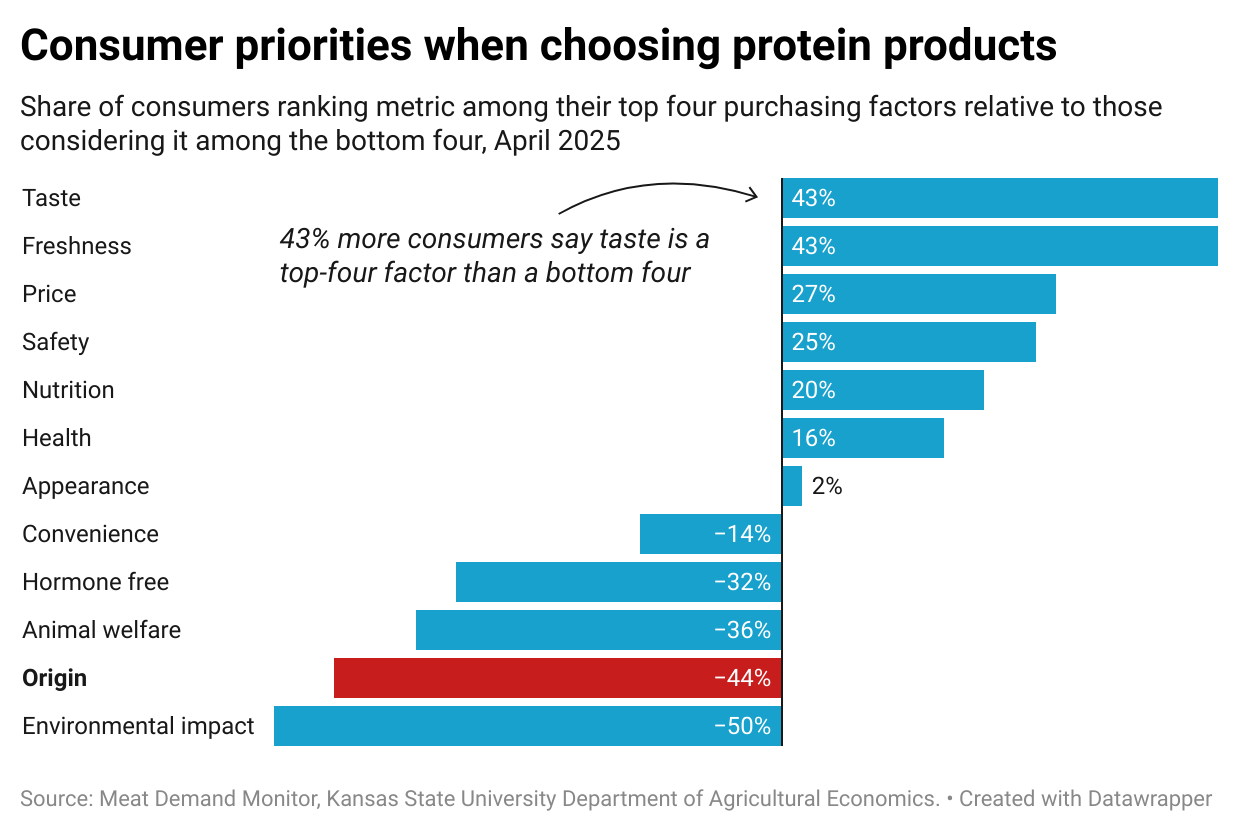
Kansas State puts out a monthly meat demand monitor that surveys consumers on the most important factors they consider when buying meat products. Country-of-origin consistently polls near the bottom of 12 metrics, Tonsor said.
A new trade landscape
Consumer purchasing preferences may not have evolved much since 2009, but the sources of U.S. beef products have, Tonsor added. Mexico and Canada are still major beef suppliers, as are Australia and New Zealand, but South American sources are rapidly increasing in importance.
Brazil was the third-largest supplier of U.S. beef last year, reporting more than 60% growth from 2023. Uruguay, meanwhile, saw 72% growth to become the sixth-largest U.S. supplier.
Any negotiated solution for MCOOL with Canada and Mexico would naturally exclude other U.S. suppliers, potentially leaving the U.S. vulnerable to WTO challenges from other aggrieved nations. But placating Mexico and Canada, two of the U.S.’ largest trade partners, may be sufficient for reviving the policy.
Bullard argued that policymakers are clearly less concerned about WTO challenges than they used to be. He pointed to a growing disregard of WTO rules from both parties. President Joe Biden’s Inflation Reduction Act broke with WTO principles in its preference for domestic content. President Donald Trump has made clear in his implementation of new tariffs and in recent trade deal talks with the U.K. that he will not be constrained by the WTO.
The House GOP-backed reconciliation bill also offers automobile loan interest relief for U.S.-made vehicles, which, on face value, would fly in the face of WTO rules.
“If Congress is just directly rejecting the core issue that the WTO used in order to rule against country-of-origin labeling … that helps pave the way for Congress to reinstate country-of-origin labeling for beef,” Bullard said.
Noah Wicks contributed to this report.
For more news, go to Agri-Pulse.com.

