
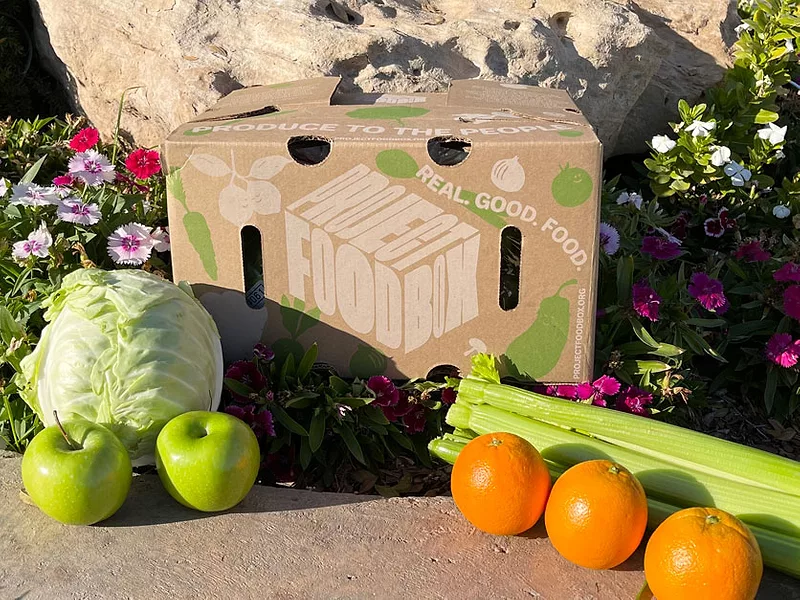
The Trump administration is considering ending a food assistance program for low-income seniors and rebooting a food box program similar to one implemented during the pandemic.
While details and funding for a revamped food box idea are scant, food banks, researchers and anti-hunger groups have noted that the first food box initiative had some issues and gaps.
President Donald Trump’s 2026 “skinny” budget request earlier this month would eliminate the Commodity Supplemental Food Program, saving $425 million.
Instead, the administration would replace CSFP with MAHA food boxes in line with the administration’s "Make America Healthy Again" priorities. These boxes would be sourced from domestic farmers and go directly to American households, according to the budget. It would be styled after the Farmers to Families food boxes that the first Trump administration implemented.
Over 176 million food boxes containing fruits, vegetables, dairy and meat products were delivered through the earlier program, according to USDA. However, it had infrastructure, access and distribution challenges that researchers and advocates say must be resolved if revamped.
The pandemic-era program left out many rural areas and contracts were awarded to “unqualified vendors with minimal oversight,” Gina Plata-Nino, deputy director at the Food Research and Action Center, wrote in a blog post. Additionally, many nonprofits lacked the resources to store and distribute the boxes, which led to additional costs for community groups, she said.
“These failures call into question the effectiveness and fairness of proposals to revive this model under the 'MAHA' food box initiative,” Plata-Nino wrote. “These cuts would lead to increased hunger and strain local communities as they attempt to fill the gap left by the administration.”
It’s easy to be “in the know” about agriculture news from coast to coast! Sign up for a FREE month of Agri-Pulse news. Simply click here.
A report by the Food Law and Policy Clinic at Harvard Law School and the National Sustainable Agriculture Coalition found that the earlier program was successful in preserving many businesses and alleviating food insecurity. USDA was also able to move quickly in setting up the program by awarding $1.2 billion in contracts to 198 contractors that successfully delivered the first 5 million boxes within 45 days of the program’s announcement, the report said.
While acknowledging successes, the report recommends alterations for future iterations of the program. Initial rounds of the Farmers to Families food boxes did provide access and support to small and mid-sized farms but subsequent policies began to favor larger companies and distributors.
The report highlights issues with distributing the boxes equitably across the country. Between May and June 2020, more than 1,000 counties received no food boxes, it said.
Emily Broad Leib, a director of the food policy clinic at Harvard and a lead author of the report, said one critique of the program was that it was disorganized. She said the intended recipients were not made clear and delivery of the packages was “a little bit of a free-for-all.”
 Emily Broad Leib (photo by Harvard Law School)
“I think the biggest concern really is how do you do something like this and build on what already exists and what makes sense rather than just sort of throwing money at … being able to say we’ve gotten food boxes out,” Leib said.
The administration could look at food as medicine programs as a model, Leib said. Some food as medicine offerings include deliveries of set packages of foods people need for health and dietary needs.
She noted at the end of the first Trump administration there were conversations on how to utilize local foods and producers to meet produce prescriptions. Food as medicine has been one area that farm groups have looked at for building regional and local food supply chains.
For procurement, Leib said the administration could look at the supply chains created through local food purchasing cooperative agreements to see if there are ways to reactivate those networks.
She added that better vetting of distributors and producers would also be an important improvement from the previous program.
During a recent House Agriculture Appropriations subcommittee hearing, Rep. Chellie Pingree, D-Maine, questioned Secretary of Agriculture Brooke Rollins on the proposed MAHA food box plans and encouraged the agency to prioritize local foods in the initiative.
“While I welcome efforts to improve the quality of food provided to low-income seniors, the proposed “MAHA” food box initiative lacks the clarity, infrastructure and foresight needed to proceed,” Pingree said in a statement after the hearing.
She also opposed elimination of CSFP, which she called a “critical lifeline” for some seniors.
In the months ahead, as details of the program begin to take shape, Leib said she’ll watch to see whether food boxes are meant to supplement or replace existing programs. Farmers to Families was in addition to services already available, like school meals, SNAP and WIC, she said.
The need for food assistance has not declined since the pandemic when efforts like Farmers to Families went into effect. In fact, with higher food prices, the need has increased, Leib said.
Should the program purchase mostly from large companies, it could exacerbate consolidation, she said.
Food banks concerned by cut to CSFP
Some food banks that participated in the Farmers to Families program and are actively engaged with CSFP are confused by the administration’s move.
Mark Lowry, director of the Orange County food bank in California, has been involved in CSFP since 1991 and said the program is rooted in nutrition.
Unlike donated offerings at a food bank that vary day to day, CSFP foods are put together by federal dietitians and nutritionists to benefit vulnerable seniors, Lowry said.
“It has not by a small margin, but by a large margin more nutritional integrity to it than anything else we do as a food bank,” he said.
CSFP is run by nonprofits like food banks and faith-based operations, with boxes assembled by volunteers. Orange County has 80 locations where the food is distributed to seniors, Lowry said.
“We think that CSFP is just a model of efficiency,” Lowry said. “It’s exactly what we as taxpayers should be investing in.”
The “skinny” budget request appears to criticize CSFP for not being nutritionally beneficial, and accuses the program of being misused for diversity, equity and inclusion and "log rolling."
Lowry said he was shocked by the language in the budget. He said no elements of DEI are in his CSFP operations. Additionally, he said the boxes contain healthier or nutritious options. For example, they use low-sodium vegetables, low-fat cheese, and fruit in water rather than syrup.
The budget lists $425 million in savings by eliminating CSFP but does not designate those funds directly to MAHA food boxes. Lowry said it’s hard to tell how serious the proposal is because of uncertain funding.
The Farmers to Families program received a total of $6 billion in congressional appropriations over one year, according to a Government Accountability Office report.
The food bank received thousands of food boxes during the pandemic through the program. In a “crisis,” the program was an appropriate response, Lowry said. But he doesn’t understand the desire to cut CSFP and restart a food box program in the name of fiscal responsibility.
The budget request also discusses bypassing food banks in the future MAHA food box program. Lowry said food banks were vital to the distribution of the Farmers to Families program, as they were already supplied with warehouses, commercial refrigerators and more.
During the pandemic, the administration was not necessarily tracking who received food boxes while CSFP packages go to a specific population. If the administration wants to replicate CSFP but with perishable foods, Lowry said it would be challenging to distribute items in their shelf life.
Industry groups see opportunities with food boxes
Revamping food boxes could create winners, particularly those who participate less in CSFP.
“The Meat Institute’s members produce meat and poultry products that are rich in protein and nutrients that are especially important in vulnerable populations like children and the elderly,” said Sarah Little, spokesperson for the Meat Institute. “Nutrient-dense products like deli meat, ground beef, pork loin or a turkey breast are affordable and perfect in a food box, food pantry or food kitchen.”
Mollie Van Lieu, vice president of nutrition and health policy at the International Fresh Produce Association, told Agri-Pulse at the National Association of Farm Broadcasting conference that the fresh produce industry has not been able to participate in CSFP. But they don’t want to see unintended consequences to food security for seniors in the switch to MAHA food boxes.
Based on budget language, the MAHA boxes likely would have a mixture of commodities, which could pose challenges for storage and food safety.
“We certainly appreciate that people need a wide variety of foods to meet their needs, but just logistically speaking, once you put in other products, it can be harder to move those,” Van Lieu said. “Because fresh produce is kind of underrepresented more broadly in USDA procurement programs, we think that ensuring that fresh produce has a significant portion of these new opportunities is important, obviously, for the industry, but will certainly help achieve the goals of the administration's 'Make America Healthy' movement.”
For more news, go to: www.Agri-Pulse.com

