
President Donald Trump may find it difficult to impose across-the-board tariffs following recent court decisions that he exceeded his authority under a law designed to address emergencies.
The U.S. Court of International Trade and a federal district court in Washington, D.C., ruled on successive days last week that Trump’s reliance on the International Emergency Economic Powers Act of 1977 to apply at least 10% tariffs on all U.S. trading partners was misplaced.
IEEPA does not provide the president with “unbounded tariff authority,” the trade court said.
The administration still has a strong desire to impose the “Liberation Day” tariffs, which remain in place after the Federal Circuit Court of Appeals placed an administrative stay on the CIT order.
In his ruling, U.S. District Judge Rudolph Contreras limited relief to the two companies that also sued but delayed an injunction halting the tariffs for those companies until June 12.
Given the stakes, it’s likely the Supreme Court will end up deciding the matter, perhaps consolidating the two cases.
Following the rulings, White House spokesperson Karoline Leavitt said the three-judge CIT panel was made up of “activist judges,” despite one appointed by Trump, one by President Ronald Reagan and one by President Barack Obama. Trump himself said on his social media platform that unfavorable rulings “would mean the Economic ruination of the United States of America!”
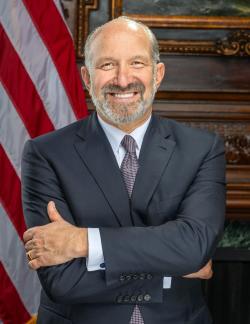 Howard Lutnick (Commerce Department photo)
“Rest assured, tariffs are not going away,” Commerce Secretary Howard Lutnick said on Fox News Sunday. “He has so many other authorities that even in the weird and unusual circumstance where this was taken away, we just bring on another or another or another. Congress has given this authority to the president, and he’s going to use it.”
Lutnick added he did not think Trump would delay imposing reciprocal tariffs announced in April but then paused for 90 days.
Trade experts say one area Trump could look for authority is Section 122 of the 1974 Trade Act, which allows the president to place tariffs of 15% for 150 days. After that expires, he would have to get congressional approval.
The CIT noted that law lets the president “impose restricted tariffs in response to ‘fundamental international payment problems,’ including ‘large and serious balance-of-payments deficits.’”
Trump likely doesn't want hands tied
Alan Morrison, a long-time public interest attorney who teaches civil procedure and constitutional law at George Washington University School of Law, said Trump would be disinclined to use Section 122.
“The reason he's using IEEPA is because it gives him so much more power,” Morrison told Agri-Pulse. “You don't have to go through any procedural steps. It's not limited to one product. It's not limited to one country.”
But of Section 122, Morrison said, “He doesn't want to do 15%, he doesn't want to be limited to 150 days.”
Morrison also noted that the case is likely to end up in the Supreme Court. It’s now before the Federal Circuit Court of Appeals, which ordered the plaintiffs in the case to respond to the formal request for a stay of the CIT order by June 5. The administration must respond by June 9.
Alan Wm. Wolff, a senior fellow at the Peterson Institute for International Economics, said Section 122 is not a clear fit for Trump, noting the need for congressional approval later.
“The president has not solicited the opinions of Congress on trade matters, so it doesn't look like a natural for him to say, oh, yeah, let me, let me consult with Congress about this,” Wolff said.
It’s easy to be “in the know” about what’s happening in Washington, D.C. Sign up for a FREE month of Agri-Pulse news! Simply click here
There are other authorities that Trump could try to use but they don’t provide the broad flexibility he seeks. Section 338 of the Tariff Act of 1930 would allow him to unilaterally raise tariffs up to 50% of a product’s value, but only after the U.S. International Trade Commission finds that a foreign country has discriminated against U.S. commerce.
 Alan Wm. Wolf (PIIE photo)
However, experts at the Council on Foreign Relations say in an analysis that “while there have been a handful of instances where Section 338’s use has been considered, it has never been used to impose trade restrictions. Its use would reasonably invite retaliation from targeted countries.”
Wolff said that the Trump presidential campaign floated the idea of using Section 338.
Experts at the libertarian Cato Institute have said, however, that “Congress has broadly delegated its constitutional tariff powers to the president.” Clark Packard and Scott Lincicome argued in a preelection analysis that “several U.S. laws provide the president with vast and discretionary authority to unilaterally impose sweeping trade restrictions, and no institution — not Congress, not domestic courts, not US international agreements — provides a quick, surefire check on such actions.”
Two options conditioned on security, discrimination concerns
Section 232 of the Trade Expansion Act of 1962, for example, “grants the president wide discretion to initiate an investigation and then impose trade restrictions such as tariffs on a certain category of products,” they wrote.
That authority requires that the Commerce Department find that the imports of certain products would threaten national security. Commerce did so during the first Trump administration, and shortly afterward he used Section 232 to impose duties of 25% on imported steel and 10% on imported aluminum from all countries except Australia.
This time around, Trump has continued to use Section 232 to impose steel and aluminum tariffs, announcing a doubling of those levies to 50% that were to go into effect June 4.
The 1930 act's Section 338 to impose tariffs is limited, Lincicome and Packard wrote, because it requires “proof of discrimination against the United States in favor of other nations.”
That could be difficult to conclude “when targeting countries that are WTO members bound by most-favored-nation requirements that restrict discrimination among members,” they wrote.
Section 301 of the 1974 trade law is also an option. Its use was “reinvigorated” by Trump in his first administration to cover a wide variety of goods from China, which resulted in retaliatory tariffs. President Joe Biden mostly retained those tariffs and used the same authority to slap 100% tariffs on electric vehicles from China.
Section 301 “contains some minor substantive and procedural checks, but it does grant the president wide discretion to address foreign economic policies by imposing tariffs or other trade restrictions on a very wide set of products imported from a targeted country or countries,” the Cato experts wrote.
Keith Maskus, an economist and international trade expert at the University of Colorado, said he doesn’t think Section 122, with its cap of 15% and 150 days, is “likely to provide the kind of long-term solution to whatever it is the president is trying to achieve. My guess is that they're much more likely to shift into the national security kind of tariffs, [Section] 232 or even [Section] 301,” dealing with unfair trade.”
But he said the need for investigations prior to using those authorities likely would be “an irritant” to Trump, who likes to move fast.
For more news, go to Agri-Pulse.com

