
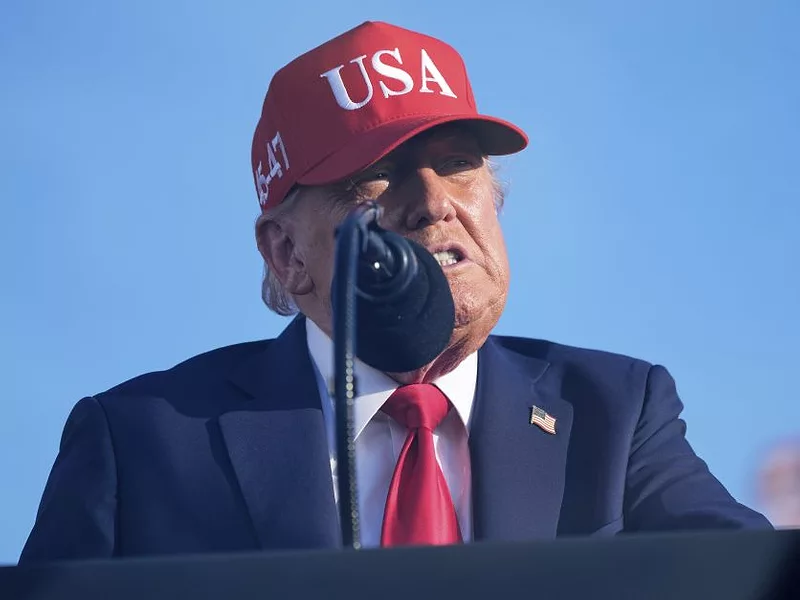
A federal appeals court ruled Friday that President Donald Trump improperly used a law to impose his sweeping retaliatory tariffs on countries around the world.
However, while an en banc panel of the U.S. Court of Appeals for the Federal Circuit upheld the basis of the Court of International Trade’s ruling against the tariffs, the judges rejected a portion of the CIT decision that would have immediately stopped the duties, giving the Trump administration an opportunity to appeal the 7-4 decision to the Supreme Court.
In May, the Federal Circuit stayed the effect of the CIT's decision.
“President Trump lawfully exercised the tariff powers granted to him by Congress to defend our national and economic security from foreign threats. The President’s tariffs remain in effect, and we look forward to ultimate victory on this matter," White House spokesman Kush Desai said in a statement.
At issue is Trump’s use of the International Emergency Economic Powers Act to impose his global tariffs.
“The Executive’s use of tariffs qualifies as a decision of vast economic and political significance, so the Government must 'point to clear congressional authorization' for its interpretation of IEEPA. … [W]e discern no clear congressional authorization by IEEPA for tariffs of the magnitude of the Reciprocal Tariffs and Trafficking Tariffs," the appeals court said.
The court noted that there are “numerous statutes that do delegate to the President the power to impose tariffs; in each of these statutes that we have identified, Congress has used clear and precise terms to delegate tariff power, reciting the term 'duties' or one of its synonyms. In contrast, none of these statutes uses the broad term 'regulate' without also separately and explicitly granting the President the authority to impose tariffs.
Don’t miss a beat! It’s easy to sign up for a FREE month of Agri-Pulse news! For the latest on what’s happening in Washington, D.C. and around the country in agriculture, just click here.
“The absence of any such tariff language in IEEPA contrasts with statutes where Congress has affirmatively granted such power and included clear limits on that power.”
The ruling also rejected the administration's argument that the power to "regulate" gave it the power to impose tariffs. "The power to 'regulate' has long been understood to be distinct from the power to 'tax.' In fact, the Constitution vests these authorities in Congress separately."
The plaintiffs are a group of small businesses and states and the states of Oregon, Arizona, Colorado, Connecticut, Delaware, Illinois, Maine, Minnesota, Nevada, New Mexico, New York and Vermont.
Trump has defended his use of the tariffs both as a tool to rebuild American manufacturing and to replace income taxes.
Analysts say that even if the IEEPA tariffs are struck down, the administration could use other, slower-moving trade tools to reinstate many of the duties. Those options include Section 122 of the 1974 Trade Act, which allows the president to place tariffs of 15% for 150 days. After that expires, he would have to get congressional approval.
For more news, go to Agri-Pulse.com.

