
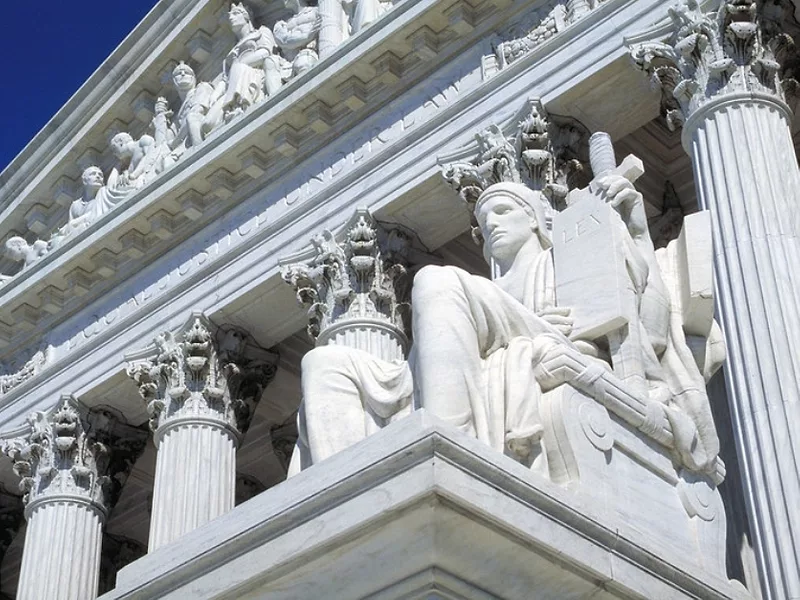
President Donald Trump’s tariffs faced tough questions at the Supreme Court yesterday.
But we won’t know for sure what the court thinks until it rules months from now following oral arguments Wednesday. (Read our coverage here.)
The justices seemed skeptical of arguments from Solicitor General D. John Sauer.
Predictions based on oral arguments are always perilous, but Georgetown University constitutional law professor Steve Vladeck said on CNN that the chances are good the administration loses.
“I went in thinking it was 50/50. I'm closer to 80/20 (against the tariffs) after that argument.
But we have examples of arguments not being predictive, so…” he said.
Conservative justices prodded Sauer on multiple facets of his arguments:
Chief Justice John Roberts on the lack of clear delegation of Congress' tariff powers: “The exercise of the power is to impose tariffs, right? And the statute doesn't use the word ‘tariffs.’”
Justice Neil Gorsuch on the challenges of reversing delegated powers: “Don't we have a serious retrieval problem here because, once Congress delegates by a bare majority and the president signs it – and, of course, every president will sign a law that gives him more authority – Congress can't take that back without a supermajority.... Even then, it's going to be veto-proof. What president's ever going to give that power back?”
Justice Brett Kavanaugh: "Why do you think presidents Clinton, Bush, Obama have not used IEEPA to impose tariffs? Because there have been trade disputes."
Cut through the clutter! We deliver the news you need to stay informed about farm, food and rural issues. Sign up for a FREE month of Agri-Pulse here.
Take note: Justice Amy Coney Barrett also contemplated how a tariff refund process might work, and agreed with Gorsuch that even if Congress feels that IEEPA gives the president too much authority, “it's going to have a very hard time pulling the tariff power out of IEEPA, correct?”
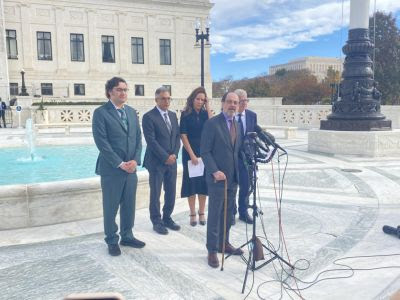 Victor Schwartz, founder of V.O.S. Selections, one of the companies challenging the IEEPA tariffs, speaks at the Supreme Court following the arguments (Agri-Pulse photo)
China lifts some tariffs, but keeps 10% rate in place
China says it will lift the bulk of the tariffs it put in place as part of its tariff dispute with the U.S. but will leave a 10% rate in place.
China will scrap some agriculture-specific tariffs of up to 15% starting November 10. It will also lower a 34% tariff applied to all U.S. exports in April to 10% for at least a year, according to a pair of Finance Ministry statements.
Take note: Matthew Nicol, an ag market analyst for UK-based China Policy, told Agri-Pulse that the lower duties would narrow the cost difference between U.S. and Brazilian soybeans. But he said the U.S. beans are unlikely to fall below Brazil’s price with an overall13% duty in the Chinese market – much higher than Brazil and Argentina’s 3%.
But, but, but: The Trump administration had previously indicatedthat Beijing will suspend “all of the retaliatory tariffs” on U.S. ag products. The White House did not respond to a request to comment on Wednesday.
Carney: U.S.-Canada talks have yet to restart
U.S. trade talks with Canada are still on ice, Canadian Prime Minister Mark Carney told reporters Wednesday.
During a news conference, the prime minister said he had apologized to Trump on the sidelines of the Asia-Pacific Cooperation Summit last week for a pulled TV ad that the president did not like.
Trump promised new tariffs on Canada over the ad, which featured former President Ronald Reagan criticizing tariffs. But, so far, no new tariffs.
Executing ‘half RINS’ may be heavy lift
U.S. farm groups would like the Trump administration to finalize a plan to reduce the value of potential valuable credits for biofuels made with foreign ingredients. But there is concern that doing so might be a heavy lift, technically speaking.
At issue are tradable credits, known as RINs, which are meant to give refiners financial incentives to blend crop-based renewable transportation fuels with traditional petroleum-based products. EPA has proposed valuing RINs at just 50% of full value for fuel made with foreign biofuel feedstocks like used cooking oil from China or tallow from Brazil.
“We’ve heard a lot of rumors about technical limitations around executing the half RIN,” Bunge CFO John Neppl said on Wednesday. “We’ve heard mixed news on that, whether it’s really an issue. Maybe it’s not an issue. We don’t really know yet.”
Bunge is among companies in favor of the plan, saying it will create greater demand for U.S. farm crops.
California’s GOP aggies might be in trouble
Republican seats in California’s farm country are in serious jeopardy after Proposition 50 passed on Tuesday. The measure will redraw the state’s congressional districts to counter mid-decade redistricting Texas Republicans carried out earlier this year.
House Ag Committee member Doug LaMalfa’s race is now rated as “likely Democratic” instead of “safe Republican,” according to Larry Sabato’s Crystal Ball. David Valadao’s re-election race goes from “leans Republican” to a “toss-up.”
The California Republican Party on Wednesday sought a temporary restraining order and injunction to block the redrawn congressional maps from taking effect.
Corteva unveils new insecticides
Corteva, one of the world’s biggest makers of crop protection products, unveiled its first bioinsecticide as it seeks to solve a multi-billion-dollar headache for farmers.
Microbial-based Goltrevo will fight sap-feeding and chewing insects, including stink bugs and the highly destructive corn leafhopper, which can lead to corn stunt disease and cause yield losses of up to 70%, Corteva said Wednesday.
The company also announced Varpelgo, a next-generation insecticide aimed at controlling chewing pests in fruits and vegetables, row crops and rice. Disease and damage from insects lead to global crop losses that cost an estimated $70 billion, Indianapolis-based Corteva said.
Commercial sales for Goltrevo are expected to begin as early as 2027 in Latin America, pending applicable regulatory approvals, Corteva said. For Varpelgo, commercial sales are expected in Asia Pacific and Latin America in the early 2030s, pending completion of field trials and applicable regulatory reviews.
Final word
Supreme Court Justice Neil Gorsuch asked Solicitor General D. John Sauer Wednesday at oral arguments in the tariff case whether the president could use the International Emergency Economic Powers Act to impose a 50% tariff on gas-powered cars and auto parts “to deal with the unusual and extraordinary threat from abroad of climate change?”
“It’s very likely that that could be done, very likely,” Sauer responded.
Kim Chipman, Oliver Ward and Noah Wicks contributed to today’s Daybreak.
.webp?t=1762183428)


