
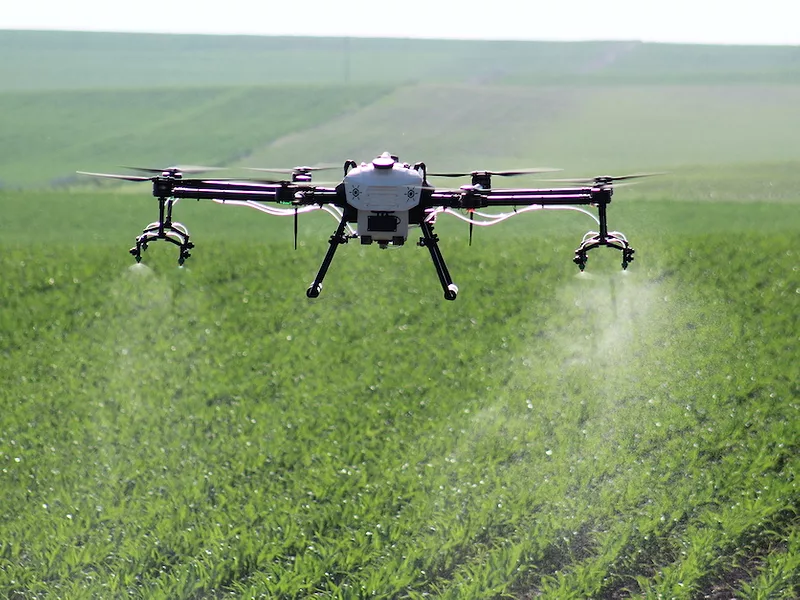
U.S. drone manufacturers are mostly happy with new executive orders designed to boost domestic drone manufacturing, including agricultural models to scout fields and apply pesticides.
President Donald Trump issued two orders Friday, one focused on restoring American “airspace sovereignty” and enhancing security at mass gatherings such as the 2026 World Cup and the 2028 Olympics in Los Angeles.
But the other one has U.S. ag drone manufactures excited. Titled “Unleashing American Drone Dominance,” the order aims to streamline regulations and promote exports of U.S.-made unmanned aircraft systems, or UAS — the longer term for what are commonly called drones.
Of particular importance to the domestic industry, the order says, “All agencies shall prioritize the integration of UAS manufactured in the United States over those made abroad to the maximum extent permitted by law.”
Drones made by Chinese manufacturer DJI currently dominate the U.S. commercial market. The order does not go so far as to ban Chinese-made drones, which already face a potential ban at the end of the year under the National Defense Authorization Act passed in December.
“This is a step in the right direction,” said Arthur Erickson, CEO of U.S. drone maker Hylio. “Let's say a sense of relief, because there's been a lot of talk about taking some powerful steps to right the ship, so to speak, and not let China dominate the drone industry, both globally and here in the U.S.”
 Arthur Erickson (LinkedIn photo)
The order, he added, “was light in terms of going after China,” but Erickson speculated that Trump did not want to “antagonize” Chinese leader Xi Jinping as the two countries enter trade negotiations.
DJI, which Erickson called “the Apple of drone companies,” said it welcomed the order, even as it fights to continue to sell its products in the U.S.
“DJI has long advocated for the advancement and growth of the U.S. drone ecosystem,” a company statement said. “We applaud the administration’s action to boost industry innovation, particularly by expanding routine Beyond Visual Line of Sight (BVLOS) operations for UAS for commercial and public safety purposes and streamlining approval and certification processes.”
Then company also welcomed “broadening the adoption of Remote ID detection technologies and empowering authorities to protect the public from inappropriate drone use.”
Regarding drone security, which is the heart of NDAA legislation targeting Chinese products, the company said it “welcomes and embraces opportunities to demonstrate our privacy controls and security features. … Our drones feature robust security protocols, are subject to independent audits, and offer industry-leading data privacy controls. As such, DJI believes our products can stand up to any scrutiny.”
It’s easy to be “in the know” about what’s happening in Washington, D.C. Sign up for a FREE month of Agri-Pulse news! Simply click here
Erickson, however, called DJI’s statement “lip service,” saying third-party assessments have shown their drones can be hacked.
For its part, DJI says it “has always supported technically grounded minimum security requirements across all UAS manufacturers, regardless of their country of origin.” It also points to an audit conducted last year by FTI Consulting that it said “provide[s] yet another independent validation of DJI’s robust data privacy practices.”
Under the NDAA bill approved in December, DJI and other Chinese drone companies have to pass a security review in order to continue to be sold in the U.S. past the end of 2025. If no action is taken, Erickson said, the ban goes into effect.
Another U.S. drone manufacturer, Guardian, also is excited about the emphasis on American-made UAS.
“I think it's great that the FAA is moving ahead – or hopefully moving ahead – based upon this executive order, with giving more of a fast lane for American-made products,” said Matt Beckwith, vice president, business development and policy at Guardian.
He cited an example of a Chinese-made drone receiving approval for a large drone exemption only 14 days after applying, while it took the agency nearly 200 days to approve a similar exemption for his company.
“What that does is it hamstrings investment, because investors become very hesitant to put money into something that doesn't have time certainty,” Beckwith said.
For more news, go to Agri-Pulse.com.

