
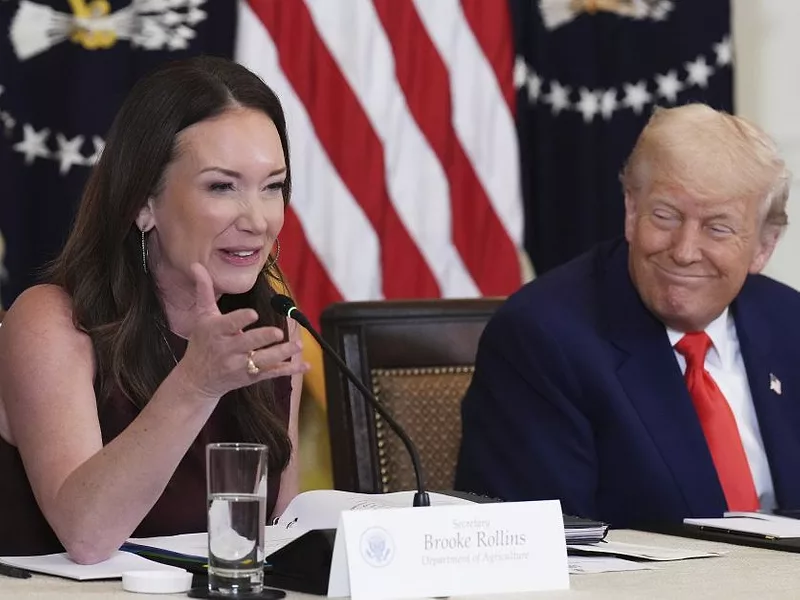
Farms appear to be protected from worker deportations – at least for now. But Ag Secretary Brooke Rollins is making it clear she’s still on board with President Donald Trump’s agenda of deporting illegal aliens from the U.S.
That policy was altered late last week, however, to soften the blow for the agricultural and hospitality sectors, according to Department of Homeland Security guidance reported by the New York Times Saturday (See our story here).
On Sunday, Rollins said on X that “severe disruptions to our food supply would harm Americans. It took us decades to get into this mess and we are prioritizing deportations in a way that will get us out.” The “mess” she was referring to is the “broken farm-labor economy.”
She also said she fully supports Trump’s immigration agenda, “starting with strong border security and deportations of EVERY illegal alien.”
Keep in mind: Recent detentions and unannounced visits by Immigration and Customs Enforcement agents to farms and other facilities had heightened criticism from the ag sector and politicians including House Ag Chair Glenn “GT” Thompson, R-Pa.
Thompson told reporters that “to come in here with guns blazing and what you're taking out are hard-working dairymen … it's just wrong. They need to knock it off. Let's go after the criminals. I think the president agrees. I don't know where the disconnect is. It must be somebody a little lower in the food chain that's making those mistakes.”
Trade discussions expected at G7
Trump and Treasury Secretary Scott Bessent are in the Canadian Rockies this week for a G7 meeting, and there are expected to be discussions about the president’s tariffs. Bessent told the House Ways and Means Committee last week that he would accompany Trump to the three-day summit and expected both will meet with Canadian Prime Minister Mark Carney.
Leaders from the G7 countries – Canada, the U.S., France, Italy, Japan, Germany and Britain – will be at the meeting as well as leaders of India, Australia and other countries.
For more on this week’s D.C. policy agenda, read our Washington Week Ahead.
RVOs mostly welcomed by biofuel, other industry groups
Biofuel and farm groups are largely responding positively to the Trump administration’s proposed renewable volume obligations.
The proposed set of RVOs for 2026 and 2027 still have a long way to go before getting finalized, but so far groups that have lobbied for stronger volumes appear pleased. The proposal set volumes for biomass-based diesel higher than a coalition of oil, biofuel and farm groups had suggested. It also includes 15 billion gallons for ethanol, which groups like National Corn Growers celebrated.
“This action provides a significant certainty to corn farmers across the country who rely on a stable biofuels industry,” NCGA wrote in a statement.
Sen. Deb Fischer, R-Neb., also hailed the proposal as a win for farmers in her state, and said she looked forward to working with the administration to ensure these are finalized.
But, but, but: Biogas advocates were disappointed by the RVOs for cellulosic biofuels. The American Biogas Council said the levels would cut growth in half.
“This proposal is not a win for all farmers. In particular, dairy and other livestock farmers are the most harmed,” ABC said in a statement.
Sen. Rounds presses Rollins for country-of-origin framework
South Dakota GOP Sen. Mike Rounds is asking USDA to work with trade officials on a framework for reimposing mandatory country-of-origin (MCOOL) labeling.
It’s easy to be “in the know” about what’s happening in Washington, D.C. Sign up for a FREE month of Agri-Pulse news! Simply click here
In a letter on Friday, the senator told Rollins that Congress is ready to include MCOOL for beef products in a future farm bill. But he argued the federal government should also take steps to prepare for its reinstatement.
“For almost a century, U.S. trade law has required the majority of imported products to bear a country of origin label. There is no reason why this same level of transparency should not exist within our beef labeling system,” Rounds wrote.
“We urge you to work with U.S. trade officials to develop a feasible framework for reinstating MCOOL for beef and to examine the deceptive practices currently distorting our beef markets,” he added.
Take note: MCOOL was repealed in 2015 after Mexico and Canada successfully challenged the law at the World Trade Organization. Some industry representatives and analysts are eying a forthcoming review of a North American trade pact as a venue for negotiating a lasting solution and paving the way for its reintroduction.
JBS makes New York stock exchange debut
Meatpacking giant JBS Foods is trading on the New York Stock Exchange for the first time.
Joining the NYSE is intended to “unlock shareholder value, align the capital structure with JBS’s global profile and expand access to investment opportunities,” according to a press release.
"This step strengthens our access to global capital markets and enhances our ability to deliver long-term value to shareholders, team members, and the communities we serve,” JBS Global CEO Gilberto Tomazoni said in the press release.
Meat processors seek inclusion in Trump’s agriculture workforce plans
A group representing meat processors wants to be included in the Trump administration’s plans to ensure labor is available to the agriculture industry.
"President Trump has an opportunity to solve the agriculture labor crisis that has challenged our farmers and ranchers for decades,” Meat Institute President and CEO Julie Anna Potts said in a press release.
“As reforms are considered, we urge the Trump Administration to include meat and poultry packers and processors in his efforts to improve agriculture worker programs,” she added.
Take note: Potts also called for reforms to the H-2A program, as well as the modernization of E-verify “to ensure the processing sector has access to a consistent, year-round, legal workforce."
Final word
“Under President Trump’s leadership, Secretary Rollins is committed to building a system that puts America First, upholds the rule of law, and delivers lasting reform through improvements to the H-2A program in coordination with Labor and Homeland Security” – USDA spokesperson Seth Christensen.
Rebekah Alvey, Oliver Ward and Noah Wicks contributed to today’s Daybreak.


