
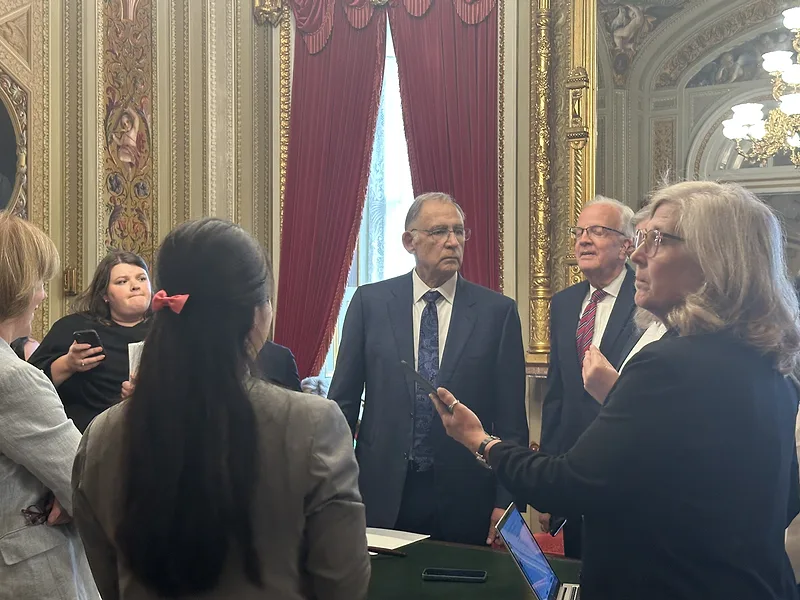
The Senate Agriculture Committee is expected to consider a farm bill during the work period between July 4th and August recesses, Chair John Boozman, R-Ark., says.
The timing means the markup would take place between July 13 and Aug. 7, according to the Senate legislative calendar. The committee previously signaled its goal of holding a markup of a farm bill by the end of June.
Text of the proposed farm bill legislation is set to be released in the next couple of weeks, Boozman told reporters on Capitol Hill.
The senator told Agri-Pulse he doesn’t expect language to allow year-round sales of higher ethanol fuel blends, known as E15, to be in the committee’s farm bill, saying it’s not in his committee’s jurisdiction. He also pointed to difficulties the House had with its ethanol bill, which was ultimately passed by the chamber last month.
However, Senate Majority Leader John Thune says there’s work being done on a year-round E15 bill. Read more in our article here.
SNAP: On the thorny matter of shifting costs of the Supplemental Nutrition Assistance Program onto certain U.S. states, Boozman said the Ag Committee is “limited as to what we can do, but we’re certainly talking to our counterparts, trying to figure out a path forward.”
Democrats including Sen. Amy Klobuchar, the committee’s ranking member, are pressing to postpone the scheduled cost shifts, while Boozman and other Republicans have held firm that they are needed to address payment errors and fix the system.
Glen Smith cleared by Senate Agriculture Committee
The Senate Agriculture Committee advanced the nomination of Glen Smith to be undersecretary of agriculture for rural development along party lines, setting the stage for a Senate floor vote. The seat is the last remaining unconfirmed post at USDA; it’s been vacant since January.
Smith could be considered by the Senate floor as early as this week. If confirmed to the role, he would supervise federal lending and grant programs.
Produce sector plants priorities in Washington
Members of the International Fresh Produce Association are in Washington this week focusing on ag labor reform, trade, nutrition and supply chain resilience.
The group is calling for reforms to agricultural workforce programs, including changes to H-2A and H-2B visa programs, while defending recent regulatory changes that it says have improved labor-cost predictability. On trade, IFPA is urging policymakers to pursue relief from nontariff barriers and continue advocating for tariff exemptions for fresh, perishable products while helping industry members navigate trade disruptions.
The group also supports protecting monthly fruit and vegetable benefits in the Special Supplemental Nutrition Program for Women, Infants and Children; increasing USDA purchases of fresh produce; and making produce prescriptions a standard benefit in federal health programs.
In addition to attendance from key lawmakers, Agriculture Secretary Brooke Rollins and Health and Human Services Secretary Robert F. Kennedy Jr. will also address attendees.
IFPA leverages MAHA: In partnership with the Foundation for Fresh Produce, IFPA is launching a new “all day, every day” campaign highlighting the new dietary guidelines’ recommendation that fruits, vegetables and whole foods are a foundational part of every person’s diet.
A billboard truck spotlighting MAHA-themed messaging about the role of fruits and vegetables in national food policy will be circulating Capitol Hill throughout the week. Recipes, cooking tips and other practical ideas to increase produce consumption are available on fruitsandveggies.org.
 Caption: Pedestrians walk past signage displaying IFPA’s “all day, every day” campaign on the Wharf in Washington, D.C. (IFPA photo)
 USDA appoints adviser for screwworm preparedness
John Bellinger, the former chair of the U.S. Meat Export Federation and Southwest Meat Association, has been appointed the senior adviser for New World screwworm preparedness, according to a USDA press release.
Bellinger is the co-founder and former CEO of Food Safety Net Services and a board member of the recently merged company FSNS and the Certified Group. He currently serves as CEO of Agri-West International and Bellinger Development. He has also served on Texas A&M’s board of regents since 2023 and is the chair of the committee on research.
“John’s roots in Texas where New World screwworm is at ground zero, and his private sector experience in the related food safety and cattle industries, will help the administration advance our response and protect U.S. livestock,” Secretary of Agriculture Brooke Rollins said in the release.
USDA has ramped up its screwworm response after recent cases were confirmed from southern Texas and New Mexico. The Animal and Plant Health Inspection Service launched a dashboard tracking cases and a website hub with response plans and other screwworm information.
Economist: Screwworm to add costs for producers, but not much market impact
New World screwworm may come with costs to producers if it continues to spread to the U.S., though the overall market impact for beef should be limited, Oklahoma State University economist Derrell Peel told Agri-Pulse Monday.
Cut through the clutter! We deliver the news you need to stay informed about farm, food and rural issues. Sign up for a FREE month of Agri-Pulse here.
Peel said producers in areas impacted by New World screwworm will need to put time, effort and money into monitoring cattle for the pest and added that addressing it will also have a “public cost” from federal and state agencies’ treatment efforts. However, he doesn’t expect it to have significant impacts on consumption or trade of beef.
“I don’t think it will have a lot of economic impacts as far as markets, broadly speaking, but it will have economic impacts in the sense that it’s going to be an extremely costly, difficult management issue for everybody that’s involved to deal with," Peel said.
Take note: Canada last week implemented temporary restrictions on livestock from areas of the U.S. impacted by the pest. Peel said Canada imports a limited amount of cattle from the U.S. and that the impacts of these restrictions may be more noticeable in the U.S. horse industry.
Keep in mind: A USDA analysis estimated that if a New World screwworm outbreak at 1976 levels would have occurred in Texas in 2024, it could have led to $732 million in losses for Texas producers and a $1.8 billion loss for the state’s economy. Nearly half of expected costs were associated with animal deaths, while 17% were associated with marketing losses, 13% with extra labor, and 10% with animal weight loss.
Senators to introduce bill including virtual fencing in Emergency Conservation Program
Sen. Pete Ricketts, R-Neb., will be leading the introduction of the Fencing Eligibility for New Conservation Equipment Act, or FENCE Act, today, which would grant USDA permission to include virtual fencing as part of the Emergency Conservation Program.
The same provision was passed in the House version of the farm bill. If passed and signed into law, the Agricultural Credit Act of 1978 would be amended to add that new or emerging technologies for fencing can be included in the program — so long as the cost of updating is not more than the cost of repair or replacement. USDA covers up to 75% of repairs or replacement for existing fencing.
“We’ve heard from producers that this would be a welcomed addition that provides more flexibility in rebuilding and recovery processes,” a Ricketts spokesperson said.
Sens. Martin Heinrich, D-N.M., and Deb Fischer, R-Neb., will be joining Ricketts in introducing the bill.
Final word
“That is a very unserious comment from a perhaps unserious ag commissioner with just a few months left. It is also a very dangerous suggestion.” — Agriculture Secretary Brooke Rollins at a news conference in Texas when asked by a reporter about Ag Commissioner Sid Miller saying he feels farmers will not report screwworm cases over fear of quarantines and the government exerting control.
.webp?t=1762183428)


