
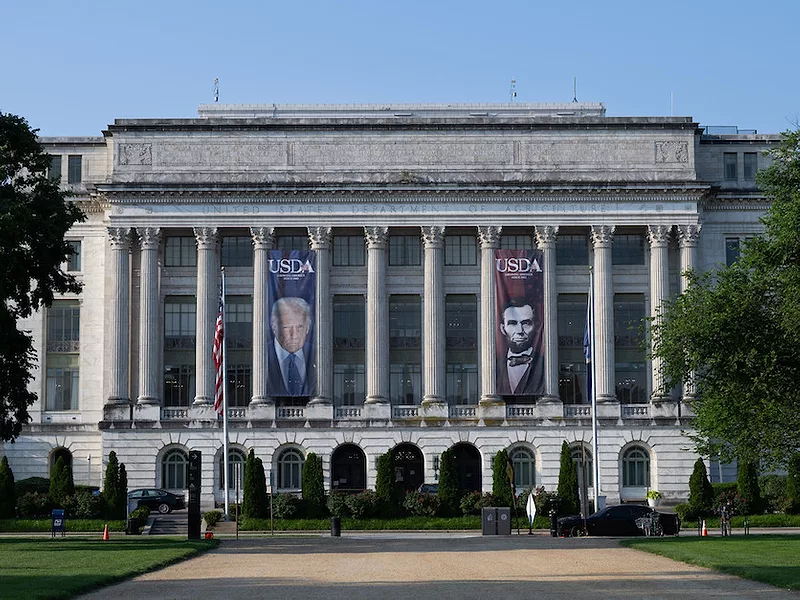
The Agriculture Department has rescinded Regional Conservation Partnership Program award offers to several organizations previously selected to receive Inflation Reduction Act funding, according to agency notices and interviews with affected recipients.
Multiple organizations with RCPP projects that were chosen to receive IRA dollars but had not yet fully executed their agreements have received letters from their state conservationists with the Natural Resources Conservation Service informing them that their conditional award offers were “rescinded as the agency is not moving forward with any new awards using the supplemental funding provided by the Inflation Reduction Act at this time,” according to copies viewed by Agri-Pulse.
These notices were accompanied by a document informing recipients of avenues they may use to appeal the decision, including through mediation, an informal review, or reviews by their Farm Service Agency county committee or USDA's National Appeals Division.
Agri-Pulse has confirmed that 13 organizations have received such notices, though the action may extend to more.
A statement provided by a USDA spokesperson said "contracts have not been canceled" but that “applications that were in the pre-approval or application phase may have been re-ranked using the traditional farm bill ranking system.”
“The impact on a particular pre-approved application varies by state, depending on the volume and strength of other applications submitted,” the statement said.
One of these projects is led by Cultivate KC, a nonprofit focused on supporting small and urban farmers in Kansas City. While the USDA announced last fall that the project, which would have funded small-scale conservation practices for urban growers while also protecting some land through easements, would receive $6.4 million in federal funding, program leaders were alerted last Wednesday that the offer was being rescinded, according to Ami Freeberg, Cultivate KC’s Director of Strategy and Partnerships.
It’s easy to be “in the know” about what’s happening in Washington, D.C. Sign up for a FREE month of Agri-Pulse news! Simply click here
The program would have helped preserve conservation funding for small-scale conservation projects, which often are not able to secure spots in other conservation programs, Freeberg told Agri-Pulse.
Neither USDA nor the project partners had finished hammering out an agreement over how the program would be carried out by the time the notice came, she said. Project leaders are now going through the process of notifying staff and partners of the USDA’s decision.
“Because it’s not something that’s yet hit the ground, it’s a little easier to swallow, like we’re not losing something, we’re losing the potential of something,” Freeberg said. "But I still think it’ll be met with pretty significant disappointment from the growing community."
Cultivate KC may look at reapplying in future funding cycles, but Freeberg said that it’ll "take a lot of work to get all the partners signed on again, especially having gone through this once.”
Jesse Womack, policy specialist at the National Sustainable Agriculture Coalition, said there are often many steps between a group receiving an RCPP award and funds getting distributed. This means some affected funds could have been approved as early as 2023. Some projects may have already hired staff or spent money in anticipation of being funded, Womack said.
Given the time lags, Womack said these cuts could be “crippling,” particularly for smaller organizations.
Even if funds weren’t allocated yet, Womack said it can take years to develop relationships and start conversations with farmers and the communities involved.
“For some of these communities, it can be like a topic of conversation for five plus years,” Womack said. “So yanking them back, even if nobody's punched in the pocketbook right now, it is still, it is a huge wrench in the works.”
On June 10, the Wheeler Soil and Water Conservation District in Oregon was notified that the Natural Resources Conservation Service would not execute its programmatic partnership agreement for a project aiming to conserve 23,000 acres of range and forest lands, according to District Manager Cassi Newton.
The project also intended to limit the risk of future wildfires. Its cancellation is “especially devastating” following wildfires that burned through the project area’s center along with nearly 13.5% of Wheeler County last year, Newton said.
"Wheeler SWCD is committed to continuing our pursuit for financial assistance to aid in restoring our landscapes for resiliency,” Newton said in an email. "We will continue to seek all available funding opportunities feasible for wildfire mitigation efforts.”
Florida-based Wildlands Conservation Inc. was planning to use most of its $25 million award to secure easements spanning over 9,350 acres of Central Florida land. Some funding would also have been used to assist producers with prescribed burning, invasive species control and other land management activities. The offer for this project, too, was rescinded.
“Everybody’s pretty disappointed and disheartened,” Wildlands Conservation's executive director, David Sumpter, told Agri-Pulse in an interview. “A lot of effort and energy went into this."
Sumpter said in an email that he and his team are “planning on dusting ourselves off and giving it another go in the next cycle when these RCPP funds are allocated directly from the farm bill.” “However, the next budget cycle sounds like projects will be capped at $10 million versus $25 million, which obviously doesn’t go as far,” he added.
Another impacted project would have conserved Texas working lands and wildlife habitat used for military exercises through easements. The Compatible Lands Foundation partnered with Fort Cavazos and Dyess Air Force Base on the project.
“While we are disappointed, we remain committed to the goals of this project, particularly conserving critical lands that support military readiness while protecting and promoting working lands,” CLF Executive Director Joe Knott said in a statement. “We plan to resubmit a proposal for consideration under the next funding cycle using farm bill funding, and we will continue working with our partners to identify other pathways to move the work forward."
In Minnesota, John Jaschke, the executive director for the state Board of Water and Soil Resources, said in a statement that his agency’s project to establish water storage practices in Minnesota for controlling runoff saw its award rescinded. As a result, the program “now relies solely on remaining prior one-time state funding sources,” he said.
“It’s disappointing that the federal government has rescinded these funds for this critical program,” Jaschke said. “Increasingly frequent and intense rains have created a need for additional water storage across Minnesota. Projects supported by this program protect infrastructure, reduce erosion and improve water quality by temporarily holding water on the landscape after heavy rains or runoff events.”
In Ohio, Meghan Harshbarger, chief of communications for the state's agriculture department, confirmed that a project her agency was leading has been affected. She said ODA will “assess the project’s status after Ohio’s biennium budget is finalized.”
Some projects subject to the USDA’s decision appear to have been funded through the farm bill rather than the IRA.
The Blue Ridge Resource Conservation and Development Council, a conservation organization serving a seven-county area in western North Carolina, was notified last October that its $15 million project supporting aquatic restoration, stream stabilization, riparian buffers and wildlife habitat would be funded through the farm bill, according to the “Congratulations” email the organization received from USDA at the time.
But despite the farm bill being the funding source for the project, Blue Ridge RCD still received a notice alerting it to the USDA’s withdrawal of its award due to the IRA, according to a copy of the cancellation notice viewed by Agri-Pulse.
A letter from the organization to members of Congress says that in North Carolina in the wake of Hurricane Helene, “entire streams shifted their alignments, farms lost tremendous amounts of land from the erosive power of the flood, and the ecological functions and habitats on these farms have been severely damaged.” Impacted farmers would have benefitted from participation in the project, the letter said.
“Unfortunately, yes, our award offer was rescinded and it will definitely impact our ability to help our farmers,” Blue Ridge RCD executive director Jonathan Hartsell told Agri-Pulse in an email.
Similarly, USDA officials had previously told the agroforestry company Propagate Ventures that its project would be funded through the farm bill, said CEO Ethan Steinberg. USDA rescinded the project’s offer using the same IRA-related justification as the others.
Steinberg said the project’s funding would have helped Mississippi River Basin farmers establish 3,500 acres of agroforestry. He’d heard interest from producers representing around 18,000 acres, more than five times the project's scope. While many farmers want to implement agroforestry practices, high upfront costs can make it difficult for them to support such an investment on farmgate margins, he said.
Steinberg said he respects the USDA’s decision and personally supports the idea of using taxpayer dollars responsibly. He added, however, that he is concerned about USDA pulling back from commitments that it has already made, which could weaken farmer confidence in conservation.
“I think at the end of the day, everyone was hoping for a different outcome,” he said. “People put their time and effort into making this happen. But ultimately, we are where we are.”
For more news, go to Agri-Pulse.com.
Editor's note: The count of impacted organizations has increased from 11 to 13 as additional organizations notified Agri-Pulse that their offers had been rescinded.


