
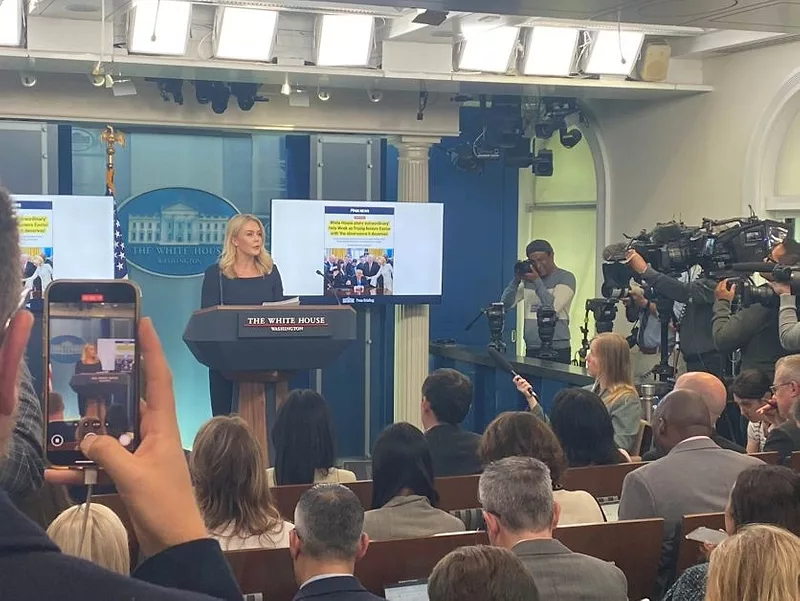
Trump administration officials are stressing that the deportation program being carried out by Immigration and Customs Enforcement agents across the country is focused on criminals.
White House spokesperson Karoline Leavitt said at her press conference Thursday that President Donald Trump “has made it very clear we need to remove public safety threats from the interior of our country, and that remains the focus and the priority of this administration when it comes to deportations.”
Echoing remarks made shortly beforehand by border czar Tom Homan, Leavitt also said it doesn’t matter where someone works. “If they're an illegal alien, rapist or murderer that was allowed in this country in the past four years by [the Biden] administration, the American people want those types of criminals to be deported from our country, and that's what the president is backing ICE to do.”
Homan said ICE was not halting worksite enforcement at farms and hospitality facilities such as hotels and restaurants, but that agents are looking for criminal violations.
“We're going to base them on priority, for those who we have a criminal nexus of trafficking, of forced labor, of tax fraud or tax evasion,” Homan said.
By the way: Count Senate Ag Chair John Boozman, R-Ark., among those on Capitol Hill who believe immigration enforcement efforts should focus on people who have committed crimes.
“What we have now is uncertainty,” he says in an interview for this week’s Agri-Pulse Newsmakers that was taped before Homan’s and Leavitt’s remarks on Thursday. “One minute it’s one way, and the next minute it’s another way. Who can plan? It really makes it very, very difficult.”
The latest edition of Newsmakers will be available today at Agri-Pulse.com.
USDA rescinds Regional Conservation Partnership Program award offers
At least 11 Regional Conservation Partnership Program awardees have seen their offers rescinded by the Trump administration in recent weeks, though the true number may be higher.
Notices the awardees received from their Natural Resources Conservation Service state conservationists informed them that the agency is “not moving forward with any new awards using the supplemental funding provided by the Inflation Reduction Act at this time.”
But, but, but: Some awardees who received the notice had previously been told by USDA officials that their funding would come from the farm bill instead of the IRA.
It’s easy to be “in the know” about what’s happening in Washington, D.C. Sign up for a FREE month of Agri-Pulse news! Simply click here
Read more in Agri-Pulse’s report on the USDA action.
Ag groups among hundreds warning of supply chain chaos
Multiple farm groups have joined counterparts from across U.S. industries to warn of impending supply chain disruptions because of U.S. tariffs.
Ship arrivals slowed significantly this year when the U.S. imposed steep new duties on Chinese products, the groups say in a letter to senior administration officials. Recent reductions in tariff levels have sent carriers scrambling to resume shipments, spurring shipping container shortages in countries of origin and price hikes.
“We cannot afford to see a repeat of the congestion and resulting cargo velocity issues that plagued U.S. supply chains during the pandemic,” the groups warn.
The Agriculture Transportation Coalition, International Fresh Produce Association, National Milk Producers Federation, U.S. Meat Export Federation and American Soybean Association are among the dozens of ag signatories.
Rail industry wants more certainty as funding cliff nears
The rail industry is asking senators to deliver certainty around government funding for rail upgrades ahead of the expiration of several programs next year.
The current surface transportation authorization was signed into law as part of the Infrastructure Investment and Jobs Act in 2021 and featured $66 billion in advanced appropriations. But the funding expires in 2026, at which point the industry could have to rely on yearly appropriations to secure public support for capital projects.
“The advanced appropriations are really critical,” Peter Gilbertson, CEO of the Anacostia Rail Holdings Co. told senators at a hearing this week.
Many improvement projects can only be carried out during a short window each year because of the climate, he said. But Congress has struggled to pass appropriations bills in recent years, with subsequent legislation becoming bogged down in interparty spats. “If you miss that cycle, you miss a year,” Gilbertson said.
Why it matters: Gilbertson pointed out that U.S. ag has directly benefitted from recent rail upgrades. Improvements on lines connecting Minnesota to ports in the Pacific Northwest have allowed farmers to use more modern grain cars that carry larger cargo volumes, he said.
APHIS proposes loosening horse import requirements
USDA’s Animal and Plant Health Inspection Service is proposing dropping the requirement that imported horses are inspected by a vet within 48 hours of travel.
A Federal Register notice notes APHIS adopted the rule in 2023 after “encountering an increasing number of sick or injured horses” arriving in the U.S. But the agency said that flight delays, long layovers and limited access to veterinarians on weekends has presented challenges for exporters.
The agency is collecting public feedback on the proposal until Aug 19.
Former Arizona water official picked for Reclamation commissioner
The Trump administration has unveiled its pick for Bureau of Reclamation commissioner — and he's no stranger to Western water issues. The nominee is Ted Cooke, a former manager of the Central Arizona Project, a 336-mile aqueduct system that serves farmers and communities across central and southern Arizona.
If confirmed, Cooke will face the tough task of stewarding tense negotiations over future water cuts between seven states in the Colorado River basin. The Central Arizona Project was among the first of the river’s water users to face drastic cuts during previous negotiations, with farmers in Pinal County, Arizona, threatened with having their access entirely cut off.
Read more of that history here.
Final word
“High grocery prices are a top economic concern for Americans, and experts state that tariffs could significantly increase the cost of canned foods. Experts have also noted potential impacts from tariffs on the costs of shelving, equipment, transportation, and other inputs that grocery stores and their suppliers need to operate, which, in turn, could also lead to higher food prices for customers.” — Sen. Maggie Hassan, D-N.H, in a letter to multiple grocery store chains seeking information on how tariffs are affecting food prices.
For more news, go to Agri-Pulse.com.


