
The initial phase of a plan to shutter the U.S. Agency for International Development and bring it under State Department control will kick off next week with the first of two planned rounds of mass layoffs. But officials carrying out the agency’s work on food security and agricultural innovation are holding out hope that their work receives an eleventh-hour reprieve.
“It’s coming down to the wire,” a senior USAID official told Agri-Pulse. Like other USAID personnel interviewed for this story, the official was granted anonymity to discuss private conversations and internal correspondence without fear of retribution. “We've got a couple of Hail Mary passes in the air,” the official said.
As part of the Trump administration’s plans to rehome USAID within State, Jeremy Lewin, the former Department of Government Efficiency official and top USAID staffer who is now acting head of foreign assistance at the State Department, told USAID employees in March that nearly all of the remaining 900 workers would see their jobs terminated on either July 1 or Sept. 2.
All employees working on USAID’s ag innovation and food security work received end-of-work dates of July 1, another USAID official told Agri-Pulse. This includes employees working on partnerships that have been engaged in pandemic prevention, crop improvement, animal health and climate resiliency, among other issues. In many cases, the work focuses on regions that need agricultural productivity gains to ensure long-term food security.
Now, all of that work is set to end, the second USAID official said.
As part of the Trump administration’s vision for streamlining U.S. humanitarian assistance, it has pledged to maintain food aid and brought some staff working on the issue to State’s Office of Global Food Security. But none of those in ag innovation were asked to make the transition.
Without staff with specialized technical knowledge, even the sole surviving program – a lab working on climate-resilient grains at Kansas State University – could be rendered ineffective.
“There is not a single qualified person at the Department of State who understands the technical side of agriculture,” the official said. “They are policy experts.”
The official described the process of shutting down all but one of the programs in the last few months as “one of the saddest parts of my life.” Even international agricultural research centers, for which USAID has been one of several supporters, are set to feel the impact, the official said.
“USAID is one of the foundational partners in terms of developing the CGIAR system,” the official said, referring to the Consultative Group on International Agricultural Research, a global partnership engaged in food security research.
“They were relying on USAID technical expertise, which is just gone completely,” the official said.
There is no guarantee the private sector would step in to make up for the government’s retreat.
Suffering draws fundraising and attention to food security issues, Mark Manary, a malnutrition expert at Washington University in St. Louis told Agri-Pulse. But ag innovation work takes place behind the scenes to provide long-term food security, not short-term relief for starving populations. The links between the work and the alleviation of suffering are not always clear-cut for would-be philanthropists and the endeavors are often void of high-profile, highly visible wins.
A last-ditch effort to save US ag innovation
A potential lifeline, however, could come in the form of a proposal submitted to political staff at USAID that would significantly scale back U.S. investments and personnel to focus on projects with the biggest payoff for reducing global hunger and those that most closely align with U.S. trade objectives, according to a copy of the blueprint obtained by Agri-Pulse.
It’s easy to be “in the know” about what’s happening in Washington, D.C. Sign up for a FREE month of Agri-Pulse news! Simply click here
The proposal would keep a barebones staff of around a dozen beyond the July 1 RIF date to preserve the core functions of USAID’s ag innovation work and bring it under State’s purview.
The blueprint proposes maintaining a handful of staff focused on crop and livestock innovations, and other personnel focused on soil and crop management, technology scaling, analytics and impact evaluation, and legal and contracting work.
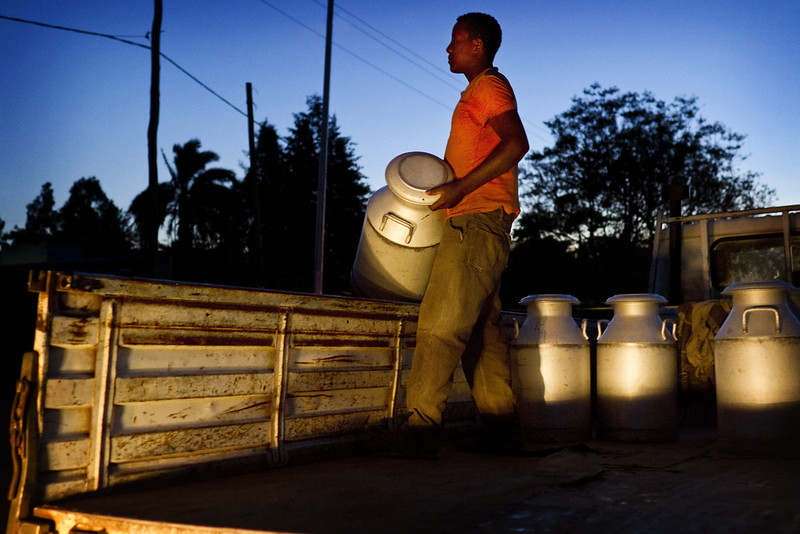 A worker collects milk for transport in Ethiopia (USAID photo)
 It proposes preserving a subset of innovation labs funded by the Feed the Future initiative mostly in farm states – like the Animal Health Innovation Lab at Washington State University and the soybean and peanut innovation labs – the funding and partnerships with CGIAR partnerships, the International Fertilizer Development Center and the World Vegetable Center partnerships, as well as a handful of public-private advanced science partnerships.
The proposal was submitted to a political appointee inside the agency in April. But while the appointee was “sympathetic,” the senior USAID official said the plan didn’t get any traction.
“My own sense is that the DOGE folks in charge of USAID are pretty impervious, and just basically want to shut things down,” the senior official said, referring to the Department of Government Efficiency launched under Trump and previously headed by Elon Musk. “If we're going to be saved, it's going to be because of State.”
The senior official has reason for hope. As a senator, Secretary of State Marco Rubio backed agricultural initiatives to strengthen global food security and reduce countries’ reliance on food aid. He also championed U.S. leadership in foreign food assistance and development.
There are also signs that Rubio still believes in the merits of ag innovation and food security. At a recent hearing before the Senate Appropriations Committee, Rubio expressed support for exactly the kind of innovation and food security work the administration is scrapping. He told Sen. Jerry Moran, R-Kan., that harnessing “American ingenuity” to boost food production at lower cost with less land is “an extraordinary thing to offer as part of our toolbox.”
The senior official said the arguments got "the attention of people at a high level" at State.
“Time is really slipping away,” the official noted, adding that once the “brain trust” behind USAID activities is let go, it could take years to rebuild these operations at the State Department. Innovation labs, for example, can take a year and half to secure the necessary grants.
The State Department did not respond to a list of questions from Agri-Pulse on the blueprint and the USAID merger.
While Congress could put money in a fiscal 2026 appropriations bill for ag innovation work, funding would likely be too late. “It’ll all be gone by the end of the month,” the senior official said.
Confusion reigns
A lack of communication, both internally and with external contractors, over next steps and anticipated interruptions to USAID operations has been a hallmark of the process.
A senior USAID humanitarian adviser based in Africa told Agri-Pulse that he had received an end-of-work date of Sept. 2, but did not know why, when many others are to be axed in July.
“There was not a very clear explanation of why some people got to stay longer or go home,” they said. The official received a “two-sentence” email in May informing him that his termination date had been adjusted to Sept. 2. “There are other people that manage very important and complex and costly humanitarian aid operations that were done by July 1,” he added.
As part of the USAID rehoming, State will bring on around 700 staff and contractors, according to an Office of Inspector General report last month – a far cry from the more than 10,000 staff and contractors employed under USAID.
The humanitarian adviser said he was still unsure of whether he would be making the move to the State Department’s Office of Global Food Security after Sept. 2. He was told to apply for a food aid job at State just two hours before a deadline. When the job was awarded to someone else, he was approached about another State position but later found out it was assigned to someone else who, he said, “didn't apply for it and doesn't know how he got the job.”
“Right now, everyone seems very confused,” the official said. “It’s just a mess.” Ambassadors in countries reliant on food aid “are genuinely worried about what they’re being handed,” he added.
State’s own inspector general raised concerns about the transition process last month. The OIG found that the department lacked a coherent workforce strategy and expressed concerns that a working group that leads the realignment would sunset July 1, long before the Sept. 2 deadline.
The State Department said it has implemented the OIG’s three recommendations for easing the realignment and OIG said in the report that it considers the recommendations resolved.
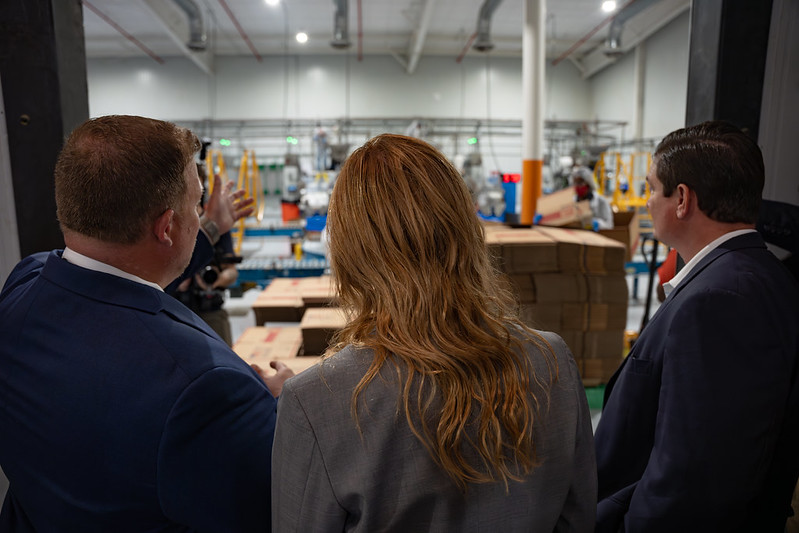 Mana's David Todd Harmon with former USAID Administrator Samantha Power and Rep. Austin Scott, R-Ga., at the Mana factory in Georgia (USAID photo)
It isn’t just those inside the agency that are struggling to get concrete answers around what operations will look like after July 1. David Todd Harmon, COO of Mana Nutrition, which provides USAID with nutrient-rich, energy-dense packets to treat acute malnutrition in children, told Agri-Pulse he had received no official word of what operations would be affected by the July 1 layoffs.
“We were kind of planning for USAID to be nonexistent,” Todd Harmon said, but after the agency resumed operations after a stop work order earlier this year, Todd Harmon said it had put out bids for $50 million in additional products.
After the foreign aid freeze earlier this year and the uncertainty around stop work orders, Mana Nutrition pivoted to supplying other organizations in the food assistance space. Todd Harmon said he is confident that the administration will deliver on its pledge to maintain U.S. food aid. With long-term assurances, he added, Mana can overcome further short-term turbulence after July 1.
“The U.S. government is talking like they're going to pursue food aid long term to include our products,” Todd Harmon said. “The short-term ramifications, as painful as they are, we can weather.”
For more news, go to Agri-Pulse.com.

