

How do we develop breakthrough technologies that actually work on the farm in a scalable fashion and enable the people who live and work in Rural America to be part of the solutions?
That’s the challenge for Reservoir Farms in California's Salinas Valley, an agricultural technology incubator, which recently opened up applications for its inaugural cohort of 12 startups. Headquartered on a 40-acre tract minutes from downtown Salinas, Reservoir sets itself apart from many other incubators by providing a lab environment combined with a working farm where robotics and other innovations can be tested on different specialty crops throughout the year.
If a lot of what the Reservoir is doing “feels a little bit different,” it’s because Danny Bernstein, CEO and managing partner, was intentional in his vision. A San Francisco native who previously worked at Meebo, Google and Microsoft, he told Agri-Pulse that there was a “saturation of technology and problem solving in urban environments.” He wanted to take key learnings from Silicon Valley and apply that knowledge to a different set of challenges in agriculture.
Berstein said he has witnessed numerous examples of startups that are building things like sensors for on-farm use without any engineers having on-farm experience. There were others who were building attachments for tractors without anyone on their team knowing how to drive a tractor. 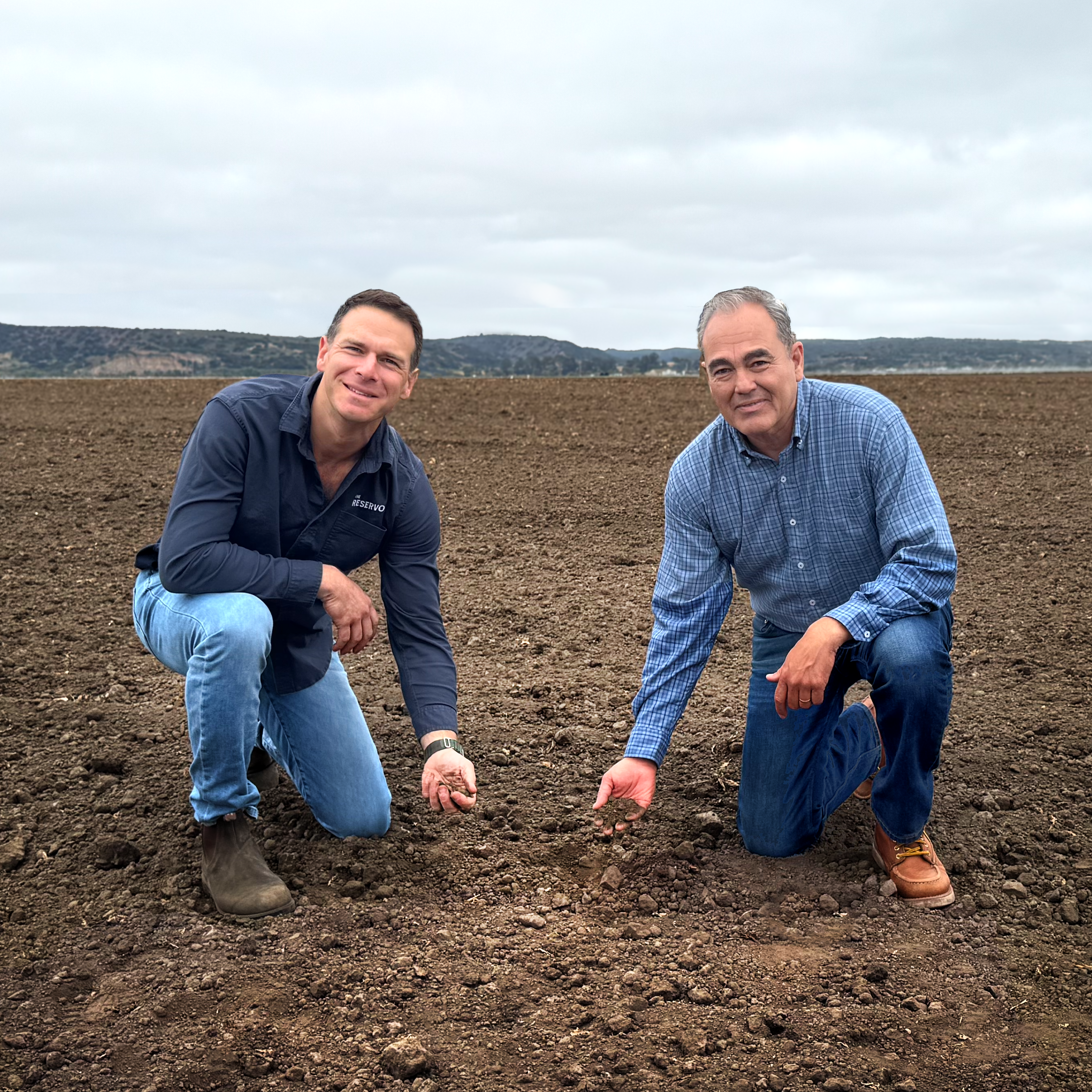 Danny Bernstein (left) and Hank Guerrero (right) at Reservoir Farms in Salinas Valley, marking Naturipe's partnership to provide expert support and sustainable strawberry farming for The Reservoir’s on-farm technology incubator. (Reservoir Farms photo)
“There’s this disconnect between the new ag-tech companies and the actual farms. And we ended up seeing a lot of these inefficiencies. That's something that inspired us,” he said. “There are over 7,000 startup incubators in the world, but none of them combine a working farm with a deep tech R&D space. We want to just take those two simple things and bring them together. And then, can we start to make this work?
“What we're basically saying is that we can let a roboticist be a roboticist. If they want to call us and say, ‘I want access to an acre of tomatoes and I want to be able to test in these conditions,’ come on over. You can start in five minutes,” Bernstein said. The lack of optimal testing environments has led to inefficiencies that slowed down several ag-tech companies and led them to run out of money before a workable product can be finalized, he believes.
Reservoir’s initial farmland is leased under a long-term agreement with the Tanimura family and Tanimura & Antle. The nonprofit has significant funding from Western Growers, the state of California’s Office of Business and Economic Development, and California Jobs First. In addition, Bernstein oversees Reservoir Ventures, which focuses on “empowering rural innovators by providing early-stage funding, incubation and growth.”
It’s easy to be “in the know” about what’s happening in Washington, D.C. Sign up for a FREE month of Agri-Pulse news! Simply click here
Best rural talent leaving?
From his Silicon Valley background, Bernstein observed that a lot of rural economies feed their best tech talent into an urban environment, and he wanted to change that dynamic.
“If you're a hotshot computer science student at Alisal High School in Salinas, the best outcome for you is to move to San Francisco. What that means, sort of extractively, in cycles over long periods of time, is a weakening of rural economies,” Bernstein said. “We’re trying to build very, very strong tech and ag-tech communities in rural regions of California. And the first place that we're starting on that is in Salinas.”
Reservoir Farms is working closely with other partners on workforce development, such as University of California Agriculture and Natural Resources, Hartnell College, Merced College and other partners in the F3 (Farms Food Future) Initiative.
Understanding field-level challenges
The Reservoir concept builds on Western Growers’ Agtech Initiative from more than a decade ago, which was based on the view that “technology startups could only succeed with guidance from growers rather than by making assumptions in the dark about field-level challenges,” said Dave Puglia, president and CEO of Western Growers, in a release. “Reservoir Farms represents a new kind of research and development model, putting growers in the driver’s seat and accelerating practical innovation that fits the real-world complexity of our farms.”
In addition to custom-planted specialty crop fields, startups will have access to fully equipped R&D workshops and flexible shop space without the burden of multiyear leases. The initial focus will be on:
- Robotic harvesters, including strawberry, broccoli, iceberg and romaine.
- Rugged mobility for uneven terrain.
- Machine vision for crop maturity/quality.
- Lightweight end effectors for delicate crops.
- Modular field robotics components.
- Edge AI for cloud-free autonomy.
- Precision soil and bed analytics.
Bernstein said he hopes Reservoir will end up being “a place for talent to be engaged and to really solve critical challenges for specialty crop agriculture, which are mostly labor related.” However, he noted that, in addition to young tech companies, well-established firms like Nutrien have expressed an interest in testing biological products. In the long term, he expects an “integrated environment for innovation and entrepreneurship.”
For now, Bernstein said Reservoir Farms has two farming partners: Tanimura & Antle is planting leafy greens and vegetables and Naturipe Farms is growing strawberries. In addition, some individual growers are involved with a celery harvesting project. A preview event is scheduled for Aug. 27 and then startups will be selected to start in September. In the future, Bernstein said he hopes Reservoir Farms will have three sites in California: one in wine country and then another in the Central Valley.
For more news, go to www.Agri-Pulse.com

