
|
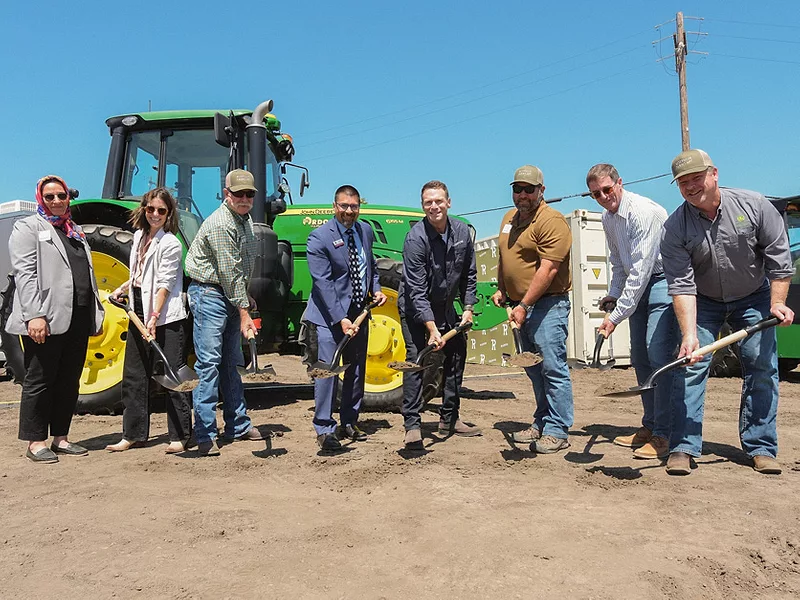
A new agricultural innovation hub has launched in the heart of the Salinas Valley, bringing together growers, startups, equipment manufacturers and public agencies to accelerate the development of technology for specialty crop farming.
The 40-acre site, known as Reservoir Farms, is designed as a working farm and ag-tech incubator where companies can test robotics, automation and data tools directly in commercial crop fields. Organizers say the model aims to bridge a longstanding gap between laboratory innovation and the realities of farming.
“We are learning. This is all a grand experiment,” said Reservoir founder and CEO Danny Bernstein during the opening event Monday. He described the project as an effort to “accelerate innovation in spaces that really need it,” particularly specialty crop agriculture, which he said has historically lagged behind other sectors in technological investment.
Bernstein, a former Google executive, said the concept grew from conversations with industry partners like Western Growers and local farm organizations. The goal was to build a startup incubator adjacent to a commercial farm where companies could prototype, test and refine equipment in real production systems.
“Those two things coming together — a prototyping studio adjacent to a working farm — doesn’t exist anywhere in the world specifically for the purpose of startups,” he said.
Growers look to automation as costs climb
Local growers say the technology being tested at Reservoir Farms could play a critical role in addressing rising production costs and labor shortages.
Gary Tanimura, owner of Tanimura & Antle, said technology is becoming increasingly necessary for California agriculture to remain competitive.
“The only way to survive is to explore the world for new high-tech things,” Tanimura said. “As our costs keep rising, hopefully we find new technology to keep those costs at a reasonable pace.”
Much of the focus is on automation that could reduce labor requirements in harvesting and field work. According to industry estimates, roughly two-thirds of farm labor hours in California specialty crops are devoted to harvesting, making it a top priority for technological innovation.
Strawberry grower Naturipe Berry Growers has already committed acreage for trials at the site.
“We’re a very highly specialized crop, we have a lot of needs,” said Hillary Thomas of Naturipe. “We have a long history of supporting tech efforts to help us with the challenges we have, which are mainly soil-borne diseases, increasing labor and growing costs, and the regulatory framework in California.”
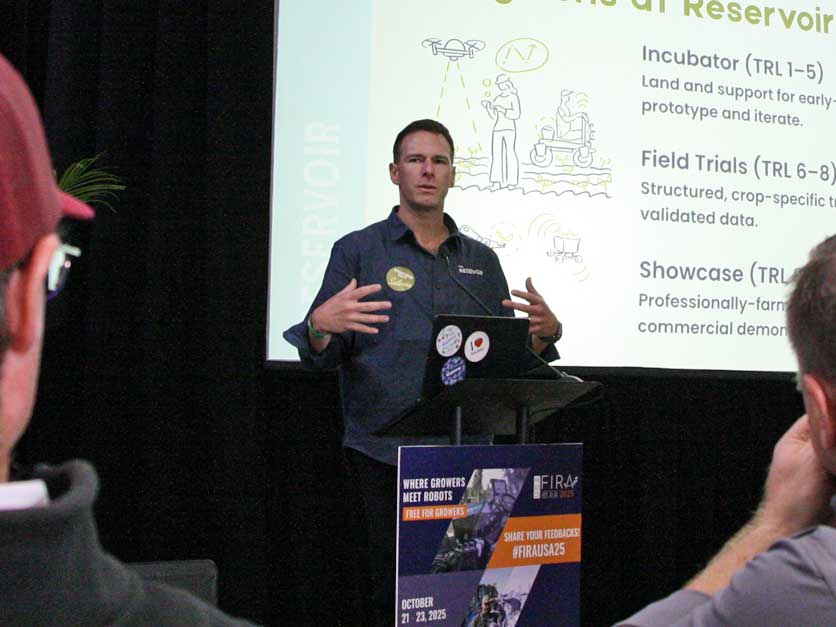 Danny Bernstein, Reservoir (Brad Hooker/Agri-Pulse photo)
Western Growers sees path to commercialization
Western Growers has been closely involved in developing the project.
“This is the culmination of years and years of vision, thinking and trying to execute on something that's admittedly very, very ambitious: bringing capital into the startup environment and the special crop industry,” President and CEO Dave Puglia told Agri-Pulse.
The industry has long struggled to move new technologies from concept to commercial adoption, particularly for labor-intensive crops like lettuce and strawberries.
Puglia said the new model — combining venture capital, startups and working farmland — could accelerate development of harvesting technology.
“We’ve automated about 2%,” he said. “It is my expectation that in five years, we will see a number — not just one, but a number — of commercially scaled harvest automation companies in the market that are operating with our members profitably.”
The push toward automation has also been driven by rising regulatory and labor costs in California, he added.
“We’re losing our competitive advantage in California,” Puglia said. “We’re trying now to recapture the competitive balance by introducing technology that reduces the unit cost implications of all those policy burdens over the last 25 years.”
Farm bureau highlights challenges and opportunity
Norm Groot, executive director of the Monterey County Farm Bureau, said the new facility could also help address urgent issues facing growers, including pest pressures and labor shortages.
“Having an early warning system to detect problems in a field is really interesting,” Groot said, noting that growers are currently battling several pest and disease threats and a system designed to scan fields and detect outbreaks early could be a game changer.
Still, he cautioned that many agricultural technologies face challenges in affordability.
“The thing I’m hearing [from farmers] is that ag-tech is great, but it costs money,” said Groot. “Some of these weeders are over a million dollars — it’s a very expensive investment.”
Even so, he said projects like Reservoir Farms offer a chance to highlight agriculture’s resilience.
“This is a story we can tell as one of the positive things happening in ag,” said Groot, noting the focus lately on the economic downturn, low crop prices and political issues impacting labor. “We can show the ag community is still resilient and we'll still continue to move forward, hopefully producing those great fresh food crops that really we need on our dinner tables.”
Startups bring new tools to the field
The facility currently hosts about a dozen startup companies developing technologies ranging from autonomous weeding robots to irrigation monitoring systems.
Netherlands-based cropr is testing an autonomous laser weeding system designed to reduce herbicide use. CEO Bert Jan Kampherbeek told Agri-Pulse the Salinas Valley is a natural place to launch the technology in the U.S. market.
“We’d like to get close to the growers who are going to use the machines to learn from them what they need and what we maybe have to change and what they really want,” he said.
Labor shortages and environmental pressures are pushing growers worldwide to consider alternatives to traditional herbicides, he added.
Another startup, Lumo, demonstrated a solar-powered irrigation monitoring system that tracks water flow across different field blocks.
“It’s making sure water is delivered to the correct block at the correct amount,” said Chris Harless, the company’s Central Coast regional manager.
 Sean Sundberg, John Deere (Brad Hooker/Agri-Pulse photo)
Equipment makers and investors join effort
Major industry partners are also involved. John Deere sees the facility as a way to speed up the development of new technologies for high-value crops.
“We feel we’re at a crossroads,” said Sean Sundberg of John Deere. “If we don’t invest and we don’t enable these solutions to hit the market faster, we're all going to be in a pickle when we don't have enough salad to eat, we don't have the tree nuts to munch on — or even wine drinks to drink.”
While advanced technology has already transformed row crop agriculture in the Midwest, he said specialty crop farming still has significant room for innovation.
“We can take that technology and bring it here and have true impact,” Sundberg said.
Venture capital investment in agricultural technology has declined sharply in recent years. The new facility aims to reduce development costs by providing shared farmland, equipment and infrastructure.
Startups typically require $50 million to $100 million in investment before reaching commercial scale, explained Walt Duflock, vice president of innovation at Western Growers.
Building a regional innovation ecosystem
Local government and education leaders say Reservoir Farms could also strengthen the region’s ag-tech workforce pipeline.
Michael Gutierrez, president of Hartnell College, highlighted new programs in agricultural mechatronics designed to prepare students for careers in farm automation. “Part of our mission is to advance economic and social mobility to our students and to our region,” he said, pointing to partnerships that connect students with emerging ag-tech companies.
Monterey County officials also emphasized the economic development potential of the project.
“Agriculture is the backbone of Monterey County,” said county board Chair Wendy Root Askew. “Innovation is where the future lies.”
Preserving agricultural legacy
The site itself carries deep agricultural history. The ranch hosting the project has been farmed for more than a century by the Tamagni family, whose barn now houses the ag-tech incubator.
“My grandfather paid $40,000 for 160 acres in 1919 for all this,” said farmer Jim Tamagni, noting his grandfather immigrated to the U.S. just 11 years earlier. “We figured he had buried gold — we don't know how he did it.”
Tamagni said the transformation from a dairy to a farm and now a high-tech research hub reflects the constant evolution of agriculture.
For organizers, the blend of tradition and innovation represents the broader vision behind the project. By connecting growers, startups, universities and investors, they hope Reservoir Farms will accelerate the next generation of farming technology — and help ensure the long-term viability of California agriculture.
“This is a California story and a passion project in many ways, but one that we think is critical for the future of tech — for technology as resilience, not technology as abundance,” said Bernstein.

