
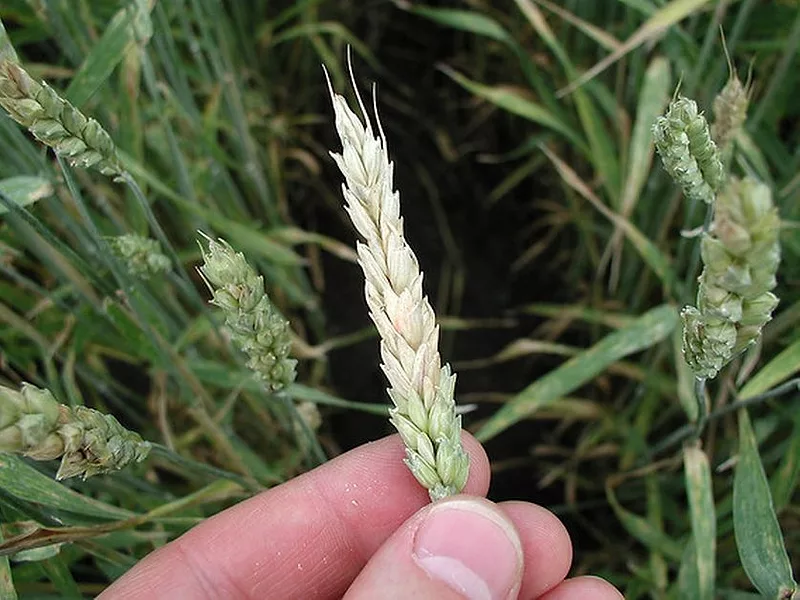
Scientists and farmers are warning that without continued research funding the U.S. will become more vulnerable to the devastating impacts of fusarium head blight, or scab, in wheat and barley.
The U.S. Wheat & Barley Scab Initiative (USWBSI) has been in operation since 1997 and involves dozens of universities and more than 100 research projects. But since the end of April, no funding has been released to land-grant universities where researchers test samples and develop resistant varieties.
About half the $15 million in annual funding goes to land-grants, which are now struggling to plug the gaps left by the lack of federal support.
The money was authorized and appropriated in the continuing resolution for fiscal 2025, said Ruth Dill-Macky, head of the plant pathology department at the University of Minnesota and co-chair of the USWBSI. “I just don't understand why it's being held up.”
The Agriculture Department did not respond to requests for comment on the delay.
Dill-Macky said the lack of funding has resulted in Virginia Tech not being able to test samples from this year’s growing season. “Those samples are really critical to the breeders in making decisions about what varieties are the most and least affected by the disease,” she said.
That means samples will have to be parceled out to the other two labs that conduct testing for deoxynivalenol, or DON, also known as vomitoxin. The others are at North Dakota State University, where funding has run out for supplies, and the University of Minnesota.
Dill-Macky said impacts of the funding shortfall will be “very, very disruptive to everybody, because we'll need to work with what resources we have left … . What we don't know at this point is how long those other labs will be able to function either,” since most of the money goes to pay for people.
 Ruth Dill-Macky (Facebook photo)The initiative supports about 125 projects, which are led by about 90 scientists across 30 states, “and most of our budget goes to personnel,” Dill-Macky said.
 Since most researchers obtain funding from multiple sources, “we have a little bit of buffering capacity,” she said. “But right now, with the loss of federal funding so wide across the board … it means that all of these labs will start losing one or two people, but we could end up losing 100 people across the country.”
Dill-Macky predicted that within a month, people at every land-grant institution involved in the USWBSI “will lose their jobs because of this. At the University of Minnesota, we've got probably half a dozen people that we’ll be laying off if we don't see the funding shortly.”
"Without immediate resolution, we risk losing an entire year of critical data and research progress," Patrick Doyle, president of the Michigan State Millers Association, said in a letter to Rep. John Moolenaar, R-Mich., on June 13. "Even more concerning, universities are now facing the potential loss of experienced scientists and staff — resources that are not easily replaced and essential to the continuity of this work."
Interested in more news on farm programs, trade and rural issues? Sign up for a four-week free trial to Agri-Pulse. You’ll receive our content - absolutely free - during the trial period.
Ashley McFarland, vice president-technical director at the American Malting Barley Association, says, “We're coming up on a timeline here where the fiscal year is going to come to an end, and these researchers really aren't going to have been given a fair opportunity to spend the money that Congress had appropriated for them.”
Also at risk is the Barley Pest Initiative, funded at $3.5 million, whose cooperative agreements with universities expired last month, she said.
McFarland says when groups representing the wheat and barley industries have inquired about the USWBSI funding, “We keep getting told that it's above USDA. So I don't know if it's a Treasury or an [Office of Management and Budget] thing, but the money has not moved to USDA.”
“I know that some researchers have already scaled back some of their work,” she said, adding, “there's a lot of good scientific work happening that's getting put to the side because of this issue. It’s really putting a halt to very critical research.”
Multiyear research projects are “very hard to stop and then restart,” she said.
One reason for that is without funding, researchers will leave.
“Once you lose people, you can’t get them back easily,” says Richard Magnusson, who farms wheat and other crops in northern Minnesota and also is co-chair of the USWBSI. Even if people leave and are then rehired, “it sets things back, because you're kind of restarting over again if you have a gap where you don't have people.”
Magnusson said the project "has done great work in helping universities and USDA develop better varieties, and then investigating how to best manage [scab] with fungicides, cultural practices, all those things that all came out of this research.”
Magnusson said he had to burn his entire 3,000-acre wheat crop in 1993 because of high vomitoxin levels.
Since 1990, scab has resulted in losses of more than $3 billion at the farmgate, according to an estimate from the initiative.
"The disease is difficult to control and tends to flare up under wet and warm weather conditions, making it a persistent threat to food security and farm profitability," according to the initiative's webpage.
 Ashley McFarland (LinkedIn photo)
“The success of the USWBSI is arguably unprecedented in U.S. agriculture,” a summary of the initiative says. It has "enabled the research community to fully engage to work toward mitigating scab as a destructive force in the U.S. food production system. There is now a solution-oriented research program” that focuses on resistant varieties, forecasting, management, food safety and economic return.
McFarland said barley, which is primarily used for beer, “has a pretty high quality specification to make sure that it's eligible for the malt market.” Fusarium head blight is a major issue for barley “because at certain thresholds, obviously it's not safe for human consumption, but [FHB] is also what causes gushing in beer. And so if there are potentially too high levels of fusarium, when you pop open the top of a bottle of beer and it all gushes out, that's potentially a fusarium infection.”
Without the USWBSI, “we’re just not going to have the high-quality barley we need to make beer,” she says.
Another reason to fund the research is to address the United States' current agricultural trade deficit.
"We're just not going to be able to turn that trade deficit around if we can't stay competitive in our research, especially as we see China and India's rapid increase in investment in R&D," McFarland says.
For more news, go to Agri-Pulse.com.

