
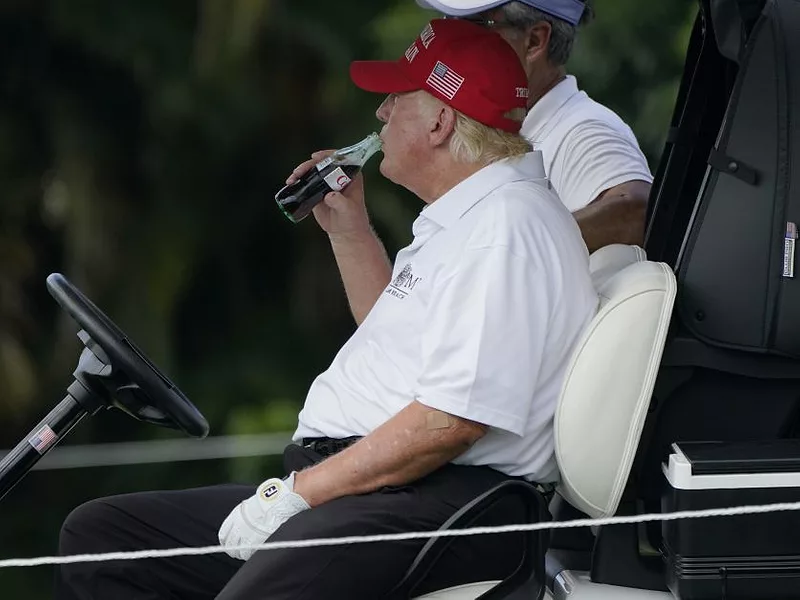
President Donald Trump has announced on social media that Coca-Cola is switching to cane sugar. That would, of course, be a lost market for the corn sweetener industry.
In the post, Trump said: “I have been speaking to Coca-Cola about using REAL Cane Sugar in Coke in the United States, and they have agreed to do so. …. This will be a very good move by them — You’ll see. It’s just better!”
But, but, but: Coca-Cola released a statement that was non-committal about the company’s plan.
Trump’s post came as the National Corn Growers Association was in D.C. for its annual summer meeting.
Corn growers eye must-pass bill for year-round E15
Leaders of the National Corn Growers Association are making it a top priority to get authorization for year-round E15 included in a must-pass bill before the end of the year. A fiscal 2026 appropriations bill is one target for the group. The annual defense authorization bill is another.
“EPA has issued summer waivers for E10 and E15, but you all know we need the certainty of year-round nationwide E15,” NCGA’s vice president of public policy, Lesly McNitt, told the group’s members before they headed to Capitol Hill to talk to lawmakers and their aides.
“The Congress has very slim majorities, but Republicans do have a trifecta, so we have an opportunity here,” she said, referring to the fact that the GOP controls both Congress and the White House.
By the way: Rep. Adrian Smith, R-Neb., told the corn growers the sector is benefiting from support across the motor fuel industry. “This is a great opportunity,” he said.
Brazil trade probe to cover ethanol
The Trump administration will examine market access for U.S. ethanol in Brazil as part of an investigation into whether the Brazilian government’s trade policies unfairly discriminate against U.S. exports.
Brazil maintains an 18% tariff on imported ethanol, which has been a point of contention for U.S. producers and officials given the U.S. allows Brazilian ethanol to enter duty-free. Last week Trump announced the U.S. would investigate any unfair trade practices or discriminatory policies employed by Brazil.
Don’t miss a beat! It’s easy to sign up for a FREE month of Agri-Pulse news! For the latest on what’s happening in Washington, D.C. and around the country in agriculture, just click here.
U.S. Trade Representative Jamieson Greer said in a statement that he has launched a Section 301 probe at the president’s request. “After consulting with other government agencies, cleared advisers, and Congress, I have determined that Brazil’s tariff and non-tariff barriers merit a thorough investigation, and potentially, responsive action."
U.S. ethanol producers welcomed the announcement. Growth Energy CEO Emily Skor said the move is a “sign that the old days of Brazil enjoying unfettered access to the U.S. ethanol market while unfairly putting a tariff on American ethanol imports could soon come to an end.”
Take note: A similar 301 probe into Chinese trade practices was used to levy tariffs of up to 25% on some Chinese products during Trump’s first term. The president has already threatened Brazil with a 50% tariff over its treatment of former president and Trump ally Jair Bolsonaro.
Trump trade adviser: Indonesia pact a ‘microcosm’ of administration’s trade goals
A top trade adviser to the president says that an announced agreement with Indonesia, which leaves sizeable U.S. tariffs in place, is a clear example of what the administration wants to get from trade talks.
“Indonesia is a microcosm of what we're trying to do,” Peter Navarro said during an event Wednesday hosted by The Hill and Newsmax.
The deal, which Trump announced on Truth Social Tuesday and Indonesia’s president confirmed Wednesday, eliminates tariffs on U.S. exports to Indonesia. Meanwhile, Indonesia’s goods sent to the U.S. will face a 19% duty under the deal. The Indonesian government also pledged to buy $4.5 billion of U.S. ag products, among other purchase commitments.
The pact is the third such agreement the president has heralded; agreements with the United Kingdom and Vietnam also left double-digit tariff rates in place.
“The bigger our trade deficit with the country, the more they’ve got to eat the tariffs,” Navarro said. “Let's be clear, the trade deals are tariffs.”
IFPA launches public health campaign
The International Fresh Produce Association has kicked off a campaign promoting fresh fruits and vegetables as a key pillar for improving public health.
The campaign, titled Fresh Produce for a Healthier America, is directed at D.C. digital outlets.
“This is a call to action to invest in the farmers, programs, and policies that make fresh produce accessible and affordable for every American—because you can’t make America healthy again without fruits and vegetables,” IFPA CEO Cathy Burns said in a statement.
Farmers told to keep speaking up on ag labor
Farmers need to keep pushing the Trump administration and lawmakers for a solution on ag labor, a California congressman and a cabinet secretary told members of the National Council of Farmer Cooperatives before they embarked on Hill visits Wednesday.
To make inroads with the administration, Rep. David Valadao, R-Calif., told attendees at NCFC’s Washington meeting they should assume that top Trump adviser Stephen Miller “might not ever be a friend. So, you've got to line up enough allies in the White House leaning on President [Trump] to work around him.”
Labor Secretary Lori Chavez-DeRemer told the group “it's important to your industry to keep talking and let us know what your story is.” She said the administration would “continue to support legal pathways to work and scale back the government overreach that our farmers and employers were forced to endure during the previous administration.”
However, she did not offer any specifics on how the administration is working to solve the long-simmering problem of a shrinking ag workforce and the current furor over immigration raids.
“The president has directed us to be working on this issue,” she said. “This is important to the administration. It's important to me. It's important to [Agriculture] Secretary [Brooke] Rollins as well. So, we are discussing it.”
Georgia farmers still waiting on some disaster relief, senator says
Georgia farmers are waiting on USDA and the state of Georgia to finish a block grant agreement more than nine months after Hurricane Helene passed through, Democratic Sen. Jon Ossoff says.
In a letter, Ossoff requested an update from Rollins and Georgia Agriculture Commissioner Tyler Harper on the funding, the absence of which he says “has left many Georgia farmers and producers in limbo.”
"Although some funds have been made available at the national level through USDA, many of Georgia's farmers and producers who were most affected by Hurricane Helene are not eligible for this assistance and tell me they are instead counting on a block grant,” Ossoff wrote.
Final word
“My private conversation with her seemed very positive. The stuff I had heard from people in the administration, of things she had been saying to the president and others, seemed very positive. Her comments last week kind of made me believe that she wasn't 100% with us. So, I'm kind of torn.” — Rep. David Valadao, R-Calif., on Agriculture Secretary Brooke Rollins, who suggested last week that Medicaid recipients and automation can replace undocumented workers.
“I don't know why she went that direction with the Medicaid population,” he added, surmising it may have been something “she had to say.”
Rebekah Alvey, Oliver Ward and Noah Wicks contributed to today’s Daybreak.
For more news, go to Agri-Pulse.com.


