
Commerce Secretary Howard Lutnick says that most countries will pay the higher duties President Donald Trump has outlined in recent letters to global leaders, even as trade discussions continue.
On CBS’ Face the Nation on Sunday, Margaret Brennan asked how tariff revenues can narrow the U.S. spending deficit if the administration lowers the tariff rates as part of deals for greater market access.
“Nothing is getting negotiated away,” Lutnick said. The 10% baseline tariff will “definitely” remain, he said.
“Many countries will pay higher, like Vietnam and Indonesia,” Lutnick added. “Most countries will pay higher… The bigger countries are likely to pay higher. That’s just the way it’s going to be.”
Trump has said in recent weeks that the U.S. has secured pacts with Vietnam and Indonesia that leave 20% and 19% tariffs in place, respectively. The Financial Times also reported last week that the final tariff rate remains a major sticking point in U.S. talks with the European Union. The president is reportedly pushing for Europe to swallow a 15% to 20% tariff.
Take note: Lutnick also stressed Sunday that Aug. 1 is a “hard deadline” for the higher reciprocal tariffs to take effect. But tariff uncertainty may linger, as Lutnick added that “nothing stops countries” from continuing to negotiate beyond that date.
Trump pressures Senate GOP on nominees
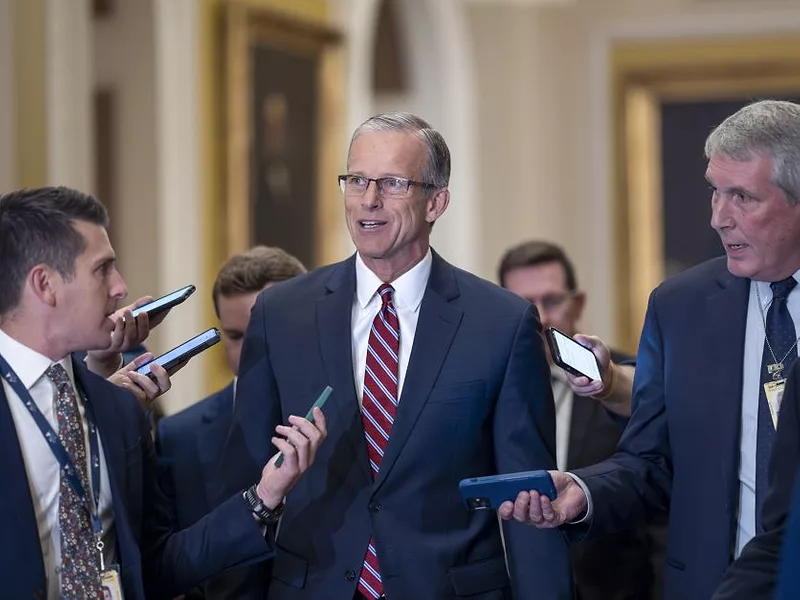
Senate Republicans are set to advance three USDA nominations through committee today, even as President Donald Trump is pressuring Majority Leader John Thune to cancel the August recess to confirm pending nominees.
The Senate Ag Committee is scheduled today to vote on the nominations of Dudley Hoskins to be undersecretary for marketing and regulatory programs; Scott Hutchins to be undersecretary for research, education and economics; and Michael Boren to be undersecretary for natural resources and environment.
A fourth USDA nominee, Richard Fordyce, will have his confirmation hearing on Wednesday. Fordyce is Trump’s pick as undersecretary for farm production and conservation.
Over the weekend Trump pressured the Senate to stay in session through August to act on his pending nominees. “Hopefully the very talented John Thune, fresh off our many victories over the past two weeks and, indeed, 6 months, will cancel August recess (and long weekends!), in order to get my incredible nominees confirmed,” Trump said in a social media post.
The Senate is highly unlikely to cancel the August recess, but Thune may pressure Democrats to agree on a deal to move some nominees ahead of the break.
For more on this week’s D.C. agenda, read our Washington Week Ahead.
Pepsi ditching dyes and seed oils in some offerings
PepsiCo will expand use of alternatives to common seed oils, and rebrand products to highlight the exclusion of artificial dyes and flavors.
Don’t miss a beat! It’s easy to sign up for a FREE month of Agri-Pulse news! For the latest on what’s happening in Washington, D.C. and around the country in agriculture, just click here.
As early as this year, Lay’s and Tostito brand products will be rebranded to highlight the company’s shift from artificial dyes and flavors. It also will expand its offerings of products using avocado and olive oil instead of canola and soybean oils.
The company is one of a wave of brands responding to the administration’s push to Make America Healthy Again. Through this movement, Health and Human Services Secretary Robert F. Kennedy Jr. and other MAHA advocates have rallied against seed oils and artificial colors.
Following the news, Kennedy urged other companies to follow PepsiCo’s lead and take similar action.
Take note: Reuters reported that during an investor call, the company also said it would consider shifting to cane sugar rather than high-fructose corn syrup, if consumers want it.
That follows a social media post by President Donald Trump saying Coca-Cola had agreed to make this switch. The company has not made a public commitment yet, but fast-food chain Steak ’n Shake said it would offer Coca-Cola made with cane sugar as early as next month.
USDA insists no shortfall at ARS
The Agricultural Research Service will not incur a “shortfall” in funding, a spokesperson told Agri-Pulse in response to an item that ran in Friday’s Daybreak. Union representatives told Agri-Pulse they had been informed verbally by management Thursday to expect a 10% shortfall at the end of the year.
“All critical functions at ARS and across the department continue to operate as normal,” the spokesperson said.
“While there are no funding issues or shortfalls anticipated, USDA leadership continues its comprehensive review across the department to ensure all dollars are being spent on items which are congressionally mandated, mission aligned, and are used in a way in which maximize taxpayer dollars. USDA will prioritize funding innovative projects which put U.S. farmers and ranchers first and will continue to bring them into the 21st century.”
Sources inside and outside the agency said Friday that questions remain about whether ARS will be able to spend the money it is allocated at the end of the year.
Bangladesh inks deal for more US wheat amid tariff tensions
The government of Bangladesh has committed to significantly growing its wheat imports from the U.S. over the next five years. Reuters reported Sunday that the deal between Bangladesh’s Ministry of Food and US Wheat Associates would see U.S. growers send 700,000 tons annually for the next five years.
The move will help the Bangladeshi government plug a growing supply gap between domestic wheat production and demand. But officials will also hope it narrows the country’s trade deficit with the U.S., an ongoing irritant for the U.S. president.
President Donald Trump threatened Bangladesh with a 35% tariff on most exports from Aug. 1 in a July 7 letter.
At a signing ceremony Bangladeshi official Ali Imam Majumder said the “step reflects our willingness to build mutual trust and deepen economic cooperation with the United States.”
Final word
“I haven't heard this much support for healthy soil in my career, so I think it's great that we have something that we can agree on. We need to have healthy soil, to have healthy food systems. Where I think we get tripped up sometimes is when there's prescriptions for how that healthy soil needs to be developed and maintained, and that's where we've got to take a step back and just think about the principles of a healthy soil, the principles of regen ag, the principles of sustainability – and talk with farmers, get their perspective on what their system looks like, because for every action there's a reaction, there's unintended consequences, and we need to make sure that we've got that whole toolbox available to make and keep the soils healthy.” – Carrie Vollmer-Sanders, president of Field to Market, discussing sustainability and regen agriculture on Agri-Pulse’s Open Mic with Jeff Nalley.
Rebekah Alvey, Philip Brasher, and Oliver Ward contributed to today’s Daybreak.


