
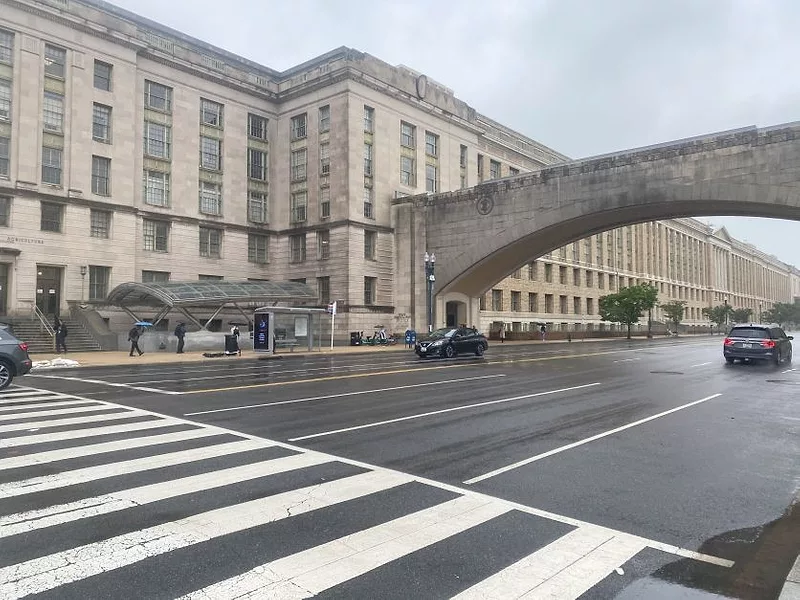
USDA has finally released its reorganization plan after months of speculation and court battles. It calls for moving more than half the employees in the national capital region to hubs in five states: Colorado, Indiana, Missouri, North Carolina and Utah.
The plan, which is going to get some scrutiny in Congress, foresees closing the department’s South Building as well as the Beltsville Agricultural Research Center in Maryland, the flagship facility of the Agricultural Research Service.
USDA’s workforce in the Washington region would be slashed from 4,600 to 2,000.
Keep in mind: When the first Trump administration relocated two USDA research agencies to Kansas City, most employees declined to move.
The House has adjourned until September, but senators were in town Thursday, and they were split on the contours of the plan. Kansas GOP Sen. Roger Marshall, for example, welcomed the prospect of more USDA employees in Kansas City. But Maryland Democrats were unhappy. Both Senate Ag Chair John Boozman, R-Ark., and ranking member Amy Klobuchar, D-Minn., said there would be a hearing on the plan.
USDA: Salary costs were unsustainble. Vilsack responds
In its announcement, USDA said the Biden administration had increased the department’s workforce by 8% and raised employees’ salaries 14.5% over four years — “including hiring thousands of employees with no sustainable way to pay them.”
That assertion doesn’t sit well with Tom Vilsack, who served as ag secretary during the Obama and Biden administrations. He tells Agri-Pulse the Biden administration “used American Rescue Plan resources, Bipartisan Infrastructure Bill and Inflation Reduction Act funding and annual appropriations to pay for staff.”
Resources were available “to pay for the additional staff for a period of time corresponding to the additional work required under those bills,” he said. “It is misleading to suggest that resources for staff were not fully funded or to suggest in any way positions were not paid for now and into the future.”
Vilsack went on to say employees “understood the term nature of their employment and that attrition and retirements over time would have opened up more permanent positions. It is equally misleading to link the reduction in force and reduced footprint in any way to efforts during the Biden administration. The plan, plain and simple, is one way to reduce workforce and cut costs to fit within the budget reductions required from the department.”
It’s easy to be “in the know” about what’s happening in Washington, D.C. Sign up for a FREE month of Agri-Pulse news! Simply click here
The challenge, Vilsack said, “will be how the plan reductions and relocations are actually implemented, how quickly they are implemented, and to what extent and for how long services to farmers and communities will be disrupted.”
Former Undersecretary for Farm Production and Conservation Robert Bonnie defended the salary increases, noting that some employees in field offices were being forced to take second jobs.
“We intentionally raised pay, particularly for our field staff,” he said. “Farm groups were supportive of that because they knew those staff out in those offices weren't being paid what they’re worth.”
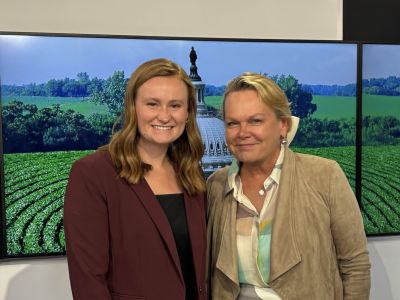
Watch Rep. April McClain Delaney, D-Md., on Agri-Pulse Newsmakers, released today, discussing the USDA reorganization plan and rural broadband. (She is at right with Newsmakers host Lydia Johnson.) Plus, Eric Steiner with OFW Law explains what to expect in the skinny farm bill, and Shirley Bloomfield from NTCA-The Rural Broadband Association discusses what's needed to continue expanding broadband connectivity.
EU member states green-light tariff retaliation plan
European Union member states have approved a retaliation plan that would hit more than $100 billion worth of U.S. exports, including a slate of U.S. agriculture products, if trade talks fall apart.
Member states signed off on a final list of products that includes those from an April list, covering around $25 billion of U.S. exports, and a second list assembled earlier this month. The plan would see U.S. exports hit with tariffs up to 30% — the same rate Trump has threatened the EU with.
The first tranche of tariffs would kick in Aug. 7 — six days after Trump’s deadline for his tariffs — according to implementing regulations published Thursday.
Take note: The EU and U.S. are reportedly closing in on a deal that would leave 15% tariffs in place. But that may not be enough to avoid some retaliation, Alice O’Donovan, secretary general at the European Liaison Committee for the Agricultural and Agri-food Trade, told Agri-Pulse.
“Purely from a face-saving perspective, they really will have to retaliate,” she said. “They've indicated in every official channel that they're ready to hit back. If they won’t, I'm not sure what sort of message that would convey.”
Australia relaxes US beef import restrictions
The Australian government is lifting restrictions on U.S. beef imports in what Agriculture Secretary Brooke Rollins is calling a “major trade breakthrough.”
Canberra had barred imports over biosafety concerns in Mexico and Canada. The United States' supply chain links with its North American neighbors had kept U.S. products out of the Australian market.
“For 20 years, U.S. beef was denied access to Australia,” National Cattlemen’s Beef Association President Buck Wehrbein said in a statement. “The lack of two-way, science-based trade has been a sticking point for many years.”
“While Australia is a valuable trading partner, their longstanding restrictions on U.S. beef were neither right nor reciprocal,” Ways and Means Trade Subcommittee Chair Adrian Smith, R-Neb., said. “The removal of these unscientific and unfair barriers, while long overdue, sends a strong message regarding the safety and quality of American agriculture products.”
North American produce groups call on leaders to settle tariff spat
A coalition of North American industry groups is calling on U.S., Canadian and Mexican leaders to negotiate a settlement to cross-border trade tensions that avoids tariffs on produce.
“Our countries rely on complementary cross-border trade to meet year-round consumer demand and ensure food security,” the groups say in a letter to President Donald Trump, Mexico’s Claudia Sheinbaum and Canada’s Mark Carney.
“We strongly urge your governments to work together to reach a long-term agreement that will restore a stable trading environment for our essential products,” the groups add. The coalition was led by the International Fresh Produce Association and the Canadian Produce Marketing Association.
Take note: Trump imposed 25% duties on Canadian and Mexican exports not covered by a North American trade pact in March. Earlier this month he threatened to hike Mexico’s rate to 30% and Canada’s to 35% unless they step up efforts to stem flows of undocumented migrants and drugs.
Senate confirms Szabo to air and radiation post, overseeing RFS
The Senate has confirmed Aaron Szabo to lead the EPA’s Office of Air and Radiation. One of his responsibilities will include administering the Clean Air Act. That includes the Renewable Fuel Standard, which is crucial to the biofuel and ethanol industries. The agency is working now to finalize renewable volume obligations for 2026-2027 under the RFS.
Various biofuel groups welcomed Szabo’s confirmation and expressed confidence that he would support renewable fuel growth.
The American Coalition for Ethanol met with Szabo during their D.C. fly-in earlier this year, and said in a statement that conversation was a “positive sign” the agency is engaged on biofuel issues. “Szabo brings more than a decade of public service and regulatory experience to this important role,” Growth Energy said in a release.
Final word
“The plan, plain and simple, is one way to reduce workforce and cut costs to fit within the budget reductions required from the department.” — Former Ag Secretary Tom Vilsack on the USDA reorganization plan.
Rebekah Alvey, Oliver Ward and Noah Wicks contributed to today’s Daybreak
For more news, go to Agri-Pulse.com.


